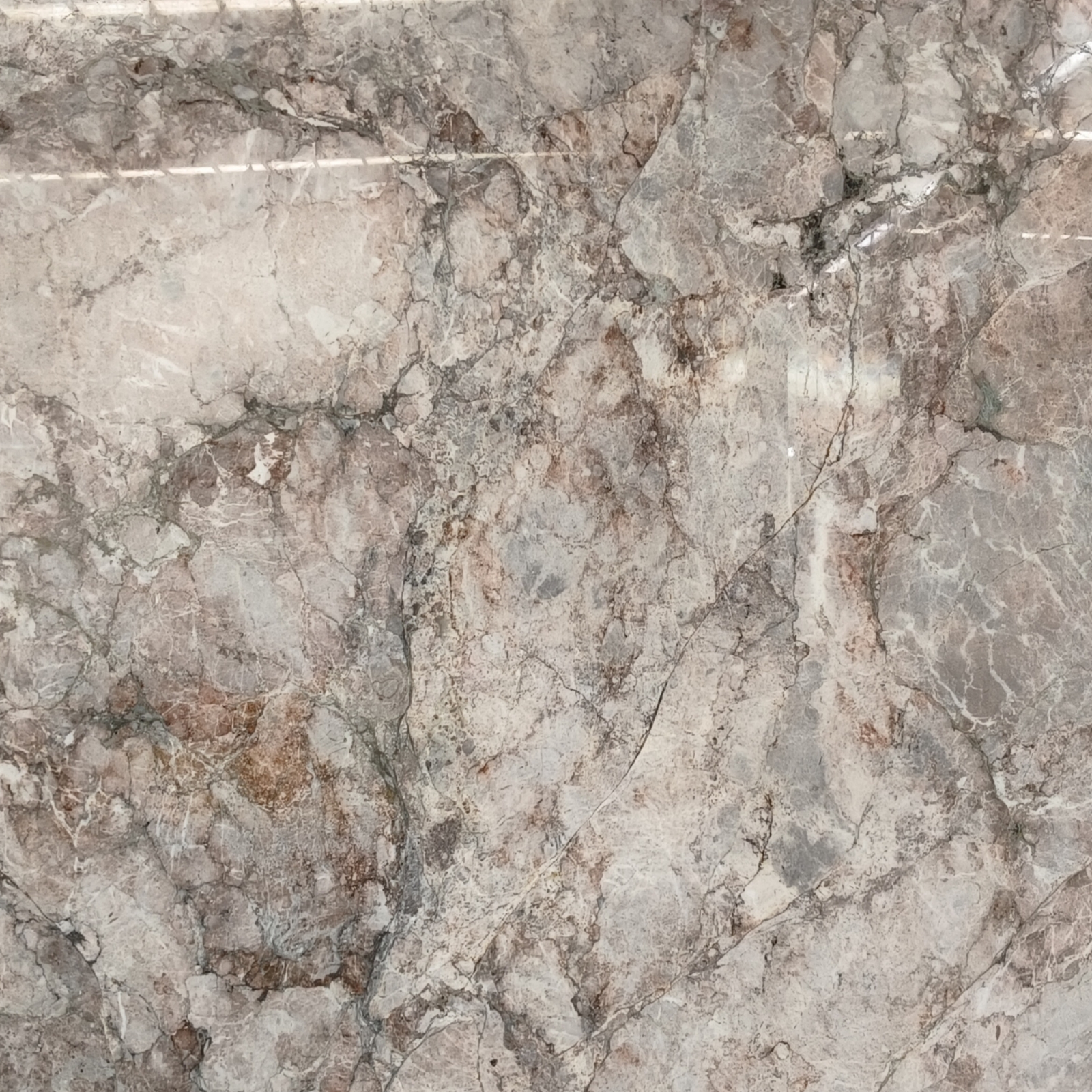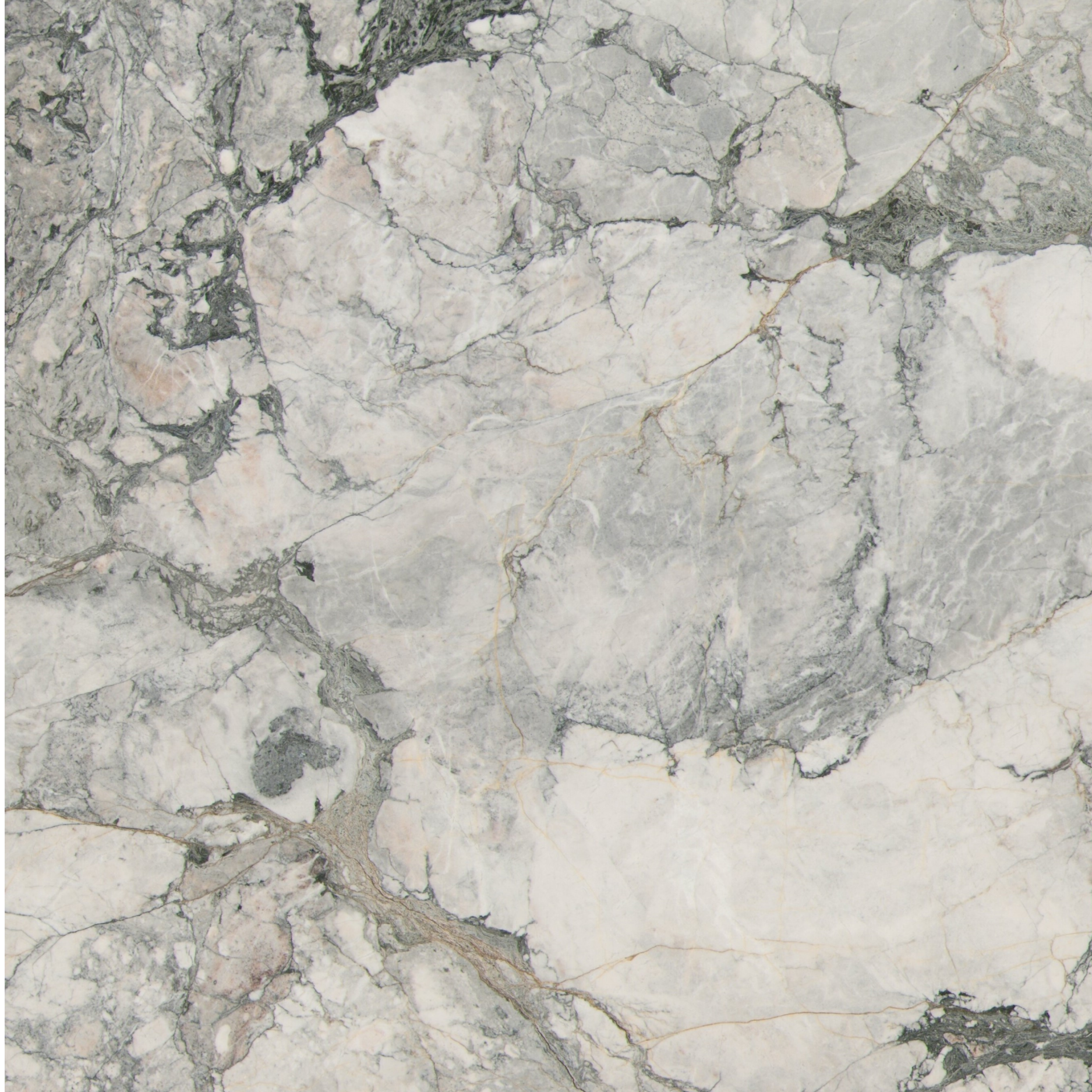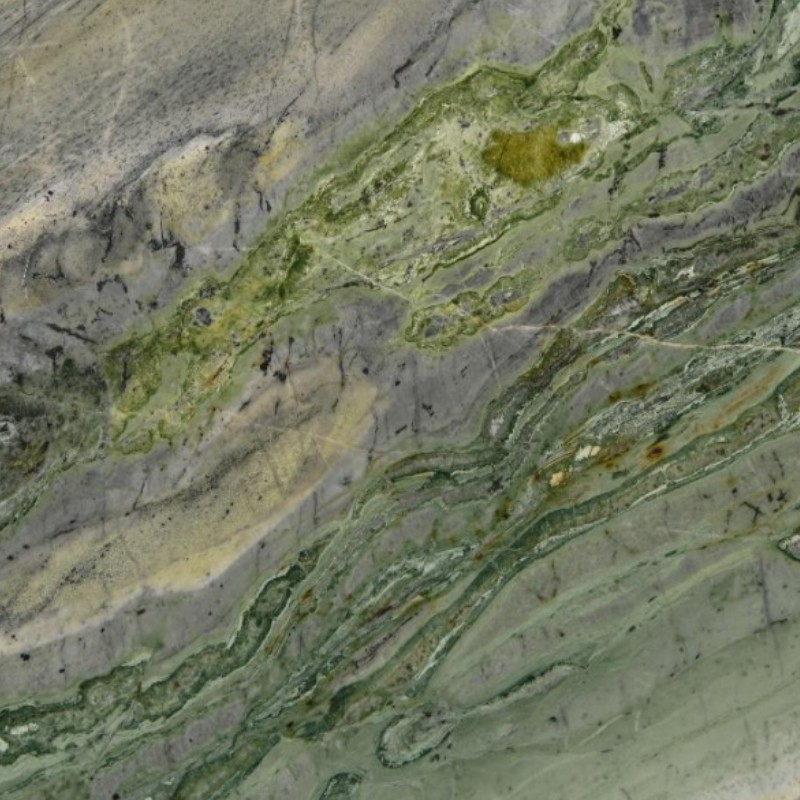
Luxury spa design is no longer only about soft lighting, scented air, and expensive towels folded like tiny hotel swans. The material behind the atmosphere must survive moisture, steam, body oils, cleaning chemicals, foot traffic, and long maintenance cycles. This is why Ice Connect Marble should be specified with a full wet-area strategy, not selected only because the slab looks beautiful in a showroom.
Ice Connect Marble has the icy white and jade-like visual language that designers often want for high-end bathrooms, wellness suites, spa corridors, private villas, boutique hotels, and resort wet zones. Its bright background and natural movement can make a compact spa room feel cleaner, larger, and more exclusive. However, marble in wet areas is unforgiving when the wrong finish, adhesive, membrane, grout, slope, or sealer is used. One small shortcut behind the stone can become a large repair bill later.
For projects that require consistent material sourcing, buyers usually start by reviewing available marble slabs before narrowing the selection by block, finish, thickness, and application area. In a luxury spa, that selection process should also include water absorption data, resin stability, slip resistance, sealing compatibility, and installation drawings. The stone may deliver the beauty, but the system protects the investment.
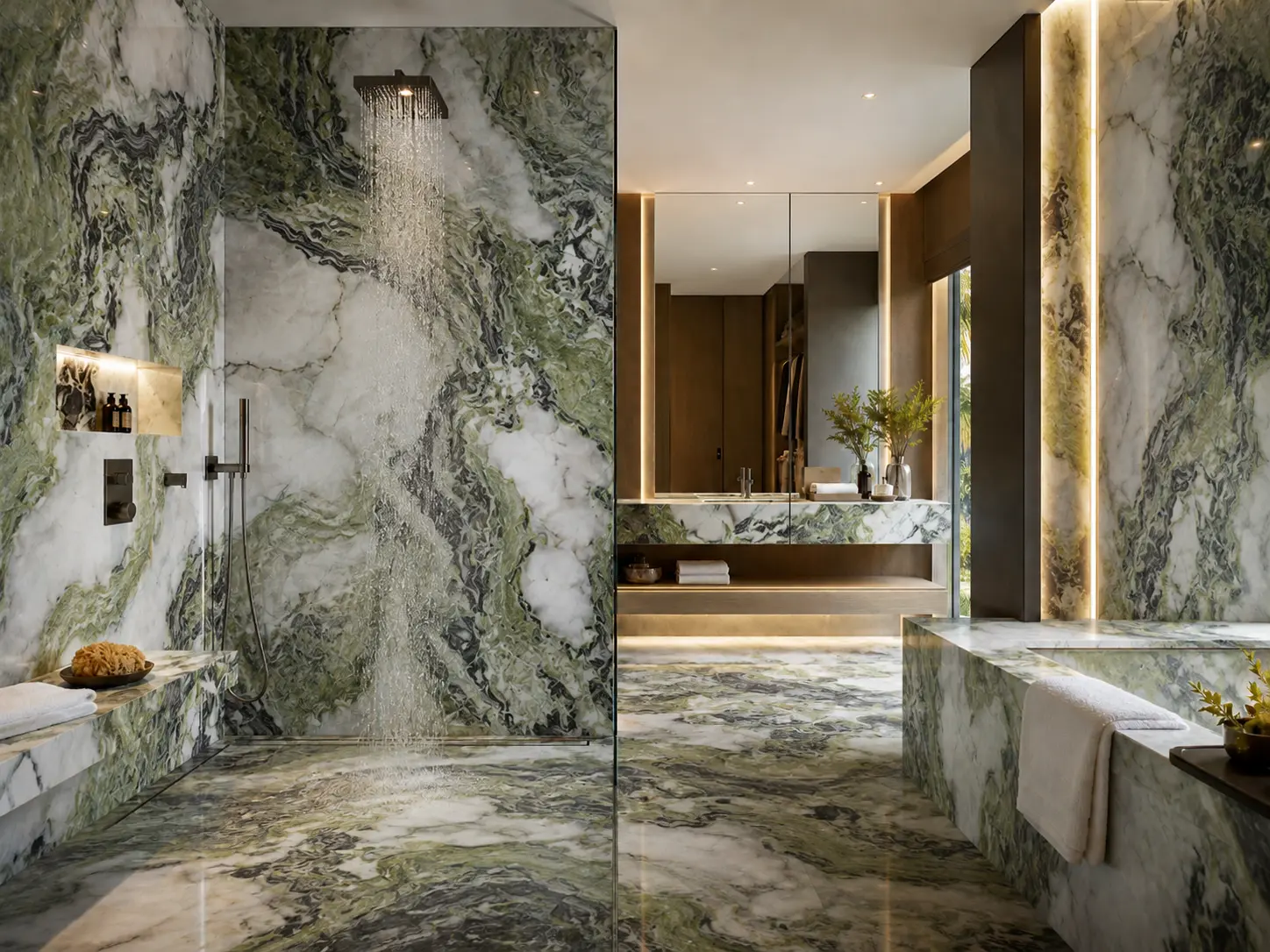
Ice Connect Marble for High-End Spa Wet Areas
Why Ice Connect Marble Is Attractive for Luxury Spa Wet Areas
Ice Connect Marble fits the visual trend of calm, bright, nature-inspired interiors. Many luxury spas now avoid heavy golden decoration and instead use clean stone surfaces, warm lighting, hidden drainage, frameless glass, and natural textures. A white and lightly veined marble can support this direction because it gives the room a fresh, hygienic, and premium feeling without looking cold when paired with timber, bronze metal, linen textures, and indirect lighting.
Its best uses include shower feature walls, vanity backsplashes, reception spa walls, relaxation lounge cladding, bath surround panels, treatment room walls, and selected dry-to-damp flooring areas. For constantly wet floors, steam rooms, or pool surrounds, the specification must become more conservative. That does not mean Ice Connect Marble cannot be used. It means the buyer needs the right finish, waterproofing assembly, and maintenance expectation from the beginning.
Before placing a commercial spa order, contractors and designers should share drawings, wet-zone locations, drainage points, expected traffic level, finish preference, and installation method with the supplier. For technical confirmation, sample requests, or project communication, buyers can use the official contact Ice Stone team channel to confirm whether the selected batch, surface finish, and packing plan are suitable for the project. This step sounds simple, but it prevents the classic marble disaster: beautiful material, wrong environment, expensive regret.
Wet Area Risk Is Different in Each Spa Zone
Not all wet areas behave the same. A vanity wall receives occasional splash. A shower floor receives direct water, soap, and foot pressure. A steam room receives vapor, heat, condensation, and chemical cleaning. A pool surround adds slip risk and often stronger cleaning agents. Treating all these zones as one “bathroom area” is a costly mistake.
| Spa Zone | Water Exposure | Main Risk | Recommended Ice Connect Marble Use |
|---|---|---|---|
| Reception spa wall | Low | Color matching and surface protection | Polished or honed slabs for a luxury feature wall |
| Vanity wall | Low to medium | Water spots, cosmetics, mild staining | Sealed honed or polished marble panels |
| Shower wall | High | Moisture migration behind stone | Honed marble with waterproof membrane behind |
| Shower floor | Very high | Slip risk and standing water | Small-format anti-slip finish only after testing |
| Steam room | Extreme humidity | Vapor penetration, sealer failure, thermal stress | Use only with vapor-rated system and tested sealer |
| Pool surround | Very high | Slip, chemical exposure, surface wear | Textured finish with slip-resistance evaluation |
A reliable supplier is not only selling a slab; it is helping the buyer reduce specification risk. When evaluating a stone partner, check experience with block selection, slab inspection, export packing, project communication, and cut-to-size supply. Buyers who want to understand supplier background, export orientation, and company capability can review the Ice Stone company profile as part of the procurement review. For B2B projects, this background matters because wet-area stone is not a one-carton retail purchase. It involves batch consistency, replacement planning, schedule control, and technical communication.
Material Parameters Buyers Should Confirm Before Ordering
Ice Connect Marble should be assessed like an architectural material, not a decorative photo. In commercial spa projects, the buyer should confirm appearance, slab size, thickness, absorption, surface finish, resin treatment, mesh backing, crack condition, vein direction, and color consistency. The more humid the space, the more important these details become.
Natural marble is a calcium carbonate-based stone, which means it is sensitive to acidic cleaners and can absorb moisture if not properly protected. A sealer can reduce water and stain absorption, but it does not make marble waterproof. The waterproofing layer must be designed behind or below the marble. This distinction is critical because many project failures happen when the owner believes “sealed marble” equals “waterproof marble.” It does not. Sealer is a surface protection tool; waterproofing is a construction system.
For designers who want the specific white and jade-like expression of the material, the product page for Ice Connect Marble White Beauty Ice Jade Marble Slab is the natural starting point. After the visual choice is confirmed, the next step should be technical matching: where will it be used, what finish is required, what substrate will support it, how much water exposure will it face, and how will the owner maintain it after handover?
| Parameter | Why It Matters in Wet Areas | Buyer Decision Point |
|---|---|---|
| Water absorption | Higher absorption may increase staining and darkening risk | Ask for test data or sample performance |
| Density | Indicates compactness and material consistency | Compare batches before bulk order |
| Flexural strength | Important for large wall panels and cut-to-size pieces | Confirm thickness and installation support |
| Surface finish | Directly affects slip risk and cleaning behavior | Use polished mainly for walls, not wet floors |
| Resin treatment | May react differently under heat, moisture, or chemicals | Test sealer and cleaning products before installation |
| Thickness tolerance | Affects installation flatness and joint consistency | Confirm tolerance for project-grade cut-to-size orders |
Waterproofing Standards: Marble Is Not the Waterproofing Layer
The biggest misunderstanding in luxury spa marble design is believing the stone itself can stop water. Marble is the visible finish. It is not the waterproof barrier. In a proper wet-area assembly, water protection must be handled by a compatible waterproofing membrane, correctly treated seams, sealed penetrations, proper drain integration, and correct slope.
For tile and stone wet areas, industry guidance commonly points to waterproof membranes, full mortar support, proper substrate preparation, and movement control. In practical terms, shower walls, shower floors, steam rooms, and spa pools should never depend only on grout and sealer. Grout joints are not waterproof. Corners move. Pipe penetrations leak if poorly treated. Large stone pieces can trap water behind them if there are mortar voids.
Before shipment, quality inspection should include slab surface condition, cracks, resin lines, thickness, finish uniformity, color range, edge quality, and packaging strength. A useful procurement reference is how to inspect and select premium Ice Connect Marble slabs, especially when buyers need to control risk before bulk payment or container loading. In wet-area projects, inspection is not picky behavior. It is insurance with a clipboard.
| Wet-Area Detail | Recommended Control | Risk If Ignored |
|---|---|---|
| Substrate flatness | Prepare a stable, flat, clean substrate before membrane installation | Lippage, hollow areas, cracking, uneven joints |
| Waterproof membrane | Use a membrane suitable for the exact wet condition | Hidden leakage, mold, stone darkening |
| Mortar coverage | Aim for around 95% coverage in wet and natural stone areas | Water pockets, debonding, cracks, hollow sound |
| Slope to drain | Design continuous slope, commonly around 1–2% depending on project code | Standing water, staining, slip complaints |
| Movement joints | Use flexible joints at corners, transitions, and changes of plane | Cracked grout, tenting, edge stress |
| Penetrations | Seal pipes, drains, valves, and niches with compatible products | Water migration behind stone |
Sealing Standards: What Sealers Can and Cannot Do
A penetrating sealer can reduce the chance of water marks, cosmetics staining, oil absorption, and dark patches. It is usually the preferred direction for natural marble because it protects while keeping the stone surface breathable. However, sealer selection must be tested before full application. Some sealers may slightly darken the stone, change the vein contrast, create uneven absorption, or behave poorly under steam and strong cleaners.
Topical coatings are often tempting because they sound stronger, but they can peel, yellow, become slippery, or create maintenance problems in spa conditions. Enhancing sealers may make veins look richer, but this can also reduce the icy softness of Ice Connect Marble. For luxury spas, the safest route is sample testing: apply the sealer to an offcut piece, wait 24–48 hours, expose it to water, shampoo, mild alkaline cleaner, body oil, and heat, then check color and surface behavior.
Creative spa applications can include shower feature walls, vanity cladding, bench faces, bath surrounds, spa reception walls, and soft-lit relaxation zones. For design inspiration, the article on creative ways to use Ice Connect Marble in high-end residential spas supports the visual side of planning. Still, creative use must stay married to technical discipline. Beauty without waterproofing is just a future complaint wearing a nice suit.
| Sealer Type | Best Use | Advantage | Limitation |
|---|---|---|---|
| Penetrating sealer | Most marble wet-area walls and vanity zones | Reduces absorption without forming a visible film | Requires inspection and reapplication |
| Enhancing sealer | Projects that want stronger vein contrast | Deepens color and visual movement | May change the original icy tone |
| Topical coating | Selected low-wear decorative walls | Creates a surface film | Can peel, yellow, or become slippery |
| Anti-slip treatment | Wet floor zones after sample testing | Improves traction | May affect appearance and cleaning feel |
Slip Resistance: Why Finish Selection Matters More Than Marketing Words
Polished marble looks luxurious, but it is rarely the safest option for wet floors. In a spa, guests may walk barefoot, step out from a shower, carry body oil on the skin, or move across a floor with soap residue. A polished surface can become slippery even when it looks clean. For this reason, polished Ice Connect Marble is better reserved for vertical walls, dry feature areas, and controlled vanity cladding.
For shower floors, pool edges, and frequently wet walking zones, honed, brushed, sandblasted, leathered, or other textured finishes should be considered. Smaller-format tiles can also improve grip because grout joints create additional traction. However, more grout joints also mean more cleaning and maintenance, so the final decision must balance safety, appearance, hygiene, and long-term labor cost.
In commercial spa projects, slip resistance should not be guessed from a photo. A surface sample should be tested under realistic wet conditions. The buyer should also confirm local building codes, hotel brand standards, insurance requirements, and accessibility rules. If the area is heavily used by the public, the safest recommendation is simple: use Ice Connect Marble where it performs well visually and technically, and combine it with more aggressive anti-slip materials where safety risk is high.
Grout, Drainage, and Movement Joints Decide Long-Term Performance
Grout color is an aesthetic decision, but grout type is a performance decision. Cementitious grout can work in lower-risk wall areas, but high-moisture spa zones often benefit from epoxy grout or premium stain-resistant grout. Epoxy grout offers better resistance to moisture and staining, but it requires experienced installation and careful cleaning during application. Poorly installed epoxy grout can leave haze on marble, which is not the kind of “spa mist” anyone paid for.
| Joint Material | Recommended Area | Benefit | Buyer Warning |
|---|---|---|---|
| Cementitious grout | Lower-risk walls and dry-to-damp zones | Easy to install and color-match | More porous and may need sealing |
| Epoxy grout | Showers, spa walls, high-moisture joints | Better stain and moisture resistance | Requires skilled installer |
| Silicone sealant | Corners and changes of plane | Handles movement better than rigid grout | Needs periodic inspection |
| Color-matched sealant | Luxury visible transitions | Cleaner appearance | Must be compatible with marble edges |
Drainage is equally important. A marble shower floor with poor slope will hold water, increase soap residue, and create dark patches. A hidden linear drain may look elegant, but it must be coordinated with slope, tile size, membrane, and stone layout. Movement joints are also non-negotiable in heated spa environments. Underfloor heating, steam, warm water, and air-conditioning cycles all create expansion and contraction. If the assembly cannot move, the stone or grout will eventually complain—and stone complains with cracks.
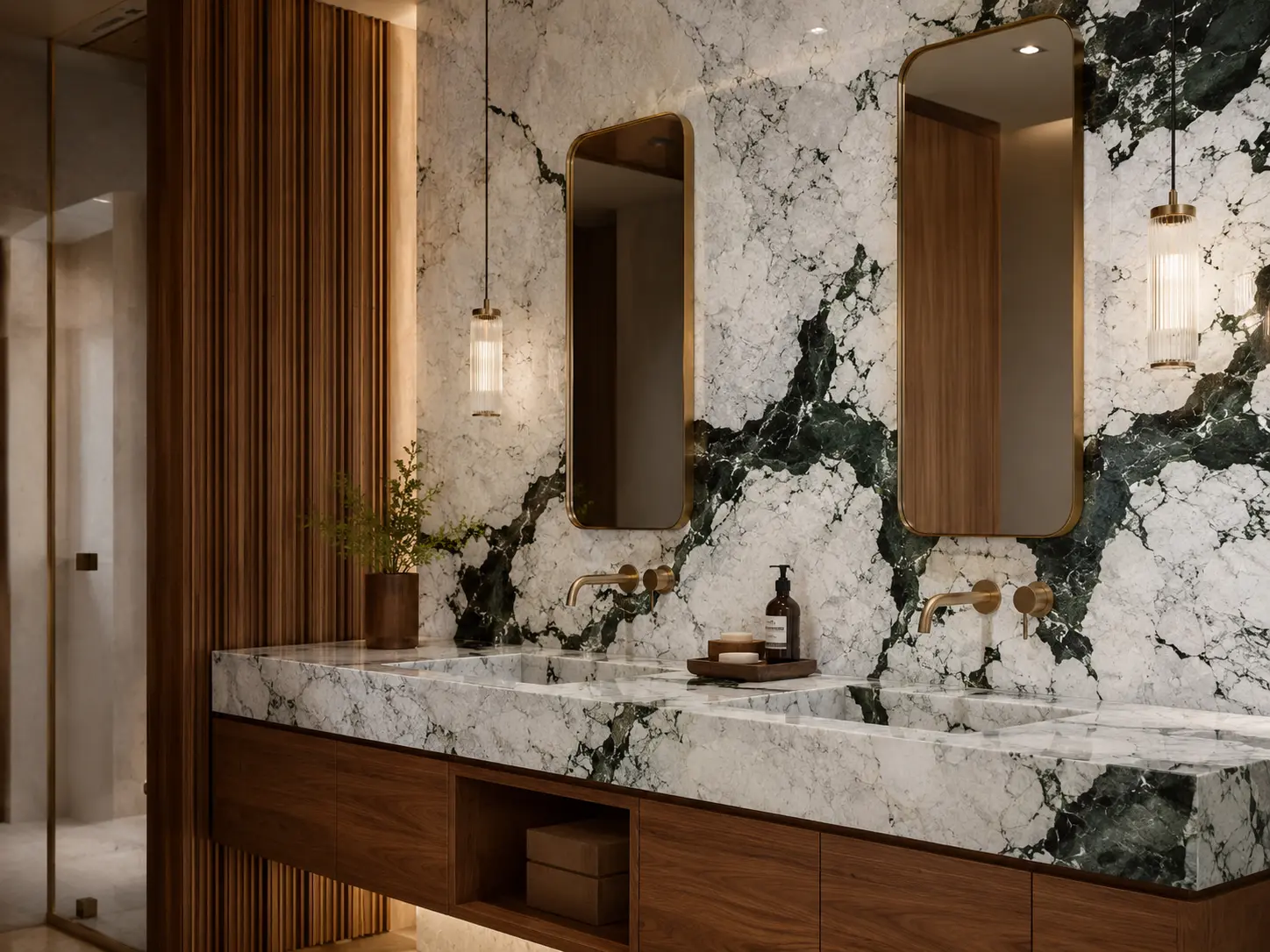
Ice Connect Marble for Bathroom Design
Ice Connect Marble vs Other Wet-Area Materials
Ice Connect Marble is not always the only material in a successful spa project. In fact, many high-end projects combine natural marble with porcelain, quartzite, granite, or textured stone to balance appearance, safety, and maintenance. This is not a compromise; it is intelligent specification.
| Material | Luxury Appearance | Wet-Area Risk | Maintenance Level | Best Use |
|---|---|---|---|---|
| Ice Connect Marble | Very high | Medium to high | Medium | Walls, feature areas, selected controlled floors |
| Porcelain tile | Medium to high | Low | Low | Heavy-use shower floors and public wet floors |
| Quartzite | High | Medium | Medium | Floors, counters, luxury wet zones |
| Travertine | Warm and natural | High if unfilled or poorly sealed | Medium to high | Walls and dry spa zones |
| Granite | Medium | Low to medium | Low | Utility wet areas and durable floors |
If the project goal is maximum luxury impression, Ice Connect Marble performs beautifully on walls, vanity zones, bathtub surrounds, reception counters, and feature panels. If the project goal is low maintenance in a public shower floor used all day, porcelain or textured stone may be safer. The smartest design often uses marble where guests look and a more slip-resistant material where guests step.
Procurement Checklist for B2B Buyers
For hotel owners, contractors, distributors, and designers, wet-area marble purchasing should be treated as a technical procurement process. Price matters, but price alone is a very bad project manager. A lower slab cost can disappear quickly if the material arrives with inconsistent color, weak packing, wrong finish, poor labeling, or no replacement planning.
Bulk buyers should confirm slab photos, videos, finish samples, thickness tolerance, resin condition, mesh backing, cut-to-size capability, packaging method, loading photos, and shipping documents. For distributors and project contractors purchasing container quantities, the guide on buying Ice Connect Marble in bulk is relevant to export planning, OEM coordination, and order control. The larger the order, the more important batch consistency becomes.
| Buyer Question | Why It Matters | Recommended Action |
|---|---|---|
| Can the supplier provide current slab photos? | Ice Connect Marble varies naturally by block | Confirm actual available material before order |
| Can the finish be customized? | Wet floors may need honed or textured surfaces | Request finish samples before production |
| Is cut-to-size available? | Spa walls and shower areas often need exact dimensions | Send drawings and tolerance requirements |
| How is export packing handled? | Marble slabs are fragile during long-distance shipping | Request photos of crates, labels, and loading |
| Can the supplier separate wall-grade and floor-grade pieces? | Different areas have different risk levels | Specify application area during selection |
If This Is Your Project, Choose This Specification
Decision logic makes the buyer’s life easier. If Ice Connect Marble is used for a luxury spa reception wall, a polished book-matched slab can deliver maximum visual impact. If it is used in a shower wall, a honed surface with proper waterproofing and sealed joints is safer. If it is used on a shower floor, choose small-format pieces, anti-slip finish, full mortar coverage, and careful drainage. If the spa includes a steam room, do not proceed without a vapor-rated assembly and sealer testing.
| If Your Project Needs | Choose | Avoid |
|---|---|---|
| Luxury spa feature wall | Polished or honed Ice Connect Marble slabs | Random mixed batches without layout planning |
| Shower wall cladding | Honed sealed marble with waterproof membrane | Unsealed stone over unprotected substrate |
| Shower floor | Small-format anti-slip pieces with correct slope | Large polished slabs |
| Steam room | Vapor-rated waterproofing system and tested sealer | Standard bathroom assembly |
| Low-maintenance commercial spa | Marble on walls plus porcelain or textured stone on floors | Marble everywhere without maintenance plan |
Common Mistakes and Their Consequences
The first mistake is treating sealer as waterproofing. Sealer reduces absorption; it does not stop water behind walls or under floors. The second mistake is using polished marble on wet floors because it looks premium. It may look premium, but slip claims do not care about aesthetics. The third mistake is ignoring drainage slope. Standing water makes even good stone look tired.
The fourth mistake is approving material from one beautiful photo. Marble must be checked by batch, slab, lighting condition, and finish. The fifth mistake is allowing harsh acidic cleaners after installation. Marble can etch when exposed to acidic substances, so hotel maintenance teams need a stone-safe cleaning protocol. The sixth mistake is skipping mockups. A mockup can reveal color change, sealer behavior, joint appearance, and slip concerns before the whole spa becomes an expensive experiment.
Recommended Maintenance Plan for Luxury Spa Owners
Maintenance should be written into the project handover. Luxury marble does not fail because it is weak; it often fails because nobody told the cleaning team what not to do. Use pH-neutral stone cleaners, avoid acidic descalers, remove standing water, inspect sealant joints, and reseal based on exposure level. Commercial wet floors may need inspection every three to six months, while lower-risk walls may only need annual review.
| Spa Area | Inspection Frequency | Possible Resealing Cycle | Main Maintenance Focus |
|---|---|---|---|
| Reception wall | Every 12 months | 18–36 months | Dust, fingerprints, visual consistency |
| Vanity wall | Every 6–12 months | 12–24 months | Water spots, cosmetics, cleaner residue |
| Shower wall | Every 6 months | 12–18 months | Grout joints, sealant, stone darkening |
| Shower floor | Every 3–6 months | 6–12 months | Slip resistance, standing water, sealer wear |
| Steam room | Every 3 months | Based on testing | Vapor impact, joint condition, surface change |
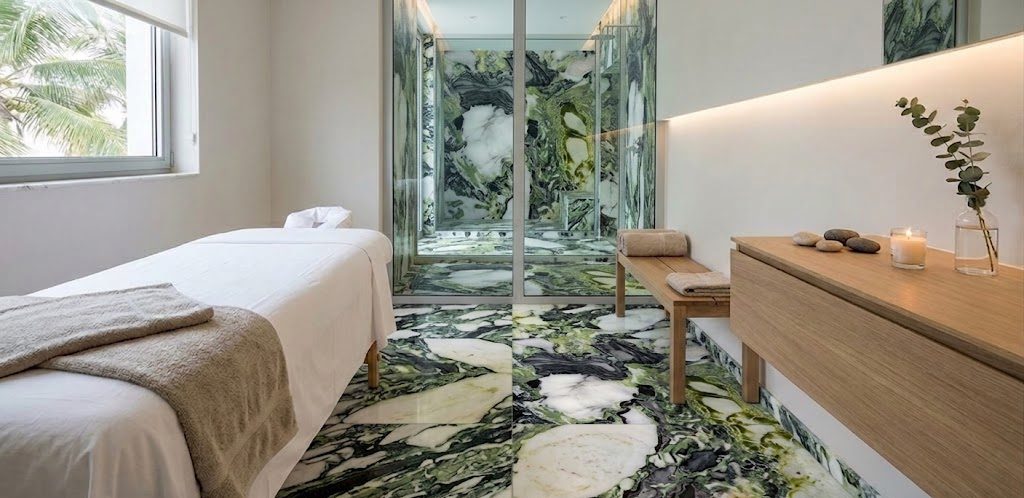
Ice Connect Marble Spa flooring
Frequently Asked Questions
1. Is Ice Connect Marble suitable for luxury spa wet areas?
Yes, Ice Connect Marble can be suitable for luxury spa wet areas when it is specified with the correct waterproofing, surface finish, sealing system, grout, drainage, and maintenance plan. It is especially effective for shower walls, vanity walls, bath surrounds, reception feature walls, and high-end spa cladding. For constantly wet floors, pool surrounds, and steam rooms, buyers should be more cautious and request sample testing, slip-resistance evaluation, vapor-rated waterproofing, and clear cleaning guidelines before installation.
2. Does sealing make Ice Connect Marble waterproof?
No, sealing does not make Ice Connect Marble waterproof. A penetrating sealer can reduce water absorption, staining, oil marks, and surface darkening, but it cannot replace a waterproof membrane. In showers, steam rooms, and other wet areas, the waterproofing layer must be installed behind or below the marble. Buyers should understand that sealer protects the stone surface, while the waterproofing system protects the building structure.
3. What finish is best for Ice Connect Marble in a spa bathroom?
The best finish depends on where the marble will be installed. Polished Ice Connect Marble is suitable for luxury feature walls, reception areas, and dry or low-splash vertical surfaces. Honed marble is usually better for shower walls, vanity zones, and areas where a softer, less reflective surface is preferred. For wet floors, shower floors, and pool-adjacent areas, a textured or anti-slip finish should be considered, and the sample should be tested under realistic wet conditions before approval.
4. How often should Ice Connect Marble be resealed in a commercial spa?
The resealing cycle depends on water exposure, traffic level, cleaning chemicals, sealer type, and surface finish. In commercial spa wet floors or shower areas, inspection every three to six months is recommended, with resealing often considered every six to twelve months if water absorption or staining increases. Lower-risk walls may only need inspection once a year and resealing every eighteen to thirty-six months. The safest approach is to test water behavior regularly instead of following a fixed calendar blindly.
5. What should buyers confirm before ordering Ice Connect Marble for wet areas?
Buyers should confirm slab photos, batch consistency, thickness, finish type, resin condition, mesh backing, water absorption data, cut-to-size capability, packing method, and export documentation. For wet areas, they should also discuss waterproofing compatibility, grout selection, sealer testing, slip-resistance requirements, drainage design, and maintenance expectations. If the project is a hotel, villa, resort, or commercial spa, sending drawings and wet-zone details before production helps reduce rework, delays, and installation risk.
References
- “ASTM C503/C503M Standard Specification for Marble Dimension Stone” — ASTM International — Natural Stone Material Standard
- “Dimension Stone Design Manual” — Natural Stone Institute — Technical Design and Installation Reference
- “TCNA Handbook for Ceramic, Glass, and Stone Tile Installation” — Tile Council of North America — Tile and Stone Installation Guide
- “ANSI A108/A118/A136.1 Installation Standards for Ceramic Tile” — American National Standards Institute — Installation and Material Standard
- “ANSI A326.3 Dynamic Coefficient of Friction Test Method” — American National Standards Institute — Wet Surface Slip-Resistance Testing Standard
- “ASTM C97/C97M Standard Test Methods for Absorption and Bulk Specific Gravity of Dimension Stone” — ASTM International — Stone Testing Method
- “ASTM C880/C880M Standard Test Method for Flexural Strength of Dimension Stone” — ASTM International — Structural Performance Testing Method
- “Natural Stone Care and Maintenance Guidelines” — Natural Stone Institute — Stone Cleaning and Maintenance Resource
How to Specify Ice Connect Marble Without Creating Future Problems
What should buyers understand first? Ice Connect Marble is a luxury natural stone finish, not a waterproofing product. Its value comes from visual depth, natural veining, cool elegance, and project-grade exclusivity. Its risk comes from moisture, slip conditions, acidic cleaners, poor drainage, and weak installation systems.
How should it be used in luxury spas? Use Ice Connect Marble confidently on feature walls, vanity walls, bath surrounds, reception areas, treatment room cladding, and selected controlled wet zones. For shower floors, steam rooms, and pool surrounds, specify the finish, membrane, grout, slope, sealant, and maintenance system before approving the order.
Why does the installation system matter? Because most wet-area marble failures begin behind the surface. Hidden water pockets, poor membrane detailing, low mortar coverage, unsealed penetrations, and rigid corner joints can cause dark patches, cracks, mold risk, and expensive rework. The stone gets blamed, but the assembly usually caused the problem.
Option logic: If the project prioritizes visual luxury, use Ice Connect Marble on walls and focal surfaces. If the project prioritizes barefoot safety, use honed, textured, or small-format marble only after slip testing. If the project requires low maintenance in a public wet floor, combine marble walls with porcelain or other anti-slip flooring. If the project includes steam, require vapor-rated waterproofing and sealer compatibility testing.
Consideration for B2B buyers: Ask for slab photos, sample testing, finish options, cut-to-size support, packing details, batch control, and export documentation before buying. A small confirmation step before shipment is far cheaper than replacing installed marble after a spa opens.
Recommendation: Treat Ice Connect Marble as a premium design material that needs professional wet-area engineering. Share drawings, zone functions, finish requirements, and cleaning expectations with the supplier before final selection. This is the quiet difference between a spa that looks luxurious on opening day and one that still looks luxurious after years of use.