Quick Summary:
Black Wood Marble is a distinctive natural stone from China, featuring a deep dark background and naturally occurring wood-like veining. With different surface finishes and slab formats, Black Wood Marble Slabs can be considered for luxury interior flooring, wall cladding, decorative countertops, and hotel design projects. Understanding its natural characteristics, physical properties, finish options, and maintenance requirements helps architects, contractors, and wholesale buyers select the right material for their projects.
Why Black Wood Marble Attracts Attention in Luxury Interior Design
Natural marble remains an important material in architectural and interior design because it combines geological character with a visual appearance that manufactured surfaces cannot completely reproduce. Among dark natural stones, Black Wood Marble stands out for its distinctive linear patterns, deep tonal appearance, and wood-grain-like visual movement.
Unlike conventional black marble varieties that may feature relatively scattered veins or cloudy patterns, Black Wood Marble is often selected for its directional appearance. Its elongated lines can create a sense of movement across large surfaces, making it suitable for projects where designers want a dark material with more visual structure than a plain black background.
However, choosing this stone involves more than evaluating a photograph or selecting a slab based on color. Buyers need to understand its natural variation, available finishes, dimensional requirements, installation conditions, and the performance characteristics required for the intended application.
This guide explains the main characteristics of Black Wood Marble, explores its architectural applications, compares different finishes, and outlines practical purchasing considerations for importers, distributors, fabricators, architects, and project contractors.
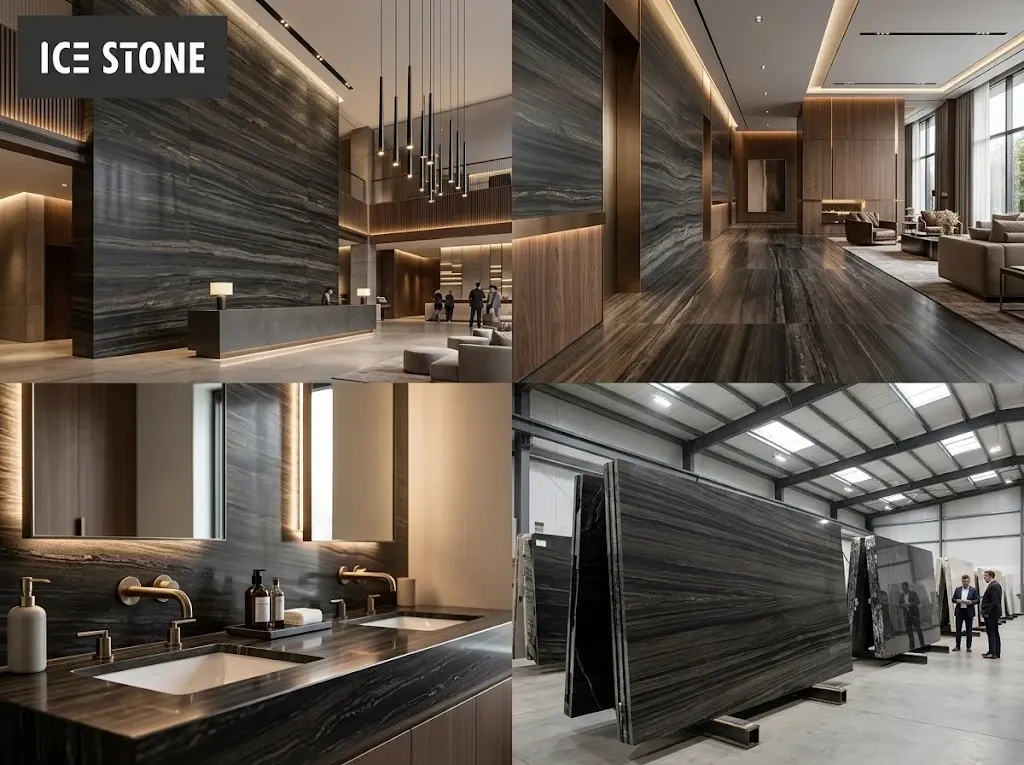
black wood marble applications
What Is Black Wood Marble?
Black Wood Marble is a natural decorative stone known for its dark base color and elongated mineral patterns that resemble the grain of natural timber. Depending on the individual block and quarry characteristics, its appearance may include black, charcoal, dark gray, brownish, or lighter linear markings.
The wood-like pattern is a visual characteristic created by geological processes over long periods. Mineral composition, sedimentary structures, geological deformation, and other natural conditions contribute to the final appearance of the stone.
Because it is a natural material, no two slabs should automatically be expected to have identical patterns. The direction, density, contrast, and continuity of the lines can vary between blocks and even between different sections of the same block.
Distinctive Visual Characteristics
- Dark background: The base color generally creates a dramatic and sophisticated visual effect.
- Linear veining: Elongated patterns create a wood-grain-like appearance and directional movement.
- Natural variation: Pattern density, color contrast, and vein distribution vary according to the selected material.
- Decorative versatility: The stone can complement metal, glass, timber, neutral paint colors, and other natural materials.
- Large-format potential: Carefully selected slabs can support visually continuous wall and floor designs.
Natural Marble Versus Wood-Look Manufactured Surfaces
Black Wood Marble is sometimes compared with porcelain slabs, engineered surfaces, and wood-look tiles. These products may create a similar visual impression, but their material structures and production methods are different.
Natural marble offers geological variation and individual slab character. Manufactured alternatives can provide more predictable pattern repetition, controlled dimensions, and standardized production. The right choice depends on design priorities, technical requirements, budget, and installation conditions.
Key Characteristics of Black Wood Marble
1. Color and Pattern Variation
The dark background is one of the main reasons buyers consider Black Wood Marble for high-end projects. Its visual depth can help create contrast in spaces dominated by lighter flooring, neutral walls, or metallic architectural details.
The linear pattern is equally important. Depending on the block, the veins may appear relatively straight, gently curved, closely spaced, or widely separated. Some slabs may have stronger contrast, while others present a more subdued appearance.
For large commercial or residential projects, buyers should review several slabs together rather than relying on a single sample. A small sample may not communicate the full pattern direction or the natural variation found across a complete slab.
2. Texture and Surface Appearance
Surface treatment affects how the color, pattern, and texture are perceived. A polished surface can increase visual depth and reflect surrounding light, while a honed surface usually creates a softer, less reflective appearance.
Other treatments may produce a more textured or aged look. The availability of each treatment depends on the stone’s physical characteristics and the capabilities of the processing factory.
3. Natural Material Variation
Natural stone should be evaluated as a geological product rather than as a perfectly uniform industrial material. Differences in shade, mineral distribution, vein continuity, and surface characteristics are normal considerations when purchasing marble.
This does not mean every variation is acceptable. Buyers should distinguish between natural visual variation and defects that may affect fabrication, installation, or service performance.
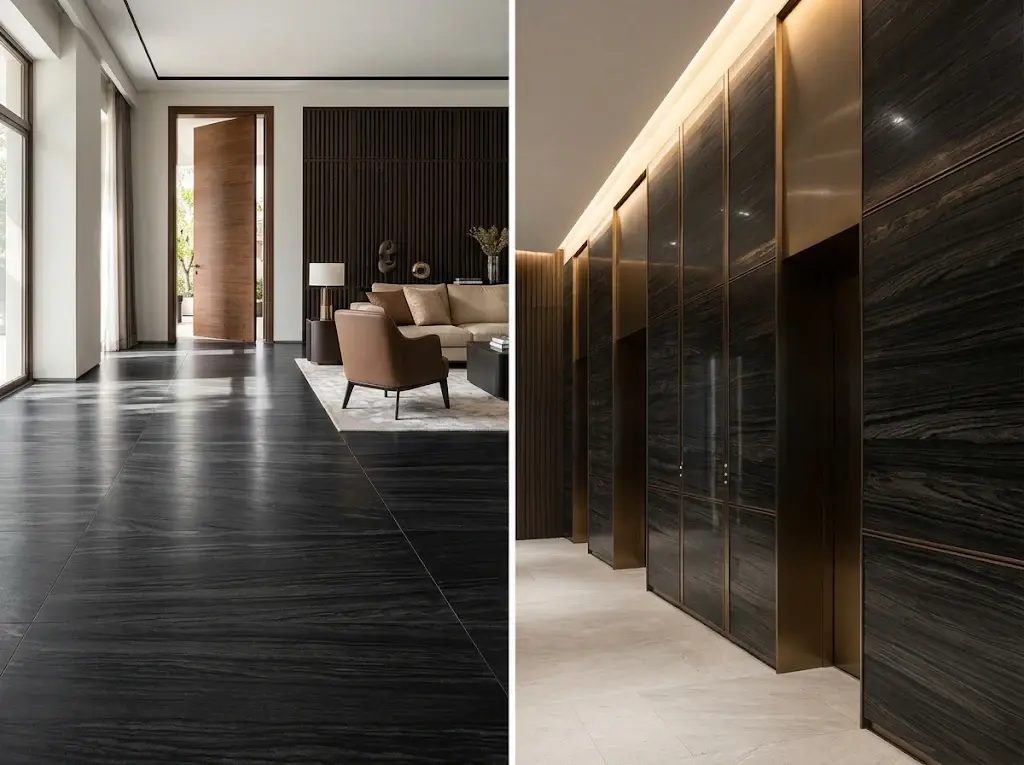
black wood marble flooring lobby cladding
Technical Properties and Data Buyers Should Evaluate
Visual appearance is only one part of material selection. For flooring, wall cladding, countertops, and commercial projects, buyers should request relevant physical and mechanical test results.
The exact performance of Black Wood Marble should not be assumed from its name or appearance. Properties can vary according to the specific quarry block, geological structure, processing condition, and test specimen.
Important Physical Properties
| Property | What It Measures | Why Buyers Should Check It | Relevant Test Method |
|---|---|---|---|
| Bulk Density | Mass per unit volume | Helps assess material characteristics and weight calculations | EN 1936 |
| Water Absorption | Water absorbed under specified conditions | Relevant to moisture exposure and maintenance planning | EN 13755 |
| Compressive Strength | Resistance to compressive loading | Important for assessing suitability under specified loads | EN 1926 |
| Flexural Strength | Resistance to bending stress | Relevant to slab handling, installation, and supported applications | EN 12372 |
| Freeze-Thaw Resistance | Resistance to repeated freezing and thawing | Important for exterior applications in relevant climates | EN 12371 |
| Abrasion Resistance | Resistance to surface wear | Relevant to flooring and areas exposed to regular foot traffic | EN 14157 |
| Slip Resistance | Surface friction under a defined test condition | Important for flooring safety and wet-area specifications | EN 14231 |
Example of a Technical Data Review Framework
When comparing different natural stone suppliers, a structured data sheet can make the evaluation process more reliable. The following table provides a practical framework for collecting information. The numerical fields should be completed using the supplier’s verified test reports rather than estimated values.
| Technical Item | Required Information | Buyer Review Focus |
|---|---|---|
| Density | Laboratory result and unit | Consistency and project weight calculations |
| Water Absorption | Test result and method | Suitability for the intended exposure |
| Compressive Strength | Measured value and test report | Specified structural and installation conditions |
| Flexural Strength | Measured value and test report | Slab thickness, support, and handling requirements |
| Slip Resistance | Test method and measured result | Flooring location and applicable safety requirements |
| Surface Finish | Polished, honed, or other specified finish | Appearance, cleaning, and maintenance expectations |
Black Wood Marble Compared with Other Dark Natural Stones
Buyers evaluating dark marble often compare several materials before finalizing a specification. These comparisons should consider more than color. Pattern direction, visual consistency, finish availability, fabrication behavior, and project requirements all influence the final decision.
| Comparison Factor | Black Wood Marble | Plain Black Marble | Black Marble with Irregular Veins |
|---|---|---|---|
| Visual Character | Linear, wood-like patterns | More uniform dark appearance | More varied decorative movement |
| Design Direction | Directional and structured | Minimalist and restrained | Expressive and decorative |
| Pattern Matching | Requires attention to vein direction | May be easier when color consistency is the priority | Requires individual slab layout planning |
| Common Design Use | Feature walls, flooring, selected countertops | Minimalist floors and wall surfaces | Statement walls and decorative interiors |
| Key Buying Concern | Linear pattern continuity | Color consistency and surface quality | Vein distribution and visual balance |
A useful comparison should always be based on actual slab photographs, physical samples, technical documents, and the intended application. Different stones may look similar in online images but perform differently under specific installation and service conditions.
Black Wood Marble Applications in Residential and Commercial Projects
The distinctive pattern of Black Wood Marble gives designers several ways to introduce dark natural stone into an interior. Its suitability depends on the material’s verified properties, the selected finish, installation details, and the environmental conditions of the project.
1. Interior Flooring
Black Wood Marble can create a strong visual foundation in luxury residential interiors, hotel lobbies, private dining areas, and selected commercial spaces. Its linear markings can help establish directional movement across a floor, particularly when slab orientation is planned carefully.
For flooring projects, buyers should pay close attention to abrasion resistance, surface finish, slip resistance, slab thickness, and the expected level of foot traffic. A polished finish may provide a refined appearance, but it should not be selected for a potentially wet walking surface without evaluating the applicable slip-resistance requirements.
2. Feature Walls and Wall Cladding
Feature walls are among the applications where the natural pattern can become a central design element. Large-format slabs can create a continuous visual surface behind reception desks, in hotel corridors, or around decorative architectural elements.
Wall cladding requires appropriate consideration of slab dimensions, thickness, substrate conditions, mechanical fixing where required, adhesive compatibility, and installation engineering. For large or elevated installations, the fixing system should be designed and reviewed by qualified project professionals.
Designers exploring directional stone patterns can also review these marble flooring and wall cladding design ideas for inspiration on coordinating natural stone surfaces with contemporary interior elements.
3. Bathroom and Vanity Applications
Dark marble can create a sophisticated visual effect in bathroom vanity areas, decorative wall panels, and selected interior surfaces. Its deep color can contrast effectively with light-colored sanitary fixtures, glass, brushed metal, and warm lighting.
Bathroom applications require more careful material evaluation because surfaces may be exposed to water, soap, cosmetics, cleaning products, and other substances. Buyers should request guidance on suitable sealers, cleaning methods, and maintenance intervals.
For shower floors and other frequently wet walking surfaces, slip resistance and drainage design must be considered. A visually attractive polished slab should not automatically be treated as suitable for every wet-area application.
4. Kitchen Countertops and Decorative Surfaces
Black Wood Marble can be considered for selected countertop and decorative applications where the design emphasizes natural stone character. Its linear appearance can work well with minimalist cabinetry, dark metal details, and warm wood finishes.
However, natural marble is generally more sensitive to acidic substances than many engineered countertop materials. Lemon juice, vinegar, wine, and certain household cleaners may react with calcium-carbonate-based stones and cause surface etching.
Buyers should discuss expected use, surface protection, edge details, support requirements, and maintenance expectations before specifying the material for a kitchen.
5. Luxury Hotels and Commercial Interiors
Hotels, restaurants, offices, and premium retail environments often use natural stone to establish a recognizable interior identity. Black Wood Marble may be considered for reception areas, decorative wall panels, lift lobbies, feature flooring, and selected furniture surfaces.
Commercial projects need a coordinated review of appearance, quantity, installation sequencing, replacement material availability, and maintenance planning. A sample approved during the design stage should be compared with the actual production slabs before fabrication.
For more project-oriented inspiration, buyers can explore natural marble applications in luxury hotel and commercial interior projects.
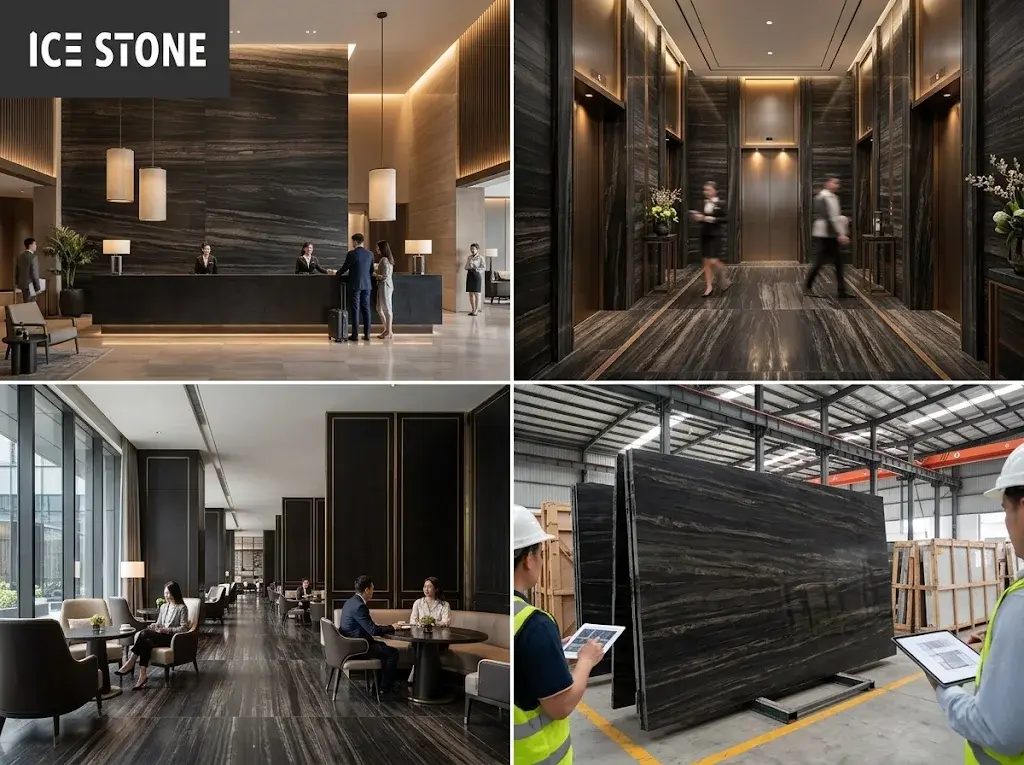
Black Wood Marble For Luxury Hotels
Black Wood Marble Finishes: How to Choose the Right Surface
Surface finish influences the appearance, light reflection, texture, cleaning behavior, and perceived character of natural marble. Selecting the correct finish is therefore an important part of the specification process.
Polished Finish
A polished finish produces a smooth, reflective surface that can enhance the depth of dark colors and increase the visual contrast of linear patterns. It is often considered for decorative walls, selected interior floors, vanity surfaces, and feature applications.
The reflective appearance can make the stone look more dramatic under directional lighting. However, polished surfaces may show fingerprints, dust, water marks, and certain scratches more visibly depending on the lighting and maintenance conditions.
Honed Finish
A honed finish creates a smooth but generally less reflective surface. It can provide a softer visual appearance and may be suitable for interiors where designers prefer understated material expression.
Honed marble is not automatically stain-proof or slip-resistant. Its performance still depends on the stone, surface treatment, contamination, cleaning practices, and the specific test conditions.
Antiqued or Textured Finish
An antiqued or textured treatment can create a more tactile surface with a less formal appearance. Depending on the processing method and the stone’s characteristics, it may be considered for selected decorative projects.
Textured surfaces may require additional attention during cleaning because dirt and residue can collect in surface irregularities. Their suitability for flooring should be evaluated using appropriate slip-resistance testing and maintenance considerations.
| Finish | Appearance | Potential Applications | Important Considerations |
|---|---|---|---|
| Polished | Glossy and reflective | Feature walls, decorative floors, vanity tops | Reflection, visible marks, wet-area suitability |
| Honed | Matte or low-sheen | Contemporary interiors, wall surfaces, selected floors | Stain management and surface protection |
| Antiqued | More textured and aged | Decorative interiors and selected architectural features | Cleaning requirements and surface consistency |
How to Select Black Wood Marble Slabs for a Project
Slab selection has a direct influence on the final appearance of a natural stone installation. Even when two slabs come from the same material category, their pattern distribution and color balance may differ considerably.
1. Review Full-Slab Photographs
Request high-resolution photographs of the actual slabs available for the project. Full-slab images help buyers evaluate the overall color, pattern direction, visible variation, and potential layout combinations.
2. Confirm Vein Direction and Layout
The linear appearance of Black Wood Marble makes orientation particularly important. Buyers should decide whether the project requires horizontal, vertical, or another specified pattern direction.
For bookmatched or continuous-pattern installations, slab sequence and cutting plans should be reviewed before production. The supplier and fabricator should confirm whether the available slabs can achieve the intended layout.
3. Check Slab Dimensions and Thickness
Slab dimensions should be matched with the project’s fabrication drawings and installation requirements. Buyers should confirm nominal thickness, length, width, dimensional tolerances, edge conditions, and any agreed processing specifications.
4. Inspect Surface Quality
Review the slabs for cracks, fissures, resin treatment, repaired areas, edge damage, and other characteristics that may affect fabrication or installation. Natural features should be assessed individually rather than automatically classified as defects.
5. Approve the Material Before Mass Production
For larger projects, buyers should establish a clear approval process covering sample selection, slab photographs, batch identification, processing requirements, and final inspection criteria.
Black Wood Marble Application Fit by Product Direction
The following matrix provides a practical design suitability guide for evaluating possible applications. It is not statistical data, a certified performance rating, or a guarantee that every Black Wood Marble block is suitable for every listed use. Final selection requires material-specific test reports and project review.
| Application | Design Suitability | Key Evaluation Points |
|---|---|---|
| Interior Feature Walls | ●●● | Pattern continuity, slab dimensions, fixing method |
| Decorative Wall Cladding | ●●● | Thickness, support system, installation engineering |
| Interior Flooring | ●●○ | Abrasion resistance, slip resistance, traffic level |
| Bathroom Vanity Surfaces | ●●○ | Water exposure, sealing, cleaning products |
| Kitchen Countertops | ●○○ | Acid sensitivity, staining, maintenance expectations |
| Shower Floors | — | Slip resistance, water management, surface suitability |
| Exterior Paving | ●○○ | Weather exposure, freeze-thaw resistance, slip performance |
| Decorative Furniture Surfaces | ●●○ | Support, edge fabrication, handling, surface protection |
Legend:
●●● = Primary;
●●○ = Strong Option;
●○○ = Depends on Workflow;
— = Usually Not First Choice.
The matrix is intended to guide early design discussions. It does not replace engineering review, laboratory testing, or the applicable building and safety requirements for a specific project.
What Buyers Should Know About Black Wood Marble Wholesale Purchasing
Wholesale purchasing involves more than comparing the price per square meter. Buyers should evaluate material consistency, available stock, processing capacity, packaging standards, inspection procedures, and export coordination.
1. Confirm the Material Source and Supplier Information
Buyers should understand whether the supplier is a quarry operator, stone manufacturer, processor, exporter, or trading company. This helps establish which stages of the supply chain are controlled directly and which are managed by external partners.
Company background, factory capabilities, product range, quality-control procedures, and export experience are useful points to review. Buyers can learn more about ICE STONE’s company profile and business background when evaluating potential cooperation.
2. Confirm the Commercial Specification
A quotation should clearly identify the material, selected slab dimensions, thickness, finish, quantity, packaging requirements, and delivery terms. If the project requires selected slabs, bookmatching, or specific vein direction, these details should be included in the order confirmation.
3. Understand Pricing Factors
The price of Black Wood Marble can vary according to block quality, pattern selection, slab size, thickness, surface finish, processing requirements, available inventory, and order volume.
Additional costs may include cutting, polishing, reinforcement, resin treatment where applicable, edge processing, inspection, crating, inland transportation, and international freight.
4. Compare Quotations on an Equivalent Basis
A lower price does not necessarily represent better value if the material has different dimensions, thickness, finish quality, or inspection standards. Buyers should compare quotations using the same technical and commercial specifications.
| Quotation Item | Information to Confirm |
|---|---|
| Material | Exact stone name and approved slab selection |
| Dimensions | Length, width, thickness, and tolerances |
| Finish | Polished, honed, antiqued, or other agreed treatment |
| Quantity | Square meters, slab count, and any cutting allowance |
| Quality Control | Inspection criteria, photographs, and approval process |
| Packaging | Crates, protection, labeling, and loading arrangement |
| Shipping Terms | Incoterms, loading port, destination, and delivery scope |
Processing, Fabrication, and Quality Control
Natural stone fabrication requires careful coordination between slab selection, cutting plans, surface finishing, edge processing, and final inspection. For Black Wood Marble, pattern direction should be considered alongside technical dimensions.
Cutting and Pattern Planning
Before cutting, fabricators should review the slab layout and confirm the intended direction of the linear pattern. This is especially important for large feature walls, long countertops, and projects where multiple pieces must appear visually coordinated.
Edge Processing
Common edge treatments may include straight edges, eased edges, bevels, and other project-specific profiles. The selected edge should be compatible with the slab thickness, installation details, and expected use.
Resin Treatment and Repairs
Some natural stone slabs may receive resin treatment or other repairs during processing. Buyers should request disclosure of relevant treatments where they affect the appearance, fabrication, or agreed product specification.
Final Inspection
A practical inspection process should include:
- Checking slab dimensions and thickness against the order.
- Reviewing the surface finish under suitable lighting.
- Inspecting visible cracks, repairs, fissures, and edge conditions.
- Confirming the approved color and pattern range.
- Checking quantity, labeling, and packaging arrangements.
- Recording inspection photographs before shipment.
Packaging, Transportation, and Export Considerations
Natural stone slabs are heavy and can be vulnerable to impact, vibration, and improper support during transportation. Appropriate packaging and loading procedures are essential for reducing handling risks.
Buyers should confirm the crate structure, internal protection, slab support, loading arrangement, and container securing method. The packaging specification should reflect the actual slab dimensions, thickness, weight, and shipping route.
Export documentation should also be prepared according to the transaction and destination requirements. Depending on the shipment, documents may include a commercial invoice, packing list, bill of lading, certificate of origin, and other documents required by the buyer or relevant authorities.
Before confirming an international order, importers should verify customs classification, applicable duties, import procedures, and any destination-specific product or documentation requirements with their customs broker or relevant authority.
Maintenance and Care for Black Wood Marble
Natural marble can retain its appearance for many years when it is correctly installed and maintained. However, maintenance requirements depend on the stone’s composition, surface finish, exposure conditions, and the products used for cleaning.
Daily Cleaning
- Remove loose dust and debris using a soft cloth or suitable dust mop.
- Use a pH-neutral cleaner formulated for natural stone.
- Wipe spills promptly, particularly acidic liquids and strongly colored substances.
- Avoid abrasive pads that may scratch or dull the surface.
- Follow the cleaner manufacturer’s dilution and application instructions.
Preventing Etching and Staining
Marble may react with acidic substances, causing etching or changes in surface appearance. Common household materials such as vinegar, lemon juice, and certain acidic cleaning products should not be used on marble unless specifically approved for the application.
Sealers may help reduce liquid absorption in suitable natural stone applications, but they do not make marble completely stain-proof or acid-proof. Sealer selection and reapplication frequency should follow the product manufacturer’s instructions and the actual service conditions.
Long-Term Maintenance
Commercial spaces with regular foot traffic may need a planned maintenance schedule. Periodic inspection can identify worn areas, damaged joints, surface dullness, or problems caused by unsuitable cleaning methods.
For large installations, buyers should request a maintenance guide before handover so that building managers, cleaning contractors, and property owners understand the correct care procedures.
Standards, Safety, and Project Compliance
Natural stone specifications should be aligned with the building codes, project standards, and market requirements applicable to the installation location. A supplier’s general product description should not be treated as a substitute for material-specific test documentation.
Relevant Natural Stone Standards
Depending on the product form and intended application, buyers may encounter the following European and international test standards:
- EN 1936: Determination of real density and apparent density, and of total and open porosity.
- EN 13755: Determination of water absorption at atmospheric pressure.
- EN 1926: Determination of uniaxial compressive strength.
- EN 12372: Determination of flexural strength under concentrated load.
- EN 12371: Determination of frost resistance.
- EN 14157: Determination of abrasion resistance.
- EN 14231: Determination of slip resistance by means of the pendulum tester.
ASTM methods may also be relevant in certain markets and project specifications. Examples include ASTM C97/C97M for absorption and bulk specific gravity, ASTM C170/C170M for compressive strength, and ASTM C880/C880M for flexural strength.
The applicable standard should be selected according to the project specification and the relevant product category. A test performed under one method should not automatically be compared with a result produced under a different method without checking the test conditions.
Environmental and Responsible Sourcing Considerations
Architects and procurement teams increasingly consider material origin, production practices, transportation, durability, and long-term maintenance when evaluating natural stone.
Buyers can request information about quarry origin, processing operations, production waste management, packaging materials, and available environmental documentation. Any environmental claims should be supported by appropriate evidence rather than general marketing statements.
How to Choose a Reliable Black Wood Marble Supplier
Selecting a supplier is an important part of controlling material quality and delivery risk. A reliable supplier should be able to explain the material’s characteristics, provide clear product information, and coordinate the practical details of the order.
Supplier Evaluation Checklist
- Material knowledge: Can the supplier explain natural variation, finish options, and application considerations?
- Product selection: Can the supplier provide photographs of actual available slabs?
- Technical documentation: Are relevant test reports available for the specified material?
- Processing capability: Can the supplier meet the required dimensions and finish specifications?
- Quality control: Is there a documented inspection and approval process?
- Export experience: Can the supplier coordinate packaging, loading, and shipping documentation?
- Communication: Are quotations, production schedules, and order details clearly confirmed?
Buyers interested in the material can review the Black Wood Marble product information for flooring and countertop applications to understand the available product direction and discuss project requirements.
For project inquiries, slab selection, specifications, or wholesale cooperation, buyers can contact ICE STONE for Black Wood Marble information and project consultation.
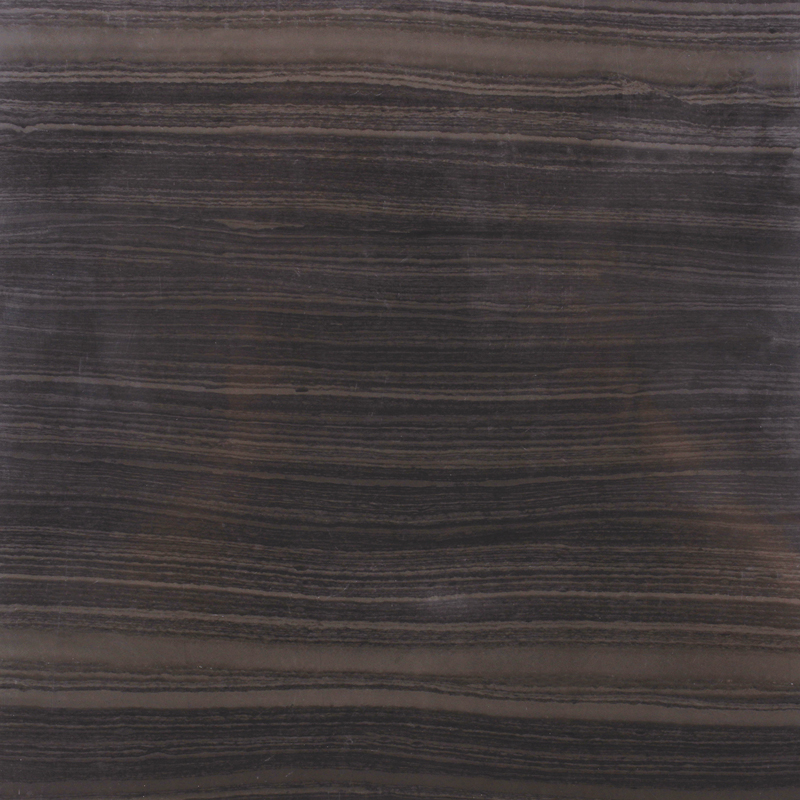
High-end-China-Black-Wood-Marble-For-Floor-And-Countertop
Making the Right Choice for Black Wood Marble Projects
Black Wood Marble offers a distinctive combination of dark color and linear natural patterns, making it an appealing option for selected luxury residential and commercial interiors. Its wood-like appearance can introduce visual movement into feature walls, decorative flooring, wall cladding, and other architectural surfaces.
However, a successful project depends on more than visual appeal. Buyers should evaluate actual slab variation, finish suitability, physical test results, fabrication requirements, installation conditions, and long-term maintenance expectations.
For importers, distributors, architects, and contractors, a structured purchasing process helps reduce uncertainty. Reviewing real slab photographs, confirming technical specifications, comparing equivalent quotations, and agreeing on inspection standards before shipment can support more reliable project outcomes.
When natural appearance and technical requirements are evaluated together, Black Wood Marble can become a considered material choice for interiors that require a distinctive dark stone aesthetic.
Frequently Asked Questions About Black Wood Marble
1. What Is Black Wood Marble Used For?
Black Wood Marble is commonly considered for decorative interior applications such as feature walls, wall cladding, selected flooring, vanity surfaces, and architectural details. Its dark background and elongated wood-like patterns can create a strong visual effect in contemporary and luxury interiors. The suitability of the stone for a particular application depends on the specific material’s test results, finish, installation method, and expected service conditions.
2. Is Black Wood Marble Suitable for Flooring?
Black Wood Marble may be suitable for selected interior flooring projects when its physical properties and surface finish meet the project requirements. Buyers should evaluate abrasion resistance, slip resistance, water absorption, slab thickness, and expected foot traffic. For wet areas or public spaces, the relevant slip-resistance requirements should be reviewed before specifying the material. A polished surface should not automatically be assumed to provide suitable traction in every environment.
3. What Finishes Are Available for Black Wood Marble?
Common natural stone surface treatments to discuss with a supplier include polished, honed, and antiqued or textured finishes. Polished marble has a reflective appearance that can emphasize dark color and linear patterns. Honed marble provides a softer, lower-sheen look, while textured treatments create a more tactile surface. Actual availability depends on the stone’s characteristics and the processing capabilities of the supplier.
4. Is Black Wood Marble Suitable for Kitchen Countertops?
Black Wood Marble can be considered for selected kitchen countertop projects when the owner understands the maintenance requirements of natural marble. Marble may be sensitive to acidic substances, including lemon juice, vinegar, and certain cleaning products. These substances can cause etching or surface changes. Buyers should discuss sealing, cleaning procedures, edge fabrication, support requirements, and expected usage before choosing the material for a kitchen.
5. How Should Buyers Select a Reliable Black Wood Marble Supplier?
Buyers should evaluate a supplier’s material knowledge, actual slab availability, technical documentation, processing capability, inspection procedures, packaging standards, and export experience. Requesting full-slab photographs and reviewing the material before production can help reduce differences between the approved sample and delivered goods. For commercial projects, specifications covering dimensions, thickness, finish, acceptable variation, inspection criteria, and shipping terms should be confirmed in writing.
References
- European Committee for Standardization (CEN). EN 1936: Natural Stone Test Methods – Determination of Real Density and Apparent Density, and of Total and Open Porosity.
- European Committee for Standardization (CEN). EN 13755: Natural Stone Test Methods – Determination of Water Absorption at Atmospheric Pressure.
- European Committee for Standardization (CEN). EN 1926: Natural Stone Test Methods – Determination of Uniaxial Compressive Strength.
- European Committee for Standardization (CEN). EN 12372: Natural Stone Test Methods – Determination of Flexural Strength Under Concentrated Load.
- European Committee for Standardization (CEN). EN 12371: Natural Stone Test Methods – Determination of Frost Resistance.
- European Committee for Standardization (CEN). EN 14157: Natural Stone Test Methods – Determination of Abrasion Resistance.
- European Committee for Standardization (CEN). EN 14231: Natural Stone Test Methods – Determination of Slip Resistance by Means of the Pendulum Tester.
- ASTM International. ASTM C97/C97M, ASTM C170/C170M, and ASTM C880/C880M: Standard Test Methods for Physical and Mechanical Properties of Dimension Stone.
Black Wood Marble: Material Insights, Design Applications, and Buying Considerations
How Should Black Wood Marble Be Selected for Architectural Projects?
Selecting Black Wood Marble should begin with the intended application, project environment, and desired visual effect. For interior feature walls, designers may prioritize natural vein direction, background consistency, and slab matching. For flooring, abrasion resistance, slip performance, surface finish, and expected foot traffic require closer evaluation. For countertops and bathroom vanities, water exposure, stain prevention, and maintenance requirements should also be considered. A successful specification combines actual slab inspection with relevant technical documentation rather than relying on appearance alone.
Why Is Black Wood Marble Different from Conventional Black Marble?
The distinctive feature of Black Wood Marble is its naturally occurring wood-like veining across a dark background. Unlike black marble with predominantly white contrasting veins or black granite with a granular mineral appearance, its linear pattern creates a visual connection with natural timber while retaining the depth and character of stone. This makes it an interesting option for contemporary luxury interiors, decorative wall panels, reception areas, and selected flooring applications. Natural variation between slabs also means that every installation can have its own visual composition.
What Are the Main Advantages and Limitations of Black Wood Marble?
The main design value of Black Wood Marble comes from its distinctive natural pattern, dark color palette, and flexibility across different interior design directions. It can coordinate with wood furniture, metal details, neutral materials, and modern lighting systems. However, as a natural marble, it requires appropriate surface care and application-specific evaluation. Acidic substances may cause etching, while moisture exposure, abrasion, and slip resistance should be assessed according to the intended use. Its suitability for exterior or demanding commercial environments must be verified through relevant test reports and professional project assessment.
Which Black Wood Marble Slab and Finish Options Should Buyers Consider?
Buyers can evaluate full slabs, tiles, and customized cut-to-size products according to project dimensions and fabrication requirements. Full slabs offer greater flexibility for large feature walls, bookmatching, and custom countertop production, while cut-to-size formats can simplify installation planning when accurate drawings are available. A polished finish emphasizes the depth of the dark background and creates a reflective appearance. A honed finish offers a softer matte effect, while antiqued or brushed finishes provide additional surface texture. The final choice should be based on actual samples, processing feasibility, maintenance expectations, and the design concept.
What Should Buyers Consider Before Purchasing Black Wood Marble Wholesale?
Wholesale buyers, importers, contractors, and stone fabricators should evaluate more than the quoted price per square meter. Important purchasing factors include block and slab selection, natural color variation, visible fissures, thickness tolerance, surface finish, processing quality, packing standards, and transportation arrangements. For large projects, actual slab photographs and numbered slab layouts can help reduce the risk of unexpected pattern differences. Buyers should also confirm minimum order quantities, available inventory, production schedules, inspection procedures, and destination-market requirements before confirming an order.
How Do Quality Standards and Material Documentation Support Better Decisions?
Relevant natural stone testing methods provide a technical basis for evaluating density, water absorption, compressive strength, flexural strength, abrasion resistance, and other project-related properties. Standards such as EN 1936, EN 13755, EN 1926, EN 12372, and applicable ASTM methods can help establish consistent testing procedures. However, the existence of a standard does not mean that a particular Black Wood Marble batch has automatically passed every test. Buyers should request representative reports and confirm that the tested material, finish, and intended application correspond to the project specification.
What Is the Future Direction of Natural Marble in Luxury Interior Design?
The natural stone market is increasingly influenced by material traceability, digital slab selection, project-specific fabrication, and more transparent quality documentation. Architects and buyers are paying closer attention to how natural patterns interact with lighting, furniture, architectural proportions, and other materials. Distinctive stones such as Black Wood Marble can contribute to this direction by offering natural visual variation rather than a completely uniform decorative surface. At the same time, responsible specification requires realistic maintenance planning, technical verification, and careful coordination between suppliers, designers, fabricators, and installers.
Final Consideration: Matching Natural Beauty with Project Performance
Black Wood Marble should be evaluated as both a decorative natural material and a project-specific building product. Its wood-like veining can create a strong visual identity in luxury residential interiors, hospitality environments, and selected commercial spaces. However, the right purchasing decision depends on matching the actual slab characteristics, finish, dimensions, technical evidence, and maintenance requirements with the intended application. By combining visual approval, documented quality control, and clear supplier communication, buyers can make more informed decisions and achieve a better balance between design expectations and long-term performance.