In luxury hospitality and commercial architecture, material selection is not simply a matter of choosing an attractive surface. Designers and project developers must consider visual identity, durability, maintenance requirements, installation complexity, material consistency, and long-term operating costs. A material that looks impressive in a showroom may perform differently when installed across a hotel lobby, a busy corridor, or a commercial bathroom.
Wooden Grey Marble offers an interesting solution for projects that require the natural character of stone combined with a contemporary architectural appearance. Its grey tones and elongated, wood-grain-like patterns can introduce movement and texture without relying on strong colors or overly decorative materials. This makes it particularly useful in interiors where designers want to create a calm, refined, and cohesive atmosphere.
For hotel owners, architects, interior designers, contractors, and stone procurement teams, the key question is not simply whether Wooden Grey Marble looks luxurious. The more important question is how to specify, process, and install it correctly so that its appearance supports the overall design while meeting practical project requirements.
This guide explains how to use Wooden Grey Marble in luxury hotel and commercial interior projects, including application planning, slab selection, finish comparison, technical evaluation, installation coordination, maintenance, and supplier communication.
Wooden Grey Marble
1. Understanding the Design Characteristics of Wooden Grey Marble
Grey Tones and Natural Wood-Like Veining
Wooden Grey Marble is recognized for its grey-toned appearance and naturally occurring linear patterns. Depending on the specific block and slab, its visual character may include flowing veins, layered lines, subtle tonal transitions, and patterns that resemble the grain of natural wood.
Unlike conventional wood materials, however, this marble provides the mineral character and surface depth of natural stone. The result is a design language that can combine the warmth of linear patterns with the restrained elegance of a grey stone palette.
Its appearance can be particularly effective in contemporary hospitality environments because grey is relatively easy to coordinate with other architectural materials. It can work alongside warm timber, brushed metal, glass, leather, neutral fabrics, and architectural lighting.
Why Its Visual Character Works in Commercial Interiors
Commercial interiors often require materials that establish a recognizable identity without making the space feel visually crowded. Wooden Grey Marble can help achieve this balance through several design characteristics:
- Linear visual movement: Its elongated veining can reinforce horizontal or vertical architectural lines.
- Neutral color coordination: Grey tones can complement a wide range of interior palettes.
- Natural variation: Each slab has its own pattern, giving the completed project a distinctive appearance.
- Surface versatility: Different finishes can create different levels of reflection, texture, and visual depth.
- Large-format design potential: Carefully selected slabs can create visually continuous surfaces across feature walls and architectural elements.
Natural Variation Should Be Part of the Design Plan
One important characteristic of natural marble is that it does not behave like a printed or manufactured decorative surface. Veining, background color, mineral inclusions, and pattern direction can vary from block to block and even between slabs from the same production batch.
For a small decorative feature, this variation may be relatively easy to manage. For a hotel lobby or a large commercial floor, however, slab variation can significantly influence the final appearance.
Designers should therefore evaluate several slabs together rather than approving a single sample as the complete representation of the material. Where visual continuity is important, the supplier and fabricator should prepare a slab layout before cutting begins.
2. Where to Use Wooden Grey Marble in Luxury Hotels
Hotels provide several opportunities for natural marble applications. Different zones have different traffic levels, moisture conditions, cleaning requirements, and visual priorities. Wooden Grey Marble should therefore be specified according to the function of each area rather than applied indiscriminately throughout the building.
Hotel Lobby Floors and Entrance Areas
The lobby is often the first major interior space that guests experience. Its flooring must support the hotel’s design identity while accommodating luggage, rolling carts, frequent pedestrian movement, cleaning equipment, and occasional moisture brought in from outside.
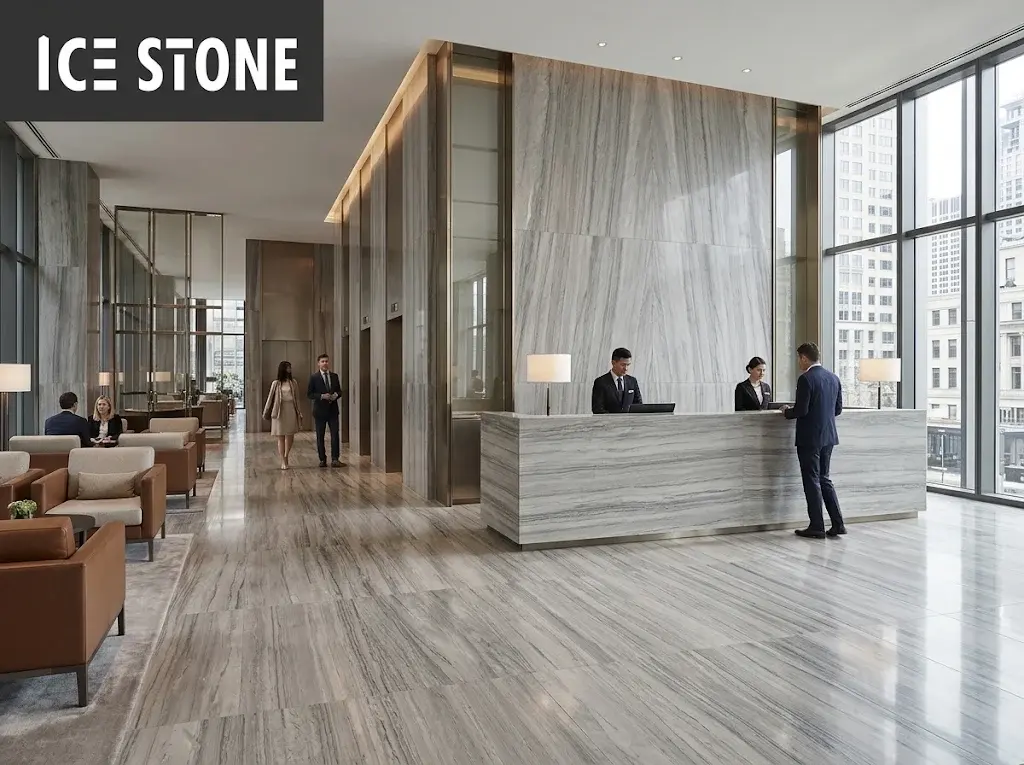
Wooden Grey Marble can be considered for lobby flooring where the design calls for a natural linear pattern and a sophisticated grey palette. Large-format pieces can help reduce the visual interruption created by excessive grout joints.
However, flooring specifications should account for more than appearance. The design team should evaluate:
- Expected pedestrian traffic and wheeled luggage movement.
- Slip resistance under the expected wet and dry conditions.
- Surface finish and its suitability for the cleaning program.
- Stone thickness, substrate condition, and installation system.
- Access to replacement material for future repairs.
- Pattern direction and alignment across the entrance and reception areas.
Polished marble can create a reflective and elegant appearance, but a highly polished surface may become slippery when wet. Entrance flooring should therefore be evaluated using project-specific slip-resistance testing and applicable local building requirements. A visually attractive finish should never replace a proper safety assessment.
Reception Desks and Front Desk Feature Panels
The reception desk is one of the most recognizable elements in a hotel lobby. It often combines functional counter space with a decorative architectural feature.
Wooden Grey Marble can be used for front desk cladding, vertical feature panels, counter surrounds, and selected countertop elements. Its linear veining may be arranged horizontally or vertically to reinforce the desk’s overall geometry.
For example, a hotel with a minimalist interior could use a grey marble front desk with warm timber panels and indirect lighting. The stone would provide visual depth, while the wood and lighting would soften the overall atmosphere.
When designing a reception counter, the fabrication team should consider edge profiles, joint positions, corner details, support structures, and the location of electrical or service access points. Large stone components must be properly supported, and the installation system should be reviewed by qualified project professionals.
Guestroom Bathrooms and Vanity Areas
Bathrooms are another potential application for Wooden Grey Marble. Grey stone surfaces can create a calm, spa-inspired atmosphere when combined with glass shower enclosures, warm lighting, metal fixtures, and neutral bathroom furniture.
Possible applications include:
- Vanity wall cladding.
- Bathroom feature walls.
- Vanity countertops.
- Decorative shelves and ledges.
- Selected floor areas with an appropriately tested finish.
- Shower walls where the waterproofing and installation systems are correctly designed.
Bathroom applications require careful attention to water management. Marble is a natural material and should not be treated as inherently waterproof. Waterproof membranes, drainage slopes, compatible adhesives, grout selection, and movement joints are essential parts of the complete installation system.
Because marble is generally calcium-carbonate-rich, acidic substances and some aggressive cleaning products can etch its surface. Toiletries, cosmetics, and cleaning chemicals should be considered when designing bathroom maintenance procedures.
Elevator Lobbies and Guest Corridors
Elevator lobbies and corridors are useful locations for creating visual consistency between public areas and guestroom floors. Wooden Grey Marble can be introduced as wall panels, decorative borders, elevator surrounds, or selected flooring elements.
For these areas, designers should pay particular attention to pattern direction. Vertical veining can make elevator surrounds appear taller, while horizontal arrangements can visually extend corridor walls.
Repeated patterns across multiple floors should be coordinated through a slab selection and cutting schedule. This is especially important when the project uses the same stone in several locations but requires a consistent overall design language.
Hotel Restaurants, Bars, and Lounge Areas
Restaurants and lounges often use natural materials to communicate a sense of quality and atmosphere. Wooden Grey Marble may be suitable for decorative bar fronts, feature walls, selected table surfaces, and architectural accents.
Food and beverage environments require additional maintenance planning. Wine, citrus juice, vinegar, coffee, and other acidic or staining substances may damage or mark marble surfaces if spills are not managed correctly.
For heavily used food preparation surfaces, the design team should evaluate whether natural marble is appropriate for the actual operational conditions. A decorative bar front may be a more practical use than a high-exposure food preparation countertop.
3. Commercial Applications Beyond Hotels
Although luxury hotels are an important market for decorative marble, Wooden Grey Marble can also be considered for other commercial interiors. The selection process should remain application-specific because different buildings have different operational requirements.
Corporate Offices and Executive Reception Areas
Corporate reception areas often need to communicate professionalism, stability, and attention to detail. Grey marble can support these objectives without introducing an overly decorative visual effect.
Possible applications include reception walls, meeting-room feature panels, executive office accents, and selected lobby flooring. In a corporate environment, combining the stone with glass partitions, metal details, and warm lighting can create a balanced contemporary interior.
Retail Stores and Luxury Showrooms
Luxury retail environments frequently use natural stone to create a distinctive setting for products. Wooden Grey Marble can be considered for display backgrounds, feature walls, decorative counters, and selected floor areas.
Its linear pattern may also help direct attention toward display zones. For example, a carefully arranged stone wall behind a product display can create a visual focal point without competing with the merchandise.
Retail projects should consider cleaning frequency, display equipment loads, potential impact damage, and the possibility of future layout changes.
Commercial Reception Desks and Shared Spaces
Business centers, private clubs, serviced apartments, and premium residential developments often include reception areas that require durable and visually distinctive materials.
Wooden Grey Marble may be used for reception counters, wall panels, concierge desks, and decorative architectural details. Its application should be coordinated with the building’s maintenance capabilities and the expected level of daily use.
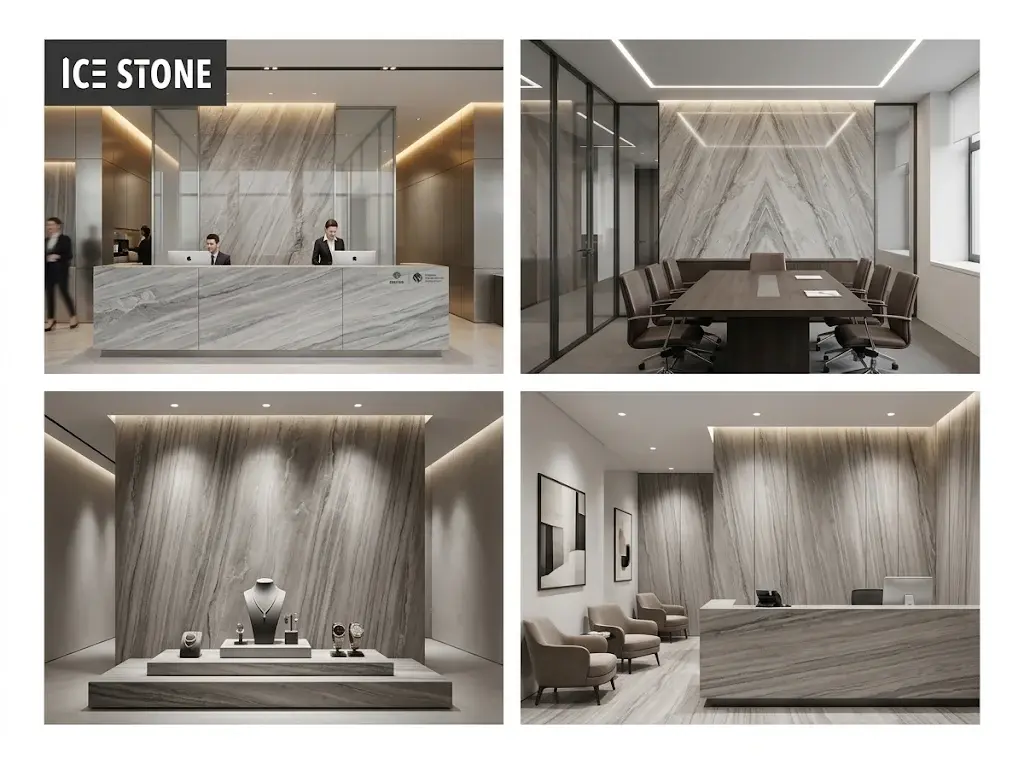
Applications of Wooden Grey Marble
4. Choosing the Right Wooden Grey Marble Finish
Surface finish changes both the appearance and practical performance of natural marble. The same stone can look significantly different depending on whether it is polished, honed, brushed, or treated with another finishing method.
Polished Finish
A polished finish creates a smooth, reflective surface that can emphasize the depth and contrast of natural veining. It is often selected for luxury lobby walls, reception features, decorative counters, and other areas where a refined appearance is a priority.
However, polishing can make surface scratches, etching, and water marks more noticeable under certain lighting conditions. Polished flooring also requires careful slip-resistance evaluation, particularly in entrances and wet areas.
Honed Finish
A honed finish produces a smoother, generally less reflective surface than a polished finish. It can provide a more understated appearance and may be appropriate for contemporary interiors where designers prefer subtle stone textures.
Honed marble is not automatically stain-proof or slip-proof. Its actual performance depends on the stone, surface treatment, maintenance program, and conditions of use.
Brushed or Textured Finish
Brushed and other textured finishes can create a more tactile appearance. They may be considered for selected wall applications, decorative panels, and areas where a softer visual effect is desired.
Textured surfaces may require more attention during cleaning because dirt can collect in surface irregularities. Their suitability for flooring should be evaluated through relevant slip-resistance testing and maintenance trials.
Finish Selection Comparison
| Finish | Visual Appearance | Potential Applications | Main Considerations |
|---|---|---|---|
| Polished | Reflective and smooth | Feature walls, reception areas, decorative counters | Etching visibility, reflections, wet slip resistance |
| Honed | Matte or low-sheen appearance | Contemporary interiors, selected floors, wall panels | Staining, cleaning, surface protection |
| Brushed | Textured and tactile | Decorative walls and selected architectural features | Cleaning access and finish consistency |
| Custom Finish | Project-dependent | Special design features and coordinated interiors | Sample approval and production verification |
The best finish should be selected through physical samples and project-specific testing. A finish that works well on a decorative wall may not be appropriate for a wet commercial floor.
5. Material Specifications and Technical Evaluation
For commercial procurement, appearance is only one part of the material approval process. Architects, contractors, and purchasing teams should request technical information that corresponds to the actual stone being supplied.
Natural marble does not have one universal set of physical properties. Results may vary according to geological formation, mineral composition, block characteristics, processing, and testing conditions. Therefore, project specifications should be based on current test reports for the selected material rather than assumed values copied from unrelated marble products.
Important Technical Parameters
| Parameter | Why It Matters | Recommended Evaluation |
|---|---|---|
| Water Absorption | Helps assess the stone’s response to moisture exposure | Request laboratory testing using ASTM C97/C97M where applicable |
| Bulk Specific Gravity | Provides information relevant to material density and engineering calculations | Review the test report for the actual material batch |
| Flexural Strength | Important for evaluating stone under bending loads | Request ASTM C880/C880M test results where applicable |
| Compressive Strength | Can support assessment of load-related material performance | Use the test method and acceptance criteria specified for the project |
| Abrasion Resistance | Relevant to flooring exposed to repeated pedestrian movement | Request a suitable test and compare results with the intended use |
| Slip Resistance | Supports pedestrian safety evaluation | Test the specified finish under relevant wet and dry conditions |
| Thickness Tolerance | Affects installation levels, joints, and fabrication coordination | Confirm actual production tolerances and inspection requirements |
Technical note: The table identifies evaluation parameters rather than claiming fixed numerical values for Wooden Grey Marble. Buyers should obtain actual laboratory reports for the selected material and confirm that the test methods, sample condition, and acceptance criteria match the project specification.
Understanding Common Testing Standards
ASTM C97/C97M provides test methods for water absorption and bulk specific gravity of dimension stone. These measurements can help procurement teams understand important physical characteristics of the selected material.
ASTM C880/C880M provides a test method for flexural strength of dimension stone. This is relevant when evaluating stone components that may be exposed to bending stresses, although final structural suitability must also account for dimensions, support conditions, installation details, and engineering design.
Test results should not be interpreted in isolation. A stone with acceptable laboratory results may still be unsuitable for a particular installation if the substrate, fixing system, finish, or environmental exposure is not properly designed.
6. Wooden Grey Marble Compared with Other Interior Materials
Commercial projects often compare several materials before approving the final specification. Wooden Grey Marble should be evaluated according to design intent, maintenance requirements, expected traffic, and project budget structure rather than judged only by its appearance.
Wooden Grey Marble vs. Conventional Grey Marble
Conventional grey marble may offer a more cloud-like or irregular visual pattern, depending on the variety. Wooden Grey Marble is generally selected when the designer wants a more linear, wood-grain-inspired appearance.
The choice is therefore often a design decision. A hotel that uses strong horizontal architectural lines may benefit from the elongated visual movement of Wooden Grey Marble, while a project seeking a softer, more clouded stone pattern may prefer another grey marble variety.
Wooden Grey Marble vs. Porcelain Slabs
Porcelain slabs are manufactured products with controlled designs and generally more consistent surface patterns. They may offer advantages in certain high-use or maintenance-sensitive environments, depending on the product specification.
Natural marble, by contrast, provides geological variation and a unique stone identity. It may be preferred where the design brief specifically requires natural material character.
Neither material is automatically superior in every situation. The decision should consider the complete performance specification, installation system, repair strategy, and visual objectives.
Wooden Grey Marble vs. Engineered Surfaces
Engineered surfaces are manufactured using controlled production processes and may offer a more consistent appearance. Their composition and performance vary by product category.
Wooden Grey Marble is a natural stone, so its veining and color variation are part of the material’s identity. Buyers who value natural geological patterns may prefer it, while projects requiring highly repeatable decorative patterns may consider manufactured alternatives.
| Comparison Factor | Wooden Grey Marble | Porcelain Slabs | Engineered Surfaces |
|---|---|---|---|
| Material Type | Natural marble | Manufactured ceramic material | Manufactured composite, depending on category |
| Pattern Variation | Natural and variable | Generally controlled by production | Generally controlled by production |
| Acid Sensitivity | Generally sensitive | Product-dependent; many are resistant to common acids | Product-dependent |
| Visual Character | Distinctive natural veining | Can reproduce stone-like designs | Can provide consistent decorative patterns |
| Maintenance | Requires stone-appropriate care | Depends on surface and joint system | Depends on product composition and finish |
7. Material Fit by Product Direction
Wooden Grey Marble can be processed into different product formats depending on block quality, slab dimensions, thickness, fabrication capability, and project requirements. The following guide illustrates its potential suitability across common commercial product directions.
Legend: ●●● = Primary | ●●○ = Strong Option | ●○○ = Depends on Workflow | — = Usually Not First Choice
This is an application-fit guide based on general material and design considerations, not statistical data or a laboratory performance ranking. Final suitability must be verified for the actual stone batch and installation conditions.
| Product Direction | Application Fit | Project Considerations |
|---|---|---|
| Decorative Marble Slabs | ●●● | Slab selection, veining, color consistency, and thickness |
| Interior Wall Cladding | ●●● | Panel dimensions, fixing system, substrate, and weight |
| Hotel Feature Walls | ●●● | Pattern matching and lighting coordination |
| Interior Flooring | ●●○ | Traffic, finish, slip resistance, abrasion, and maintenance |
| Vanity Countertops | ●●○ | Water exposure, cosmetics, sealing, and cleaning |
| Reception Counters | ●●○ | Support structure, edge profiles, joints, and impact risk |
| Decorative Furniture | ●○○ | Component size, weight, fabrication, and structural support |
| Exterior Cladding | ●○○ | Climate, freeze-thaw exposure, anchoring, and engineering review |
| Heavy-Duty Food Preparation Surfaces | — | Acid exposure, hygiene requirements, staining, and operational demands |
For buyers evaluating different stone formats, reviewing a supplier’s natural marble slabs can help establish the available material direction before moving into detailed fabrication planning.
8. Slab Selection and Vein Matching for Large Projects
Large commercial projects often require multiple slabs to create a coordinated visual result. The challenge is not only finding enough material, but also ensuring that the selected slabs work together as part of one architectural composition.
Review Multiple Slabs Before Approval
One sample cannot fully represent the natural variation of a marble batch. Buyers should request photographs or physical inspection of multiple slabs, ideally with consistent lighting and clear identification of each slab.
For large installations, the approval process should include:
- Reviewing the background color and tonal range.
- Checking vein direction and visual density.
- Identifying natural fissures, veins, and other geological features.
- Confirming slab dimensions and usable cutting areas.
- Assessing whether the slabs can create the required pattern sequence.
- Recording the approved material batch for production control.
Bookmatching and Pattern Continuity
Bookmatching is a layout technique in which adjacent stone slabs are arranged to create mirrored or coordinated patterns. It can be especially effective for feature walls, hotel reception backdrops, and large decorative panels.
However, bookmatching depends on the natural pattern of the selected slabs. It should not be assumed that every slab can produce a visually balanced mirrored composition.
Before fabrication, the supplier and project designer should review slab images and prepare a layout drawing. This reduces the risk of cutting valuable material before the final visual arrangement has been approved.
Control Material Quantity and Cutting Allowance
Procurement teams should calculate the required quantity based on approved shop drawings rather than relying only on the visible finished surface area.
Additional material may be required for cutting losses, edge details, pattern matching, replacement pieces, and future maintenance. The appropriate allowance depends on the project geometry and fabrication plan.
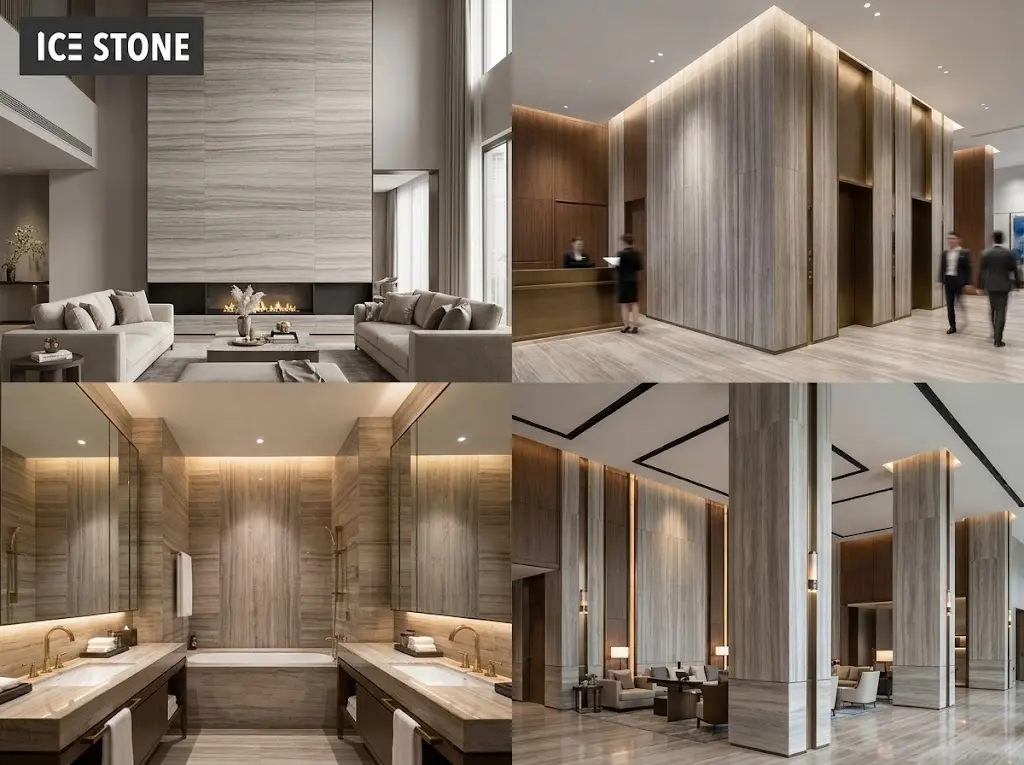
High-quality Wooden Grey Marble
9. Installation Considerations for Commercial Projects
Even high-quality marble can perform poorly when installation details are inadequate. For commercial applications, material selection and installation planning should be treated as one coordinated process.
Substrate Preparation
Before installation, the substrate should be checked for flatness, stability, cleanliness, moisture conditions, and compatibility with the specified adhesive or fixing system.
Large-format stone panels are sensitive to uneven support and improper fixing. The installation team should follow the project engineer’s requirements and the selected system manufacturer’s technical instructions.
Adhesive and Fixing System Selection
Adhesive selection should consider stone characteristics, panel size, installation location, substrate type, environmental conditions, and curing requirements.
Wall cladding may require mechanical anchoring or a designed combination of fixing methods, depending on panel dimensions, height, building conditions, and applicable regulations. Heavy stone panels should never rely on an unverified fixing arrangement.
Joint Design and Movement Accommodation
Stone installations require properly planned joints. Changes in temperature, structural movement, substrate behavior, and moisture conditions can influence the long-term performance of an installation.
Movement joints, perimeter gaps, and appropriate sealant details should be coordinated with the architectural and engineering drawings. Filling every joint rigidly without considering movement can contribute to cracking or other installation problems.
Moisture Management
Bathrooms, spa facilities, and other wet areas require a complete waterproofing strategy. Marble itself should not be treated as a waterproofing layer.
The project team should coordinate waterproof membranes, drainage, slope, adhesive compatibility, grout, and movement joints before installation begins.
10. Maintenance Planning for Hotels and Commercial Buildings
Maintenance is an important part of the lifecycle cost of natural marble. Hotels and commercial properties often operate with frequent cleaning schedules, different cleaning contractors, and multiple teams responsible for public areas.
A suitable maintenance plan should be prepared before the stone is handed over to the building operator.
Use Stone-Compatible Cleaning Products
Marble is generally a calcareous natural stone, meaning that it can react with acidic substances. Acidic cleaners, vinegar-based products, and certain bathroom chemicals can cause surface etching.
Daily cleaning should use products specifically recommended for natural marble. Neutral-pH stone cleaners are commonly used, but the selected product should always be checked for compatibility with the stone finish and any applied treatment.
Clean Spills Promptly
In hotel restaurants, bars, and guest bathrooms, spills may include coffee, wine, citrus juice, cosmetics, oils, and cleaning chemicals. These substances can leave marks or cause surface damage if they remain in contact with the stone.
Staff should be trained to blot spills rather than aggressively rubbing them across the surface. Appropriate cleaning procedures should be documented and communicated to housekeeping teams.
Understand the Role of Sealers
Some marble installations may benefit from an appropriate impregnating sealer, depending on the stone’s absorption characteristics and the intended application.
However, sealing does not make marble completely stain-proof, acid-proof, or maintenance-free. Sealers can reduce the rate at which certain liquids penetrate the stone, but they do not prevent chemical etching caused by acidic substances.
Before applying a sealer across a large project, the contractor should test it on an approved sample and confirm the resulting appearance, drying behavior, and compatibility with the finish.
Establish a Preventive Maintenance Schedule
A hotel maintenance program may include daily dust and debris removal, routine cleaning, periodic inspection, prompt spill treatment, and scheduled professional stone maintenance.
The exact frequency should be determined by actual traffic, finish, exposure, and operating conditions. A busy hotel entrance will generally require a different maintenance schedule from a decorative wall in a low-contact executive lounge.
11. Common Procurement Risks and How to Avoid Them
Commercial stone procurement involves multiple parties, including designers, suppliers, fabricators, logistics providers, contractors, and project managers. Miscommunication between these parties can create delays, material waste, and visual inconsistencies.
Risk 1: Approving a Small Sample Without Reviewing the Full Batch
A small sample may show the general color and pattern but cannot represent every slab in a large order. This can lead to unexpected differences after delivery.
Recommended approach: Request a complete slab review, record approved slab references, and confirm the batch before production.
Risk 2: Selecting Material Based Only on Appearance
A stone that looks attractive may not meet the requirements of a wet floor, heavily used reception counter, or exterior wall system.
Recommended approach: Evaluate laboratory data, finish performance, maintenance requirements, installation conditions, and applicable building standards.
Risk 3: Ignoring Fabrication Requirements
Complex patterns, narrow components, cutouts, and unusual edge profiles can increase fabrication difficulty. If these requirements are not considered early, the project may encounter additional cutting losses or schedule changes.
Recommended approach: Share shop drawings and dimensional requirements with the supplier before finalizing the material order.
Risk 4: Inadequate Replacement Material Planning
Commercial buildings may require repairs long after the original installation. If no matching material remains available, replacement pieces may have visible differences.
Recommended approach: Where practical, retain clearly identified spare material from the approved production batch and record the stone’s finish and installation details.
Risk 5: Unclear Responsibility for Quality Inspection
Stone projects can involve separate teams for quarry selection, slab processing, fabrication, packing, and installation. If inspection responsibilities are unclear, defects may not be identified until the material reaches the construction site.
Recommended approach: Define inspection stages, acceptable tolerances, photographic records, packaging standards, and approval responsibilities in the procurement documentation.
12. How to Evaluate a Wooden Grey Marble Supplier
For hotel and commercial projects, supplier evaluation should cover more than product availability. Buyers need a partner who can communicate material characteristics, coordinate slab selection, support documentation, and respond to project-specific requirements.
Review Product Knowledge and Material Experience
A capable marble supplier should be able to explain the material’s natural variation, available finishes, slab dimensions, processing options, and relevant technical documentation.
Buyers should also understand the company’s background, product categories, and experience serving different stone markets. Reviewing the supplier’s marble supplier company profile is a useful starting point when evaluating its business scope and product experience.
Confirm Product Availability and Production Coordination
For large projects, buyers should confirm whether the required quantity can be supplied from a visually coordinated batch. They should also discuss production lead times, inspection arrangements, packaging, and shipping schedules.
When a project includes multiple applications, such as lobby flooring, feature walls, and reception counters, the supplier should understand how the different components relate to one another.
Request Project-Relevant Documentation
Useful documents may include:
- Material photographs and slab identification records.
- Available technical test reports.
- Thickness and dimensional information.
- Surface finish specifications.
- Inspection and quality-control records.
- Packing and shipping information.
- Maintenance recommendations.
Discuss Project Requirements Before Ordering
Before placing an order, buyers should communicate the project location, intended application, required dimensions, surface finish, quantity, delivery schedule, and technical requirements.
This is particularly important when the project requires coordinated slabs, special cutting, bookmatching, or several different finished components.
13. A Practical Procurement Checklist for Wooden Grey Marble Projects
The following checklist can help architects, contractors, and purchasing teams organize the material approval process.
| Stage | Items to Confirm | Expected Output |
|---|---|---|
| Design Planning | Application areas, dimensions, color palette, pattern direction | Material design brief |
| Sample Approval | Color, veins, finish, surface appearance | Approved physical sample |
| Technical Review | Absorption, strength, thickness, slip resistance where relevant | Technical approval record |
| Slab Selection | Batch consistency, slab dimensions, vein matching | Approved slab layout |
| Fabrication | Cutting drawings, edge details, tolerances, inspection | Fabrication approval |
| Delivery | Packing, labeling, transport, receiving inspection | Delivery inspection record |
| Installation | Substrate, fixing, joints, waterproofing, protection | Installation quality record |
| Handover | Cleaning instructions, spare material, maintenance plan | Stone maintenance documentation |
14. Health, Safety, and Sustainability Considerations
Silica Dust Control During Fabrication and Installation
Natural stone fabrication and construction activities can generate respirable dust. Depending on the stone’s mineral composition and the specific task, workers may be exposed to respirable crystalline silica.
In the United States, OSHA’s construction silica standard, 29 CFR 1926.1153, establishes an action level of 25 micrograms per cubic meter and a permissible exposure limit of 50 micrograms per cubic meter, both calculated as eight-hour time-weighted averages.
Employers should assess the work activities and apply appropriate exposure controls. These may include wet cutting, local exhaust ventilation, suitable dust collection, HEPA-filtered vacuuming, exposure-control planning, worker training, and respiratory protection where required.
Dry sweeping and uncontrolled compressed-air cleaning can create additional dust exposure and should be avoided where prohibited or where safer methods are available. These precautions relate to fabrication and construction activities rather than normal occupancy of a properly completed stone interior.
Responsible Material Procurement
Commercial buyers are increasingly expected to consider material sourcing, transportation, durability, maintenance, and environmental documentation.
Natural stone procurement can be supported by requesting relevant supplier documentation and understanding the production and transportation process. Where sustainability certification or environmental declarations are required, buyers should verify the actual scope and validity of the documentation rather than assuming that every marble product carries the same certification.
Long-term material planning also matters. A properly designed and maintained stone installation may remain part of a building for many years, but its environmental and economic value depends on responsible extraction, processing, installation, maintenance, and eventual replacement decisions.
15. Design Inspiration and Project Planning Ideas
Wooden Grey Marble can be used in different ways depending on the architectural concept. The following approaches illustrate how designers can adapt the material to different commercial settings.
Concept A: Contemporary Luxury Hotel Lobby
Use large-format Wooden Grey Marble panels as a reception backdrop, combined with warm timber, brushed metal, and indirect lighting. A restrained palette can allow the natural stone pattern to become the main visual feature.
The flooring can use a coordinated but appropriately tested finish, with entrance zones designed to manage water and pedestrian safety.
Concept B: Minimalist Executive Office
Use the marble selectively on the reception wall, meeting-room feature panels, or executive lounge. Combine it with clear glass, dark metal details, and neutral furniture to create a professional atmosphere.
Keeping the stone application focused can prevent the space from becoming visually heavy while still giving it a distinctive natural material identity.
Concept C: Premium Retail Environment
Use Wooden Grey Marble as a display wall or decorative counter surround. The linear pattern can create a subtle architectural background that supports product presentation.
For areas exposed to frequent handling, specify a finish and maintenance process that match the retail operation.
Concept D: Spa-Inspired Guest Bathroom
Combine grey marble wall panels with warm lighting, neutral cabinetry, and carefully selected metal fixtures. Use a compatible waterproofing system behind the stone and choose cleaning products suitable for natural marble.
For shower floors and other wet walking surfaces, evaluate slip resistance separately instead of assuming that a particular finish is automatically safe.
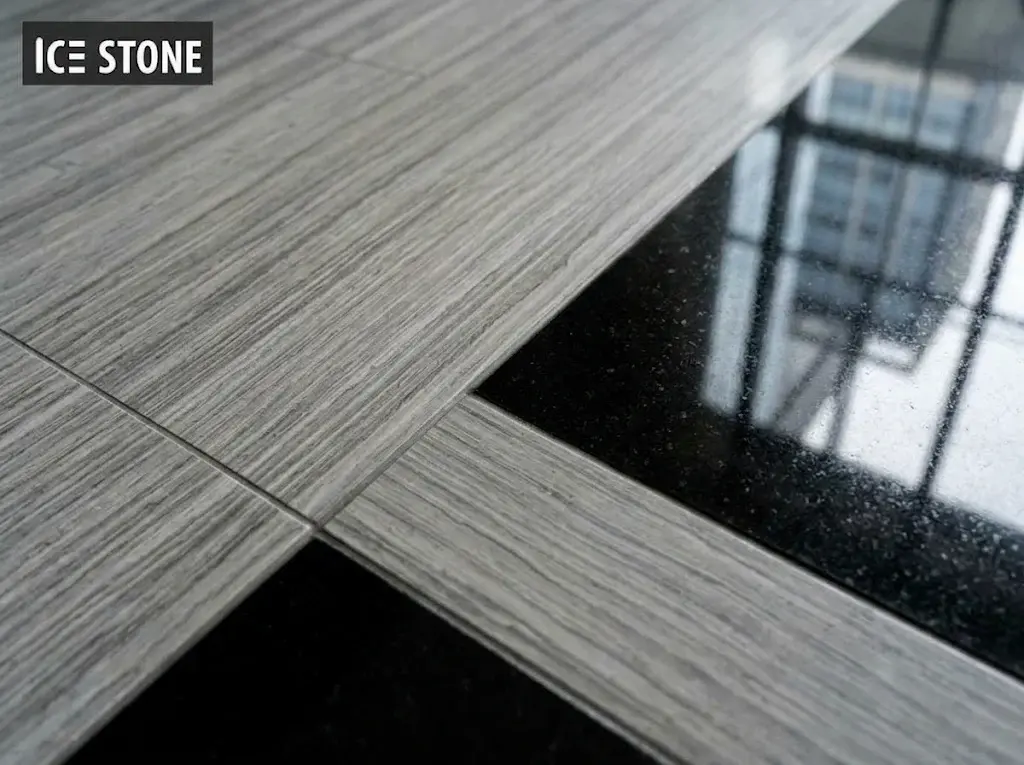
Wooden Grey Marble Supplier
16. Making Wooden Grey Marble a Successful Project Material
Wooden Grey Marble can contribute a distinctive natural appearance to luxury hotels, commercial offices, retail spaces, and premium public interiors. Its grey palette and linear veining provide designers with an alternative to more conventional stone patterns, particularly when the project requires a calm but recognizable architectural feature.
However, a successful installation depends on more than the visual appeal of the slabs. Buyers should evaluate the intended application, surface finish, physical test results, slab consistency, fabrication requirements, installation system, maintenance program, and supplier coordination before confirming the final specification.
For project teams considering this material, reviewing Wooden Grey Marble for commercial projects can provide a more focused starting point for assessing its product characteristics and potential applications.
It is also useful to study practical Wooden Grey Marble flooring and wall cladding ideas when developing a coordinated design concept for hotel and commercial interiors.
Ultimately, the best results come from aligning design intent with material performance and installation planning. When the selected slabs, finishes, fabrication details, and maintenance procedures are properly coordinated, Wooden Grey Marble can become a meaningful part of a long-term commercial interior design strategy.
17. Frequently Asked Questions About Wooden Grey Marble
1. What is Wooden Grey Marble commonly used for in luxury hotel projects?
Wooden Grey Marble is commonly considered for hotel lobby feature walls, reception desk cladding, elevator surrounds, decorative flooring, bathroom wall panels, vanity areas, and selected restaurant or lounge features. Its grey background and linear veining can complement contemporary hospitality interiors. The most suitable application depends on the stone’s actual characteristics, finish, technical test results, traffic conditions, and maintenance requirements.
2. Is Wooden Grey Marble suitable for commercial flooring?
Wooden Grey Marble can be considered for selected commercial flooring applications, but suitability should be confirmed through project-specific evaluation. Buyers should review abrasion resistance, finish, thickness, substrate conditions, pedestrian traffic, cleaning procedures, and slip resistance under relevant wet and dry conditions. A polished finish should not automatically be assumed suitable for every entrance or wet-floor environment.
3. What finish is best for Wooden Grey Marble in hotel interiors?
The best finish depends on the location and design objective. Polished finishes provide a reflective appearance and can emphasize natural veining, making them useful for decorative walls and selected reception features. Honed finishes offer a lower-sheen appearance for more understated interiors. Brushed or textured finishes can introduce tactile interest. Flooring and wet-area finishes should be evaluated through suitable slip-resistance and maintenance testing before approval.
4. Does Wooden Grey Marble require sealing and special maintenance?
Maintenance requirements depend on the stone’s absorption characteristics, finish, location, and exposure. An appropriate sealer may reduce the penetration of certain liquids, but it does not make marble completely stain-proof or acid-proof. Daily care should use products suitable for natural marble, and acidic cleaners should be avoided. Hotel operators should establish cleaning instructions and train maintenance teams to respond promptly to spills.
5. What should buyers check before purchasing Wooden Grey Marble for a large commercial project?
Buyers should review multiple slabs, confirm color and vein consistency, approve the finish, check slab dimensions and thickness, request relevant technical test reports, and coordinate fabrication drawings. They should also confirm production capacity, quality inspection procedures, packaging, delivery schedules, installation requirements, and spare-material planning. A clearly documented approval process helps reduce visual inconsistencies and procurement risks during large commercial projects.
References and Technical Resources
- Care & Cleaning of Natural Stone
Author: Natural Stone Institute
Institution: Natural Stone Institute
Source: Technical guidance on natural stone cleaning, maintenance, and care. - Dimension Stone Design Manual
Author: Natural Stone Institute
Institution: Natural Stone Institute
Source: Technical reference for dimension stone selection, design, and installation. - ASTM C97/C97M – Standard Test Methods for Absorption and Bulk Specific Gravity of Dimension Stone
Author: ASTM International
Institution: ASTM International
Source: Standard test methods for absorption and bulk specific gravity of dimension stone. - ASTM C880/C880M – Standard Test Method for Flexural Strength of Dimension Stone
Author: ASTM International
Institution: ASTM International
Source: Standard test method for evaluating the flexural strength of dimension stone. - Respirable Crystalline Silica – Construction
Author: Occupational Safety and Health Administration
Institution: U.S. Department of Labor
Source: Construction industry guidance on respirable crystalline silica exposure and control measures. - 29 CFR 1926.1153 – Respirable Crystalline Silica
Author: Occupational Safety and Health Administration
Institution: U.S. Department of Labor
Source: U.S. construction standard establishing exposure limits and control requirements for respirable crystalline silica. - ANSI/NSC 373 – Sustainable Production of Natural Dimension Stone
Author: Natural Stone Council and participating standards organizations
Institution: Natural Stone Council / ANSI framework
Source: Sustainability framework for evaluating natural dimension stone production. - Natural Stone: A Guide to Selection and Use
Author: Natural Stone Institute
Institution: Natural Stone Institute
Source: Industry educational resource covering natural stone characteristics, selection, and application considerations.
Discuss Your Wooden Grey Marble Project Requirements
Every commercial stone project has its own design priorities, technical requirements, and delivery schedule. Whether you are specifying marble for a hotel lobby, reception counter, feature wall, bathroom, or retail interior, early communication can help clarify material selection and production details.
Prepare your project drawings, estimated quantity, preferred finish, application areas, and delivery location before requesting a quotation or technical discussion. This information helps the supplier evaluate the requirements more accurately and recommend an appropriate material and production approach.
For project-specific material selection, slab coordination, and procurement discussions, you can contact the marble project team to discuss your requirements.