Quick Guide to Panda White Marble Staircase Designs
Quick Summary:Panda White Marble brings dramatic black veining and a bright background to luxury residential staircases, from floating steps and curved entrances to bookmatched feature walls and illuminated designs. Choosing the right Panda White Marble staircase designs requires more than visual appeal: buyers and project teams should evaluate verified stone properties, stair tread dimensions, surface finish, slip resistance, structural support, fabrication tolerances, and installation requirements. For villas and high-end residential developments, early coordination between designers, engineers, stone fabricators, and installers helps protect both design intent and long-term performance.
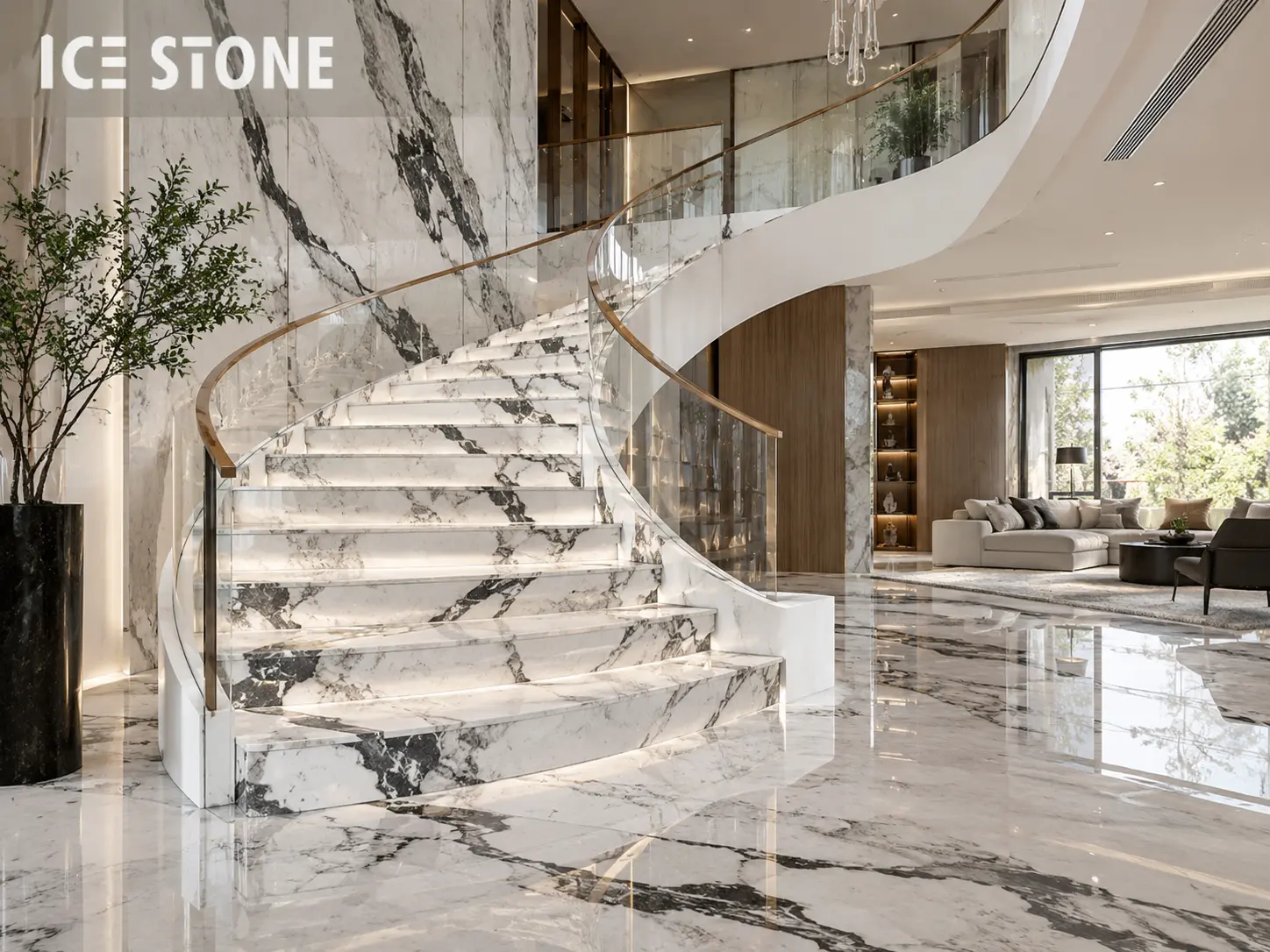
A staircase can become one of the most memorable architectural features in a luxury home. Beyond connecting floors, it shapes the first impression of an entrance hall, establishes visual continuity between living spaces, and creates an opportunity to display the natural character of premium stone. Panda White Marble, recognized for its bright background and expressive black veining, is an attractive option for residential projects that require a distinctive material with a strong visual identity.
From floating marble steps and sweeping curved staircases to bookmatched feature walls and custom-cut treads, the material can support a range of contemporary and transitional interiors. However, successful Panda White Marble staircase designs depend on more than appearance. Designers and buyers must also consider stone selection, tread geometry, finish performance, structural support, fabrication tolerances, maintenance, and applicable building regulations. This guide explores ten design directions and explains how to turn a compelling concept into a well-coordinated residential project.
panda white marble staircase luxury residential design
Why Panda White Marble Works in Luxury Staircase Design
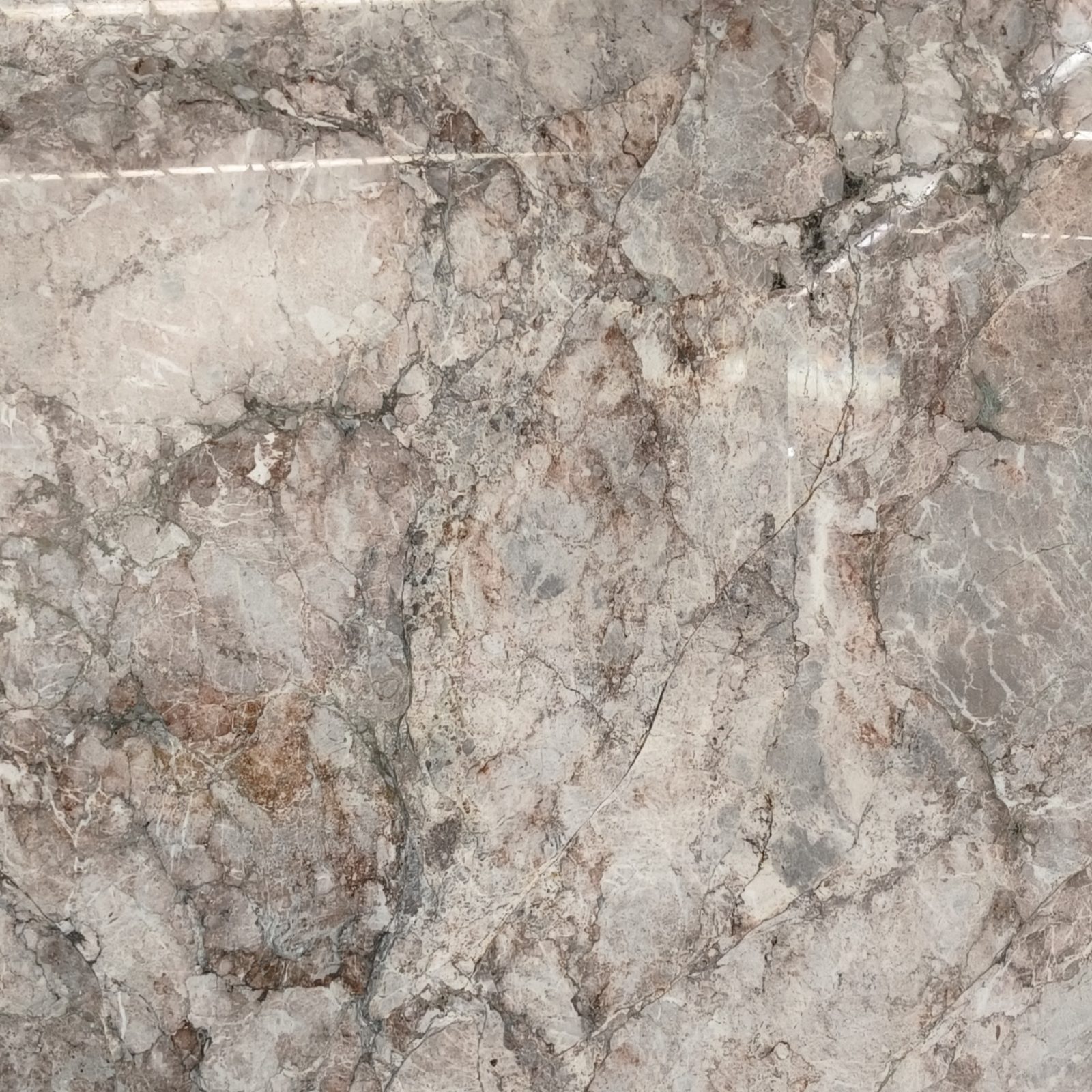
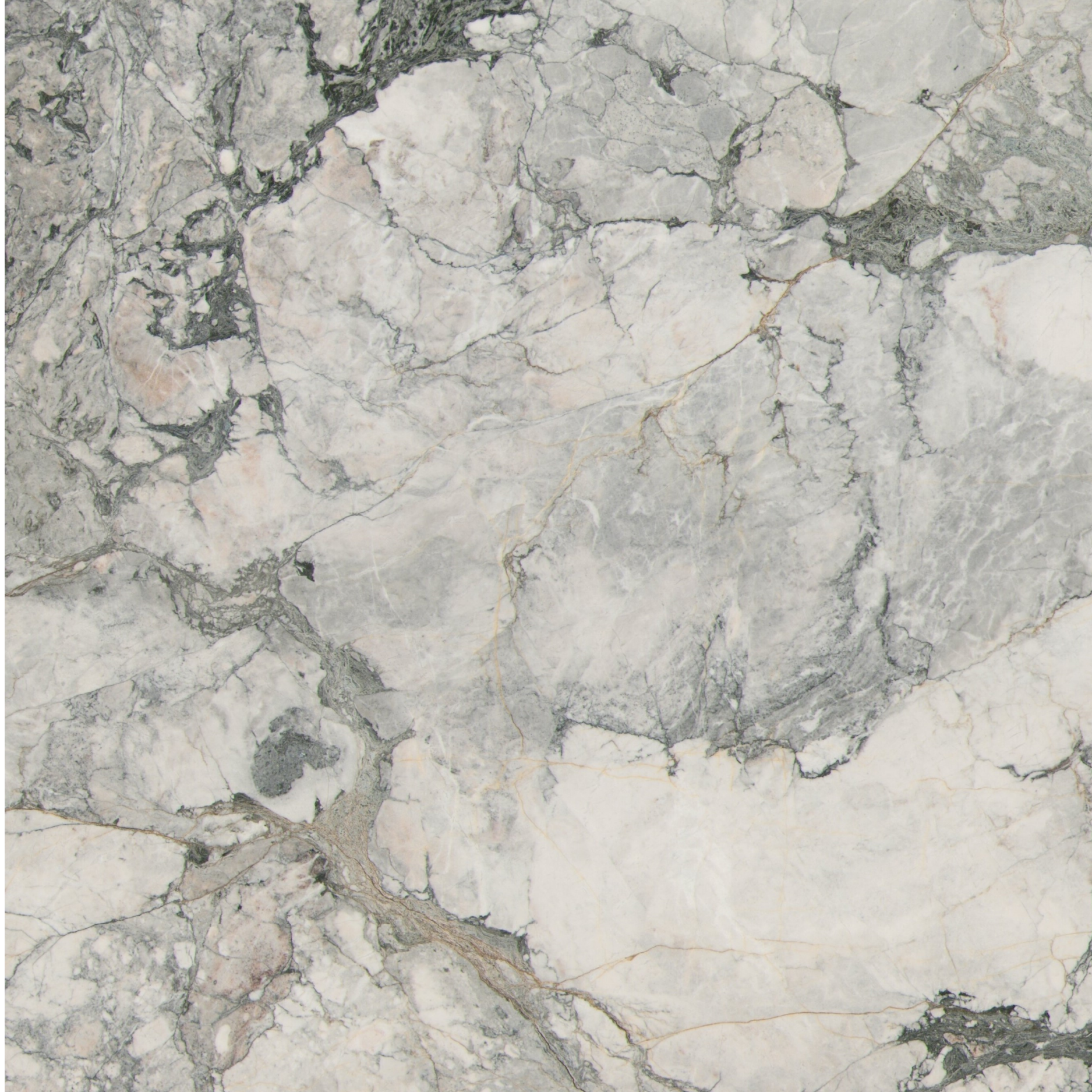
The appeal of Panda White Marble lies in the contrast between its light background and dark, flowing veins. Depending on the selected slab, the pattern may appear as broad black bands, delicate linear markings, or irregular ink-like movements. This visual variation makes each installation individual rather than mechanically uniform.
In a double-height foyer, a dramatic vein pattern can create a strong focal point. In a minimalist villa, a restrained staircase with simple edges allows the stone to provide most of the visual interest. In a residence with timber flooring, bronze hardware, or clear glass balustrades, the monochromatic stone can connect different materials without competing with every decorative element.
Because natural stone varies from block to block, project teams should review actual slabs before approving a large order. Digital photographs are useful for initial selection, but full-slab images, representative samples, and a documented selection process are more reliable for high-visibility work. Buyers comparing different Panda White Marble slabs should evaluate background tone, vein direction, natural fissures, repairs, and consistency across the proposed batch.
For a clearer understanding of the supplier’s background, product scope, and business capabilities, buyers can review the company’s natural stone company profile before discussing project requirements. Supplier evaluation should include relevant product experience, communication, documentation, processing capability, and the ability to coordinate material selection with fabrication and delivery schedules.
Top 10 Panda White Marble Staircase Designs for Luxury Residential Projects
1. Floating Straight Staircase with Minimalist Detailing
A floating staircase creates the impression that individual treads extend from the wall without visible support. When paired with Panda White Marble, the effect combines a strong stone pattern with a light, architectural silhouette. This design is particularly suitable for contemporary villas, open-plan living rooms, and entrance spaces with generous natural light.
For the cleanest result, designers often coordinate the tread edges, wall finish, and concealed support system from the beginning. The marble may serve as a finish over an engineered support structure rather than as an unsupported structural element. The actual support design must be determined by a qualified professional based on span, loads, anchoring, stone properties, and the selected construction system.
2. Grand Curved Staircase for a Villa Entrance
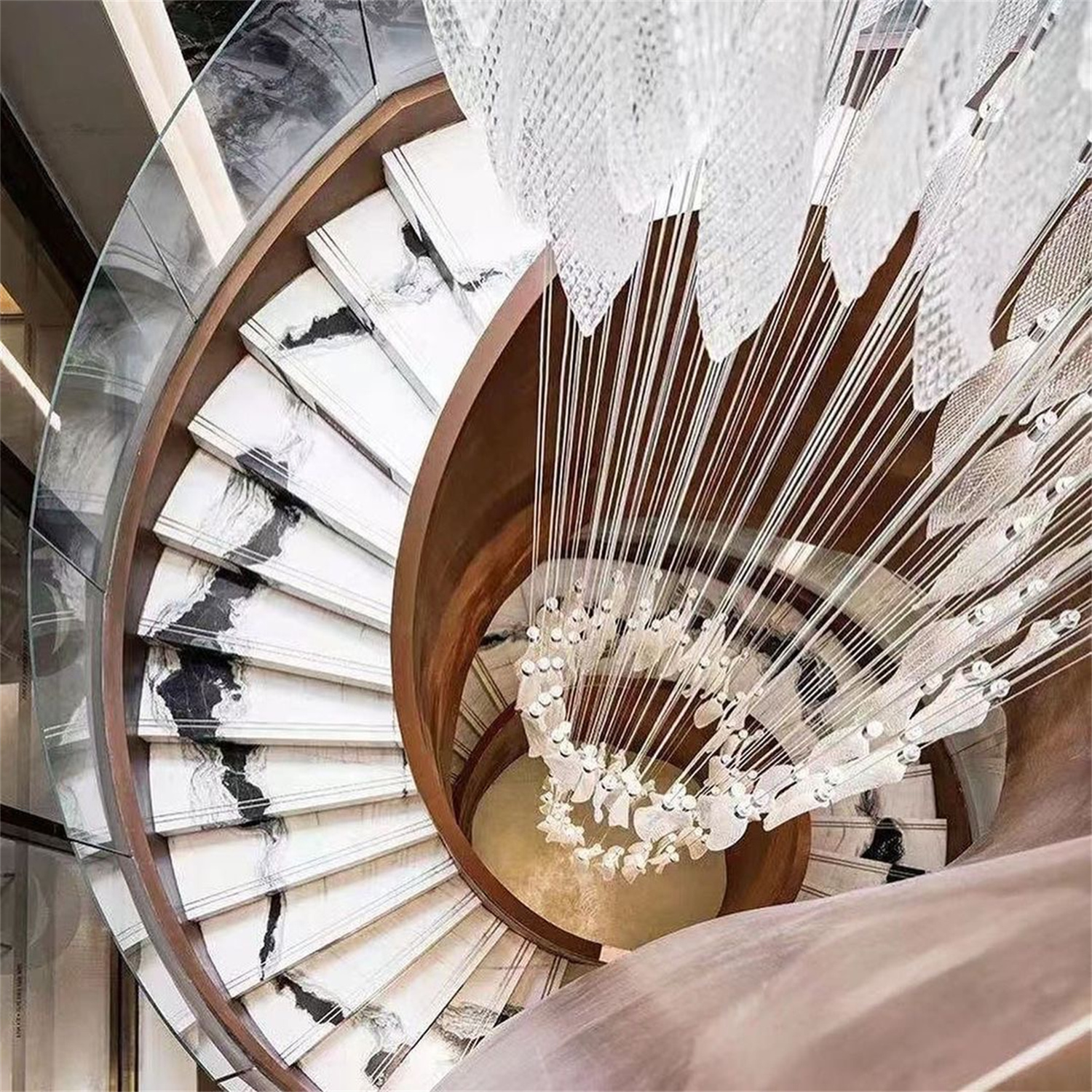
A curved staircase can create a ceremonial entrance and soften the geometry of a large foyer. The continuous sweep of the stair can make a luxury residence feel more like a bespoke architectural project than a standard interior fit-out. Panda White Marble is especially expressive when the vein direction is planned to complement the curve rather than create visual interruptions.
Curved staircases require more detailed surveying and fabrication than simple straight flights. Each tread may have a different shape, and the inner and outer edges may require different dimensions. The fabricator should receive approved drawings, templates, edge profiles, and a clear numbering system. A dry layout or digital layout review can help reveal inconsistencies before the stone is installed.
3. Bookmatched Marble Feature Wall with Coordinated Steps
Bookmatching uses adjacent slabs arranged as mirror images to create a symmetrical or butterfly-like pattern. On a staircase, the technique can be used on a feature wall behind the flight, around a landing, or in a double-height vertical space. Coordinating the wall pattern with the stair treads can produce a unified composition, particularly in homes with restrained furniture and simple architectural lines.
Bookmatching requires careful slab selection because the final effect depends on the relationship between neighboring pieces. Vein direction, background tone, slab dimensions, and cutting sequence should be reviewed before production. Designers should also distinguish between a visually bookmatched wall and a stair tread layout: the two areas may need different fabrication decisions because they perform different functions.
For projects built around a strong black-and-white composition, review the available Panda White Marble bookmatch slabs as a starting point for discussing pattern direction and slab selection. Confirm current stock, dimensions, finish options, and batch characteristics directly before specifying the material.
4. Black-and-White Marble with Brass or Bronze Accents
Metallic details can add warmth to the strong contrast of Panda White Marble. Brass handrails, bronze-colored lighting, and carefully designed metal trims can create a sophisticated combination without overwhelming the natural stone. This approach is effective in formal entrance halls, modern classic villas, and interiors that mix monochromatic materials with warmer finishes.
The best result comes from using metal as a supporting detail. A thin brass line may emphasize a landing or edge, while a bronze handrail can provide a tactile contrast to the polished stone. Designers should consider the finish’s resistance to fingerprints, corrosion, cleaning products, and repeated contact. Any metal components near the stair edge must be coordinated with the walking surface and must not introduce a trip hazard.
5. Panda White Marble Combined with Natural Wood
Wood can soften the dramatic appearance of black-and-white marble. Oak wall panels, timber handrails, wood slat screens, and warm-toned flooring introduce texture and visual warmth. This combination works particularly well in contemporary villas where homeowners want a refined space that still feels comfortable and residential.
For example, a staircase may use Panda White Marble for the treads and landings, timber for the handrail, and a neutral wall finish to balance the contrast. The design team should plan transitions between materials carefully. Wood can respond to changes in moisture and temperature, while stone is relatively rigid; therefore, junctions, movement allowances, and fixing methods must suit the chosen system.
6. Glass-Balustrade Staircase for an Open-Plan Villa
A glass balustrade allows the marble pattern to remain visible from multiple viewpoints. It is a suitable option for open-plan homes, double-height foyers, and spaces where daylight is an important part of the architectural design. Transparent glass can visually reduce the mass of the railing while keeping attention on the stone’s natural veining.
Glass should not be treated as a purely decorative accessory. The glass type, thickness, edge treatment, support method, handrail configuration, and fixing details must be selected according to the applicable code and engineered requirements. Connections must be coordinated with the stone so that drilling, anchoring, or edge loading does not create unacceptable damage or stress concentrations.
For project sourcing, buyers may compare the broader marble slab collection to understand available visual options before finalizing the stair design. The selected slab should be approved for the intended application, and the project team should verify the exact material and finish rather than assuming that every marble variety performs identically.
7. Thick-Profile Marble Treads with Waterfall Edges
Thick-profile treads create a substantial, sculptural appearance. A waterfall edge extends the visible stone down the side of a tread or landing, making the assembly look more monolithic. This design is often used in large residential projects where the staircase is intended to become an architectural centerpiece.
Designers should clarify whether the thick appearance comes from a solid stone section or a fabricated edge build-up. These approaches differ in weight, material use, joint visibility, handling, and support requirements. A thicker visual profile does not automatically mean the stair is structurally stronger. The support system, span, load, stone properties, and fixing details must be checked as a complete assembly.
Before production, confirm the finished thickness, edge profile, mitre details, visible seams, and acceptable variation. Larger components also require suitable packing and handling plans to reduce the risk of corner damage during transport and installation.
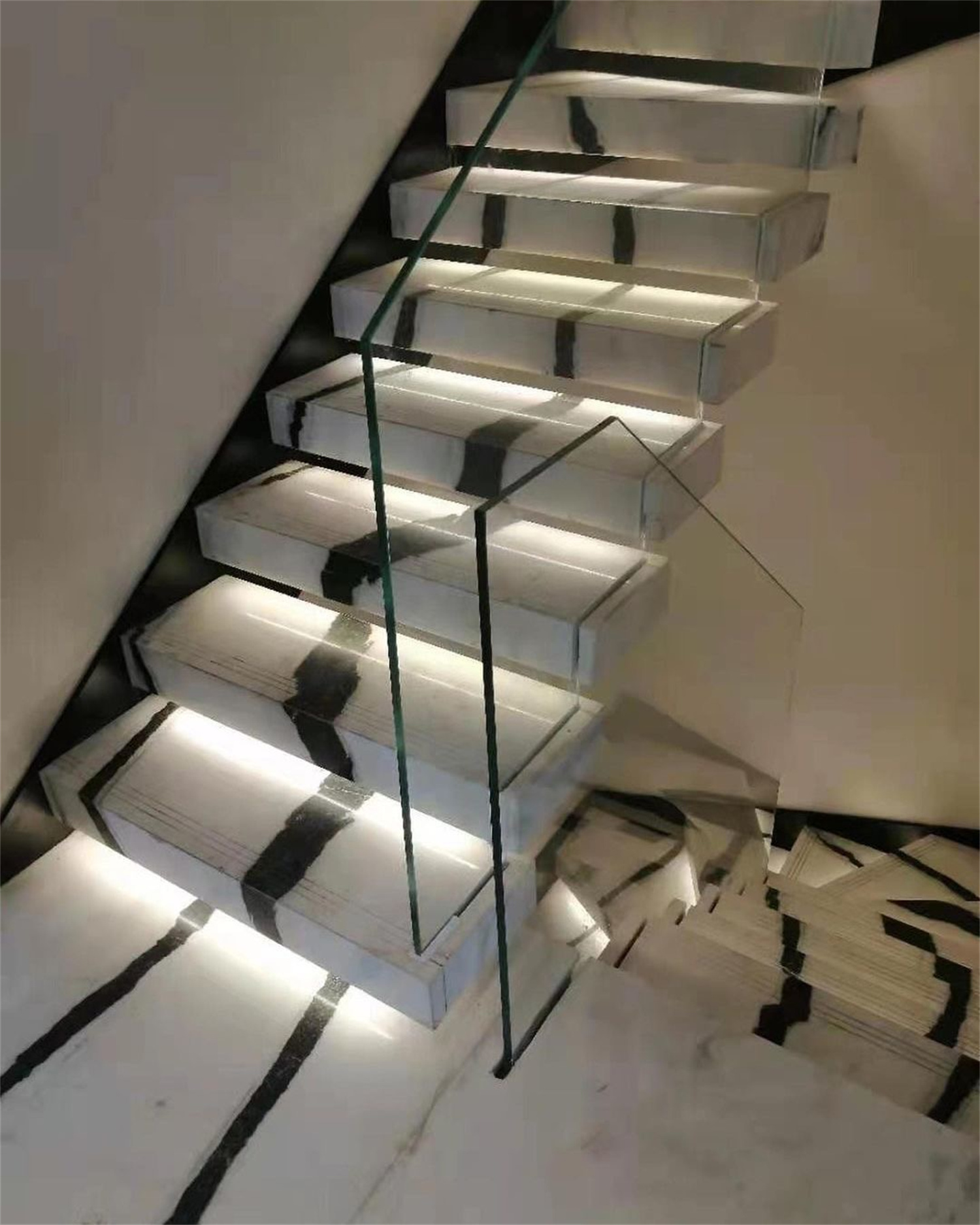
8. Floating Marble Steps with Integrated LED Lighting
Integrated lighting can reveal the texture of Panda White Marble after dark and improve the visual definition of each step. Recessed LED strips beneath the tread, discreet side lighting, or concealed illumination along a wall can produce a controlled architectural effect. Warm lighting often complements timber and bronze details, while neutral lighting can emphasize a cooler monochromatic palette.
The lighting layout should be coordinated with the stone fabrication drawings. Electrical channels, cable routes, access panels, heat management, and maintenance access should be determined before cutting begins. Lighting should not create glare or obscure the edge of a tread. Designers should also ensure that the visual effect does not compromise the required lighting levels or the visibility of changes in elevation.
9. Vein-Selected Treads and Risers for Visual Continuity
Matching the vein direction across stair treads, risers, and landings can make the entire staircase feel intentional. Some projects use horizontal bands to emphasize the width of the steps, while others select individual pieces for a more irregular, natural composition. Both approaches can work, provided the desired visual logic is established before cutting.
Natural marble is not a printed surface, so identical repetition should not be expected. Instead, the objective is to create an approved visual sequence within the natural variation of the material. Slab photographs, numbered layouts, cutting diagrams, and written approval records help the fabricator and installer understand which pieces belong in each location.
Buyers should also check whether the selected slab contains natural fissures, filled areas, or other features that affect the choice of cut. These characteristics should be assessed in relation to the final tread dimensions and support system rather than judged solely from a full-slab photograph.
10. Honed or Textured Marble for Everyday Residential Use
A honed finish offers a lower-sheen appearance than a polished finish and can suit contemporary homes, understated interiors, and spaces where designers prefer a softer visual effect. Depending on the stone and finishing process, textured finishes may also be considered for specific applications. However, a matte appearance alone does not prove that a surface is slip-resistant.
Stair safety depends on the complete design, including tread geometry, nosing details, lighting, footwear, contaminants, maintenance, and the tested performance of the finished surface. The project team should specify the appropriate test method and acceptance criteria for the location and jurisdiction. Samples should be reviewed under realistic lighting, and the selected cleaning routine should be compatible with the stone and any applied treatment.
Panda White Marble Technical Specifications for Staircase Projects
Natural stone properties can differ between quarries, blocks, and production batches. Published product sheets are useful for preliminary evaluation, but the final specification should be based on documentation for the material actually supplied. ASTM C503/C503M addresses relevant physical characteristics and sampling for marble dimension stone, including properties such as absorption, density, compressive strength, and flexural strength.
The following table provides an indicative screening framework. The numerical values shown are examples from published supplier information, not guaranteed values for every Panda White Marble source. They must not be used as structural design values without appropriate verification.
| Parameter | Indicative Published Example | What Buyers Should Verify |
|---|---|---|
| Bulk density | Approximately 2.69 g/cm³ in one supplier listing | Batch-specific density test and calculation of component weight |
| Water absorption | Approximately 0.18% in one supplier listing | Test method, conditioning, sample identity, and report date |
| Compressive strength | Approximately 135 MPa in one supplier listing under stated test conditions | Test direction, dry or wet condition, sample size, and applicability to the design |
| Flexural strength | Approximately 15.5 MPa in one supplier listing under stated test conditions | Actual material test results and engineering safety factors |
| Available thickness | 18 mm, 20 mm, and 30 mm are examples found in product listings | Actual stock, finished tolerance, component dimensions, and support requirements |
| Surface finishes | Polished and honed are commonly listed; other finishes depend on the supplier | Finish sample, cleaning method, appearance, and slip-performance criteria |
| Product forms | Slabs, tiles, and cut-to-size components may be available | Maximum dimensions, processing capability, packing, and project quantities |
Data note: The values above are examples from supplier-published product information and should be treated as indicative only. A different source may report different results. The project specification should state the required test methods, acceptance limits, and documentation before procurement.
Density is relevant when calculating the dead load of stone components, but it does not establish whether a tread can safely span between supports. Flexural and compressive strength results also need interpretation within the correct design system. Stone thickness, support spacing, edge details, fixing methods, and anticipated loads must be considered together by the responsible engineer.
How to Choose Marble Stair Tread Sizes and Thickness
Standard Dimensions Versus Custom-Cut Treads
Stair geometry should be established by the architectural design and the applicable building regulations before the marble is ordered. Tread depth, riser height, clear width, landing dimensions, headroom, handrails, and guarding requirements must be coordinated with the structural system and finished floor levels.
Thicknesses such as 18 mm, 20 mm, and 30 mm may appear in supplier catalogs, but these are purchasing and fabrication options rather than universal structural rules. A thin stone layer bonded to an engineered substrate performs differently from a solid stone tread supported across a span. Designers should not select a thickness solely because it looks substantial or appears in another project’s photographs.
For custom marble stair treads, the purchase specification should identify the finished length, depth, thickness, edge profile, surface finish, tolerance, and any required cut-outs. Curved or tapered treads need templates or approved shop drawings. Every piece should have a unique reference so the fabricator, packer, and installer can identify its final position.
Calculating Material Quantities and Allowances
A reliable material take-off should count treads, risers, landings, side panels, skirting, and feature-wall cladding separately. Area-based calculations alone may underestimate the amount of material required for a staircase because cut direction, vein matching, edge finishing, and unusable slab sections can affect yield.
For example, a straight flight with 16 treads and 16 risers should be listed by component count and dimensions. The landing and any side cladding should be measured separately. If bookmatching is required, the fabricator should prepare a slab layout before final quantities are approved. Any allowance for cutting waste should reflect the real layout and fabrication method rather than an arbitrary percentage applied to every project.
Polished Versus Honed Panda White Marble
| Selection Factor | Polished Finish | Honed Finish |
|---|---|---|
| Appearance | Reflective surface with strong visual contrast | Lower sheen with a softer visual effect |
| Vein presentation | May make the pattern appear more pronounced | May make the pattern appear more restrained |
| Visible marks | Fingerprints and some surface marks may be conspicuous | Some marks may be less obvious, depending on lighting and use |
| Slip performance | Must be verified for the actual application | Must also be verified; matte does not automatically mean slip-resistant |
| Design fit | Formal entrances and high-impact interiors | Contemporary and understated interiors |
| Maintenance | Requires stone-compatible cleaning and appropriate care | Also requires stone-compatible cleaning and appropriate care |
Neither finish should be selected based on appearance alone. Ask for a sample from the intended batch and assess it under the project’s lighting conditions. Where slip resistance is a concern, specify a suitable test method and acceptance criteria. A surface treatment, coating, or sealer should not be assumed to improve safety unless its performance has been verified for the intended use.
Safety, Building Codes, and Installation Requirements
Stair Geometry, Handrails, Guardrails, and Headroom
Building requirements vary by country, state, municipality, occupancy, and building type. In the United States, the applicable edition of the International Residential Code or International Building Code, together with local amendments, may govern tread depth, riser height, handrails, guards, headroom, and related features. The exact provisions must be confirmed by the project’s architect or code professional.
For example, the 2024 International Building Code includes provisions for stair tread and riser dimensions, stairway construction, walking surfaces, and handrails. Those provisions should not be copied indiscriminately into every residential project: a private dwelling, a multi-unit residential building, and a public or commercial space may be governed by different rules. The finished marble surface must be coordinated with the underlying stair geometry so that the required dimensions remain compliant after installation.
Slip Resistance and Stair-Nosing Details
Slip performance depends on more than whether the surface looks glossy or matte. Water, dust, cleaning residues, footwear, lighting, tread shape, and maintenance practices can affect the risk of slipping. Stair nosings should be clearly visible and appropriately detailed without creating an abrupt edge or a trip hazard. Any anti-slip insert or treatment should be compatible with the stone and approved for the specific location.
Substrate, Adhesives, Movement, and Installation Quality
The substrate must be suitable for the selected stone installation system. The installer should confirm substrate condition, flatness, structural movement, adhesive compatibility, grout or joint requirements, and the manufacturer’s installation instructions. A material that performs well as a wall finish may require a different support strategy when used as a stair tread.
Before installation, inspect every component for dimensions, finish, visible defects, repairs, and vein direction. Compare the delivered pieces with the approved layout and record any discrepancies before they are permanently fixed. This process reduces the risk of discovering avoidable differences after the staircase has been assembled.
For additional project planning, buyers can review guidance on designing durable marble staircases. Although the title focuses on public buildings, the broader coordination principles—material selection, support design, detailing, installation quality, and maintenance planning—can inform residential projects. Specific code requirements still need to be checked for the actual building type and location.
Panda White Marble Versus Other Staircase Materials
| Material | Visual Character | Design Flexibility | Main Considerations |
|---|---|---|---|
| Panda White Marble | High-contrast black veining on a light background | Statement stairs, feature walls, coordinated stone interiors | Natural variation, finish selection, care, and verified technical properties |
| Carrara Marble | Usually softer grey veining on a light background | Classic, transitional, and understated interiors | Pattern variation, surface care, and project-specific performance |
| Calacatta Marble | Often bold veining with a light background | High-impact luxury interiors | Selection, availability, cost, and variation depend on the specific material |
| Porcelain Slabs | Manufactured patterns with controlled visual consistency | Large-format contemporary designs | Product-specific edge detailing, fixing systems, and performance data |
| Granite | Often granular or crystalline, depending on the variety | Modern and traditional architectural applications | Appearance and technical properties differ significantly between varieties |
There is no single material that is best for every staircase. Panda White Marble is compelling when the design depends on dramatic natural veining. Porcelain may appeal to projects that prioritize a manufactured pattern, while other natural stones may better match a specific palette or performance brief. The final decision should balance visual intent, verified technical data, maintenance expectations, fabrication capability, budget, and local requirements.
What Is Trending in Luxury Residential Marble Staircase Design?
Several design directions are relevant to current high-end residential work. One is the use of larger, visually continuous stone surfaces to reduce unnecessary visual interruptions. Another is the combination of stone with timber, glass, and metal to create contrast without adding excessive ornament. Bookmatched walls and carefully selected vein sequences also remain attractive options for projects where the staircase is a focal point.
Lighting is increasingly considered as part of the architecture rather than an afterthought. Concealed LED details can emphasize the underside of a floating tread or make a feature wall more legible after dark. At the same time, designers need to avoid glare and ensure that the stair edges remain visible. Aesthetic lighting should complement, not replace, appropriate general lighting and code compliance.
Another important direction is more deliberate material selection and documentation. Buyers increasingly need clarity about the actual stone batch, processing tolerances, maintenance instructions, and the relationship between a sample and the delivered material. These are practical project priorities rather than claims about a particular market share or growth rate.
How to Source Panda White Marble for Luxury Residential Projects
What Should Buyers Ask a Marble Supplier or Factory?
Before requesting a quotation, prepare the stair drawings, finished dimensions, approximate quantities, preferred finish, edge profiles, and project location. State whether the requirement is for slabs, cut-to-size treads, risers, landings, or a complete coordinated package. If the design includes bookmatching, provide a reference layout and clarify how slab selection will be approved.
Buyers evaluating a Panda White Marble manufacturer or Panda White Marble factory should ask for recent photographs of the actual available material, representative samples, technical documentation, processing tolerances, packaging details, and a realistic production schedule. If a supplier offers cut-to-size services, confirm whether the quotation includes shop drawings, piece numbering, edge processing, dry layout, and inspection records.
For broader material selection, a dedicated Panda White Marble types guide can help buyers understand why pattern and appearance should be reviewed carefully. Product names alone do not guarantee identical color, vein scale, geological origin, or physical properties. The specific material proposed for the project should be confirmed before a purchase order is finalized.
Quality-Control Checklist Before Shipment
- Confirm the material name, origin information where available, and approved batch.
- Review full-slab photographs or an approved selection record.
- Verify thickness, finished dimensions, tolerances, edge profiles, and surface finish.
- Check the approved cutting layout and numbering of treads, risers, landings, and panels.
- Review relevant test reports and ensure they identify the material being supplied.
- Agree on the inspection process for natural variation, repairs, fissures, and visible defects.
- Confirm protective packaging, labeling, packing lists, and transport arrangements.
- Retain the approved sample, drawings, and written acceptance records for comparison on delivery.
These checks help address common buyer concerns: unexpected variation, pieces arriving in the wrong sequence, edge damage, unclear tolerances, and gaps between the approved sample and the delivered batch. They also give the fabricator and installer a shared reference for resolving questions before the stone reaches the site.
Common Mistakes to Avoid When Designing Panda White Marble Stairs
- Choosing from a single photograph: A photograph may not represent the full slab, the actual batch, or the lighting conditions at the project site.
- Ignoring vein direction: Unplanned cutting can create an inconsistent visual sequence across treads, risers, and landings.
- Assuming thickness guarantees strength: Structural behavior depends on support, span, loading, fixing, stone properties, and engineering design.
- Treating honed as automatically non-slip: Surface appearance is not a substitute for an appropriate performance test.
- Leaving details until installation: Lighting channels, railing anchors, edge profiles, and material junctions should be coordinated before fabrication.
- Skipping batch-specific documentation: General catalog data may not represent the exact material supplied.
- Underestimating packaging and handling: Large or irregular stone components need appropriate protection and clear identification.
The most reliable way to avoid these issues is to establish a documented approval process. The designer confirms the intended appearance, the engineer reviews structural requirements, the fabricator checks production feasibility, and the installer confirms site conditions. Buyers should not treat these responsibilities as interchangeable.
Final Recommendations for Luxury Residential Projects
Panda White Marble can make a staircase a defining feature of a luxury residence when its natural pattern is matched to the architectural concept. Floating steps suit clean contemporary interiors, curved stairs create a ceremonial entrance, and bookmatched slabs provide a strong visual statement. Timber, glass, metal, and carefully planned lighting can add contrast while preserving the stone as the main design element.
The best outcome comes from making design and technical decisions together. Select the actual stone batch, verify relevant physical properties, confirm stair geometry and structural support, choose the finish based on both appearance and use, and document every cut-to-size component before production. A well-coordinated supply process can reduce avoidable waste, improve visual consistency, and make installation more predictable.
For a residential project, the next step is to prepare the drawings, approximate quantities, preferred finish, and reference images before requesting a detailed quotation. Buyers can then contact the marble supplier for project-specific information and confirm current availability, sample options, fabrication scope, technical documents, and delivery arrangements. The final specification should be approved by the project’s design and engineering professionals before production begins.
Frequently Asked Questions About Panda White Marble Staircases
1. Is Panda White Marble suitable for luxury staircases?
Panda White Marble can be suitable for luxury residential staircases when the selected material, finish, dimensions, support system, and installation method are appropriate for the project. Its black-and-white veining makes it particularly effective in feature staircases, entrance halls, and contemporary villas. Suitability should not be judged by appearance alone. Buyers should review batch-specific technical documentation and involve qualified professionals in the structural design, surface selection, and installation planning.
2. What is the best finish for Panda White Marble stairs?
The best finish depends on the desired appearance, lighting, cleaning routine, and performance requirements. Polished marble offers a reflective surface that can emphasize contrast, while honed marble creates a softer, lower-sheen appearance. Neither finish should automatically be considered safer than the other. Where slip resistance is important, the project team should specify an appropriate test method and acceptance criteria for the actual location, and should also consider nosing details, contaminants, lighting, and maintenance.
3. What thickness should Panda White Marble stair treads be?
There is no universal thickness for every marble stair tread. Options such as 18 mm, 20 mm, and 30 mm may be available from suppliers, but the correct choice depends on whether the stone is a finish layer or a structural component, as well as the tread dimensions, support spacing, load, anchoring system, and engineering requirements. A qualified professional should confirm the design before fabrication. Buyers should specify finished dimensions and tolerances rather than selecting thickness solely from a catalog.
4. How do you maintain a Panda White Marble staircase?
Use a stone-compatible, pH-neutral cleaner and a soft cleaning tool, and remove spills or residues promptly. Avoid acidic cleaners and abrasive methods that can damage or dull marble surfaces. Sealing may be appropriate for some materials and applications, but a sealer does not make marble stain-proof or remove the need for maintenance. The care plan should follow the stone supplier’s recommendations and the selected finish. Periodically inspect joints, edges, anti-slip details, and any treatments used on the staircase.
5. How can buyers source Panda White Marble for a villa project?
Start with the architectural drawings, component dimensions, estimated quantities, preferred finish, and project schedule. Ask the supplier for actual slab photographs, representative samples, relevant test reports, processing tolerances, cut-to-size capability, packing details, and a documented approval process. For bookmatched designs, approve the slab layout and piece numbering before cutting. Before shipment, check the finished dimensions, edge profiles, surface finish, natural variation, and packaging. Confirm all commercial and technical details in writing so the fabricator, installer, and buyer work from the same approved specification.
References
- Standard Specification for Marble Dimension Stone (ASTM C503/C503M). ASTM International. ASTM International Standards and Technical Publications.
- International Building Code, Chapter 10: Means of Egress. International Code Council. 2024 International Building Code.
- Panda White Marble: Product and Physical Property Information. TML Stone. Product technical information and specifications.
- Panda White Marble: Technical Information and Product Applications. Morningstar Stone. Natural stone product documentation.
- Natural Stone Tile. Natural Stone Institute. Natural stone selection, installation, and care guidance.
- Dimension Stone Design Manual. Natural Stone Institute. Technical guidance for natural stone design and installation.
- TCNA Handbook for Ceramic, Glass, and Stone Tile Installation. Tile Council of North America. Industry installation guidance.
- Guide to the Selection and Use of Dimension Stone. ASTM International. Natural stone selection and application guidance.
Panda White Marble Staircases: Design Insights, Material Fit, and Project Decisions
What makes Panda White Marble valuable for staircase design? Its distinctive black-and-white pattern gives residential stairs a recognizable architectural identity. The material is especially relevant when the staircase, landing, or feature wall is intended to serve as a focal point. Its suitability for a specific project still depends on verified material properties, fabrication quality, support design, finish selection, and installation conditions.
Why should design and procurement be planned together? Natural stone varies between slabs, and complex staircases may require custom dimensions, numbered components, coordinated vein direction, and specialized edge details. Early approval of actual slabs and fabrication drawings helps reduce avoidable cutting errors, visual mismatches, transport damage, and installation delays.
How should a project team choose a suitable product direction? Start with the architectural objective, then identify the material form and processing requirements. A feature wall may prioritize pattern continuity, while stair treads require careful consideration of geometry, support, edge treatment, and surface performance. The same stone name does not automatically mean that every product form is suitable for every application.
Material Fit by Product Direction
Legend: ●●● = Primary; ●●○ = Strong Option; ●○○ = Depends on Workflow; — = Usually Not First Choice
The following ratings are qualitative fit indications, not statistical data. They do not represent measured probabilities, guaranteed performance, or a substitute for engineering review and product-specific testing.
| Product Direction | Design Fit | Key Decision | Required Verification |
|---|---|---|---|
| Marble slabs for feature walls | ●●● | Visual impact and vein continuity | Actual slab selection, fixing system, wall substrate, and layout approval |
| Bookmatched marble slabs | ●●● | Symmetrical or mirrored vein composition | Adjacent slab availability, cutting sequence, and approved dry layout |
| Cut-to-size stair treads | ●●○ | Accurate geometry and edge finishing | Dimensions, support system, loads, finish, and relevant test data |
| Matching risers and landings | ●●○ | Coordinated appearance across the staircase | Finished levels, tolerances, pattern sequence, and joint details |
| Marble flooring | ●●○ | Visual continuity between the stair and adjacent rooms | Flooring suitability, finish performance, substrate, and maintenance |
| Decorative wall cladding | ●●● | Vein scale and vertical visual emphasis | Panel dimensions, anchoring, weight, and installation details |
| Custom curved stair components | ●○○ | Complex geometry and fabrication precision | Templates, approved shop drawings, material yield, and handling plan |
| Exposed stone used as a structural tread | ●○○ | Structural performance rather than appearance alone | Engineer-approved design, verified properties, support, and connections |
| Wet or exterior stair applications | ●○○ | Exposure, water management, and slip performance | Location-specific testing, drainage, weather exposure, and code review |
The matrix is intended to guide early discussions, not to approve a material for construction. A product that is visually appropriate may still need additional testing, detailing, or engineering review. Where reliable project-specific information is unavailable, the correct decision is to verify suitability rather than assume it.
Options: Which Staircase Design Should Buyers Prioritize?
- For a dramatic entrance: Consider a curved staircase or a straight flight with a bookmatched feature wall.
- For a contemporary open-plan villa: Consider floating steps, restrained detailing, and a coordinated glass balustrade.
- For a warmer residential atmosphere: Combine the stone with timber, bronze, or neutral wall finishes.
- For a strong pattern-led interior: Select actual slabs and approve the vein layout before cutting.
- For everyday family use: Prioritize safe stair geometry, suitable lighting, maintainable finishes, and tested surface performance.
- For complex custom projects: Confirm fabrication feasibility, templates, tolerances, packaging, and installation responsibilities before production.
Considerations: Buyer Risks and Decision Logic
The most common procurement risk is approving a design from a photograph without confirming the actual batch. Other risks include incomplete technical documents, unapproved substitutions, unclear dimensions, insufficient support details, poorly coordinated railings, and inadequate packaging for custom-cut pieces.
A practical decision sequence is:
- Define the staircase design, building location, and intended use.
- Confirm applicable regulations and obtain the required architectural and engineering review.
- Select the material form, finish, and actual slab batch.
- Verify relevant physical properties and specify acceptance requirements.
- Approve the cutting layout, finished dimensions, edge details, and piece numbering.
- Confirm inspection, packing, transport, installation, and maintenance responsibilities.
Industry Direction and Long-Term Value
Luxury residential stone design increasingly benefits from combining visual planning with clearer technical documentation. Large-format surfaces, bookmatched patterns, integrated lighting, and mixed-material details can create distinctive results, but they also increase the need for accurate measurements and early coordination. Project value is therefore not defined only by the stone’s appearance; it also depends on material selection, fabrication accuracy, installation quality, maintainability, and the ability to preserve the intended design through delivery.
Project Recommendation
For buyers considering Panda White Marble for a villa staircase, prepare the drawings, approximate quantities, desired finish, reference images, project location, and installation schedule before requesting a quotation. Ask for actual slab images, relevant technical documentation, sample approval, fabrication details, and a clear quality-control process. A structured review helps designers and buyers balance the visual impact of natural stone with safety, project feasibility, and long-term care.
Next step: Use this checklist to align the designer, engineer, stone supplier, fabricator, and installer before confirming the final material and production scope. This collaborative process supports a more predictable result without relying on appearance alone.