Explore Four Seasons Marble for luxury interiors, including green and pink varieties, slab specifications, design applications, maintenance, and sourcing advice.
Quick Summary:
Four Seasons Marble is a commercially named natural stone valued for its distinctive colors, expressive veining, and potential to create focal points in luxury architecture and interior design. From Four Seasons Green Marble slabs to pink-toned decorative stone, suitable applications may include feature walls, furniture, selected countertops, and hospitality interiors. Buyers should confirm the exact material identity, slab characteristics, finish, technical data, and maintenance requirements before specifying the stone for a project.
four seasons marble luxury hotel design
What Is Four Seasons Marble?
Understanding the Commercial Stone Name
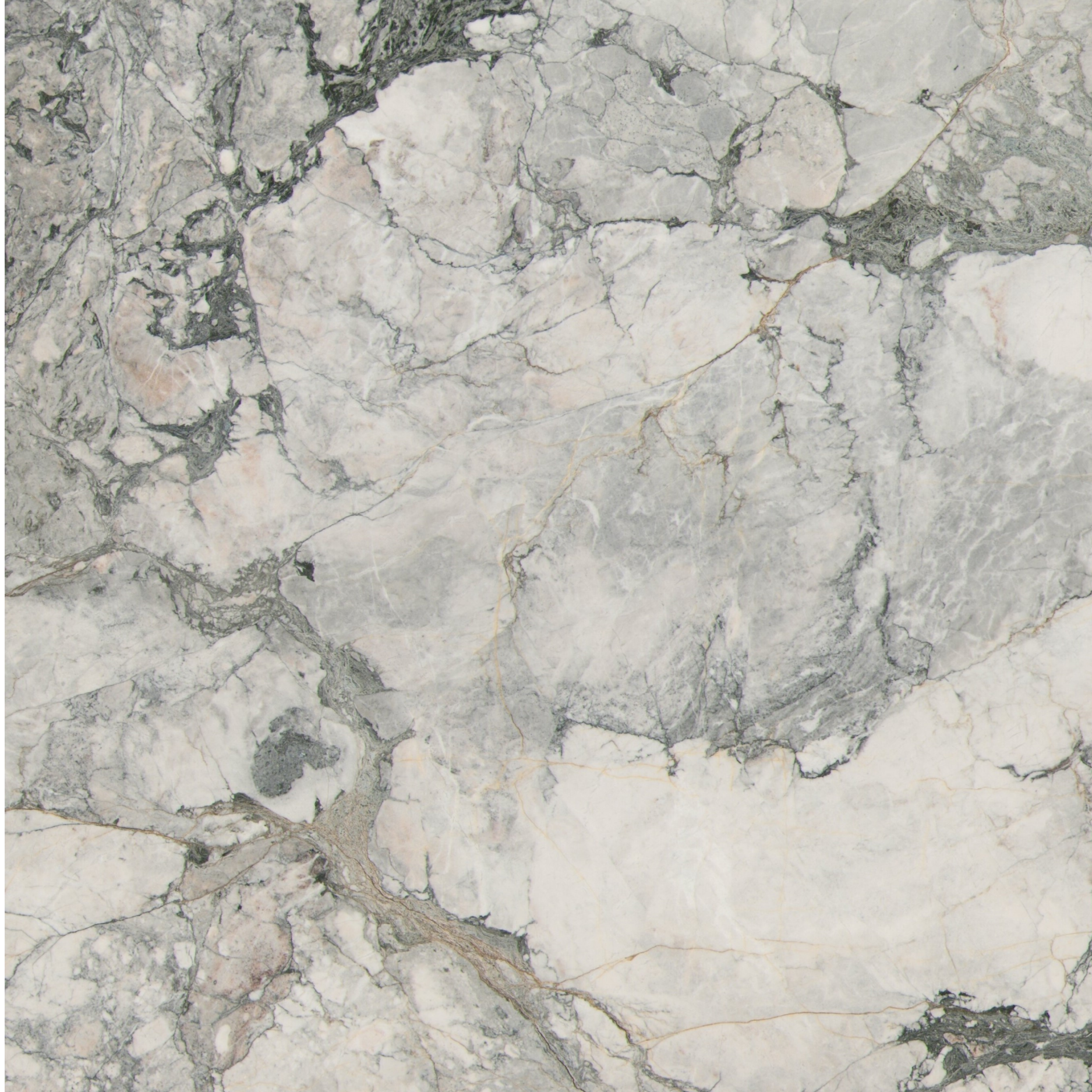
Four Seasons Marble is a commercial stone name associated with decorative natural stone varieties, including green and pink products. The name communicates a design identity rather than, by itself, establishing a complete geological classification. The exact mineral composition, geological origin, physical characteristics, and recommended applications must be confirmed for the specific product being purchased.
This distinction matters in professional specification. Natural stone names can be influenced by appearance, quarry location, trade conventions, and supplier terminology. A commercial name should therefore be treated as the starting point for product identification, not as a substitute for technical documentation.
Buyers comparing natural marble slabs should ask for the precise product name, available origin information, current slab photographs, dimensions, finish, and any relevant test reports. These details are particularly important when a project depends on consistent color, a coordinated sequence of slabs, or a specific performance requirement.
Four Seasons Green Marble and Its Visual Character
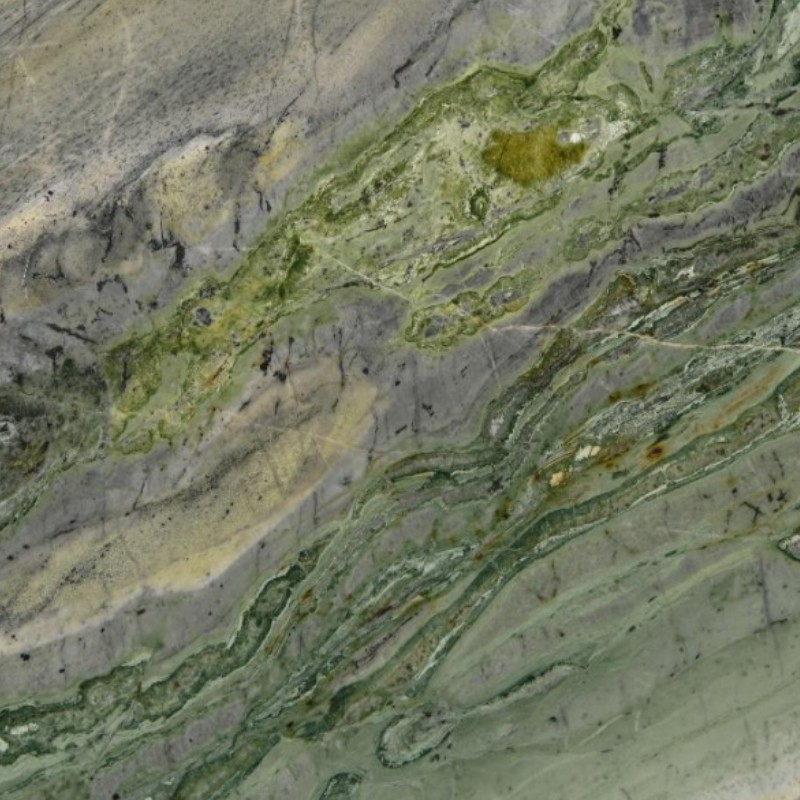
Green natural stone can complement interior palettes that incorporate plants, timber, muted metals, cream upholstery, and warm neutral finishes. Depending on the particular slab, the green field may appear relatively calm or contain contrasting veins and areas of color variation. This variation gives designers opportunities to create a feature surface that feels different from conventional white or gray marble.
Four Seasons Green Marble can be considered for statement walls, decorative flooring, selected furniture, and interior surfaces where the stone’s pattern is central to the composition. Its actual appearance should be assessed using the slabs intended for the project because natural variation may affect the balance of colors and veins.
For a living room, a broad green slab may serve as a backdrop to a low-profile sofa and timber furniture. In a hotel reception area, the same visual direction could be used to establish a recognizable material identity. These are design scenarios rather than claims about specific completed projects, and the final layout should always be based on the actual material and site conditions.
Four Seasons Pink Marble and Warm Interior Palettes
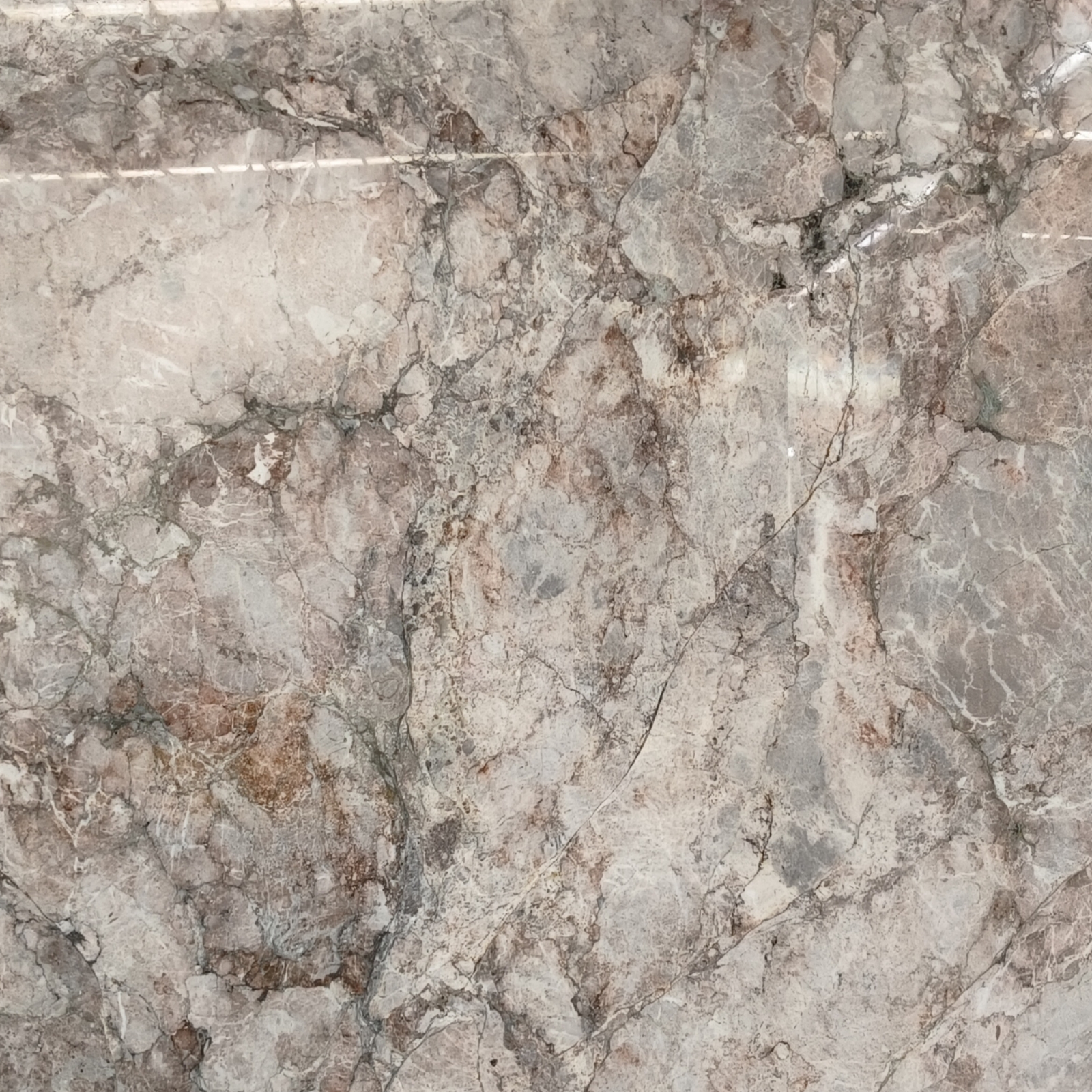
Pink-toned natural stone offers a different design direction. Depending on its color distribution and vein pattern, it may complement cream, burgundy, warm gray, brass-colored metal, or pale timber. Rather than using pink as a dominant color throughout an entire interior, designers can apply it selectively to a vanity surround, console table, decorative wall panel, or hospitality feature.
For example, a boutique hotel might use a pink-toned marble console in a reception lounge, with neutral walls and soft lighting to keep the stone visually prominent. A private residence could use a smaller slab as a decorative table surface or niche lining. The suitability of these applications depends on the actual product, finish, dimensions, and installation design.
When reviewing Four Seasons Pink Marble for luxury residences, consider the room’s lighting and neighboring materials before committing to a large quantity. A stone that appears soft and warm in a showroom may look more saturated under different lighting conditions.
Why Four Seasons Marble Is Attracting Interior Designers
Natural Patterns Create Individual Design Statements
One reason designers specify distinctive natural stone is that its pattern cannot be reproduced exactly from one slab to another. This creates opportunities for custom compositions, including bookmatched arrangements, large feature panels, sculptural furniture, and carefully coordinated surfaces.
The same characteristic creates a procurement challenge. Buyers cannot assume that all slabs will share identical colors, veins, or distribution of natural features. A project that requires a calm, balanced surface may need a different selection strategy from one that deliberately seeks dramatic contrast.
For successful specification, slab inspection should happen early enough to influence the design. A designer may need to adjust a panel layout, edge detail, or furniture dimension after reviewing the actual material. This is more reliable than treating natural stone as a completely uniform manufactured sheet.
Biophilic Design and the Use of Natural Materials
Biophilic design often explores ways to strengthen the visual connection between interiors and the natural world. Plants, daylight, timber, stone, and natural color palettes can all contribute to this approach. Green-toned stone may support the concept by introducing botanical associations without relying on printed patterns or artificial finishes.
However, the use of a natural material does not automatically make a project environmentally preferable. A responsible evaluation should consider quarrying, processing, transport, durability, expected service life, replacement requirements, and available environmental documentation. Buyers should request evidence rather than infer sustainability credentials from appearance alone.
Statement Materials in Luxury Hospitality
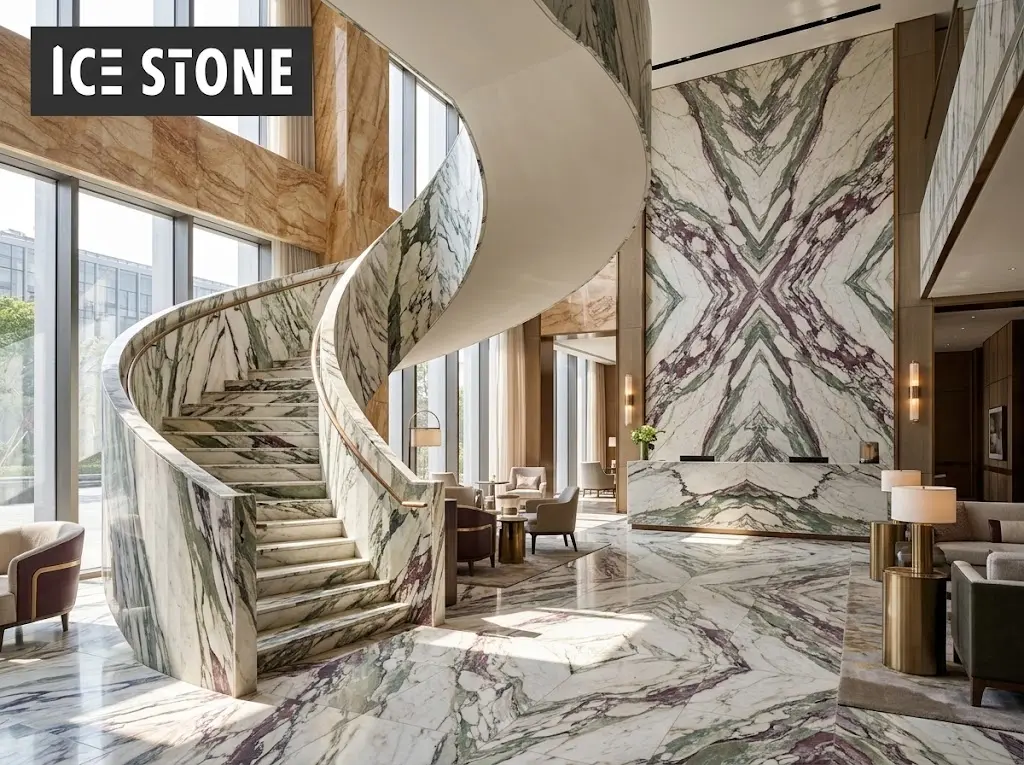
Hotels, restaurants, private clubs, and premium residential developments often use a distinctive material to establish a visual focal point. A carefully selected slab can help define a reception desk, lounge, bar front, feature wall, or bespoke furniture piece.
In these applications, design impact must be balanced with operational demands. Surfaces may be exposed to frequent cleaning, contact with food and beverages, luggage impacts, and repeated use. A wall panel, a table, and a kitchen worktop experience different conditions and should not be treated as interchangeable applications.
The practical value of Four Seasons Marble therefore depends on more than its visual appeal. The designer and buyer need to match the actual product to the location, maintenance expectations, and project requirements.
Where Can Four Seasons Marble Be Used?
Feature Walls and Architectural Backdrops
A feature wall is one of the clearest ways to showcase a distinctive stone pattern. A large slab can establish a focal point behind a sofa, reception desk, bed, or decorative console. Where multiple pieces are required, the layout should account for vein direction, panel joints, openings, and the visual center of the wall.
Designers should also consider the lighting angle. Grazing light may emphasize texture and surface variation, while direct reflections can draw attention to polish and finish. A mock-up or lighting test can help establish whether the selected finish supports the intended effect.
Kitchen Islands and Backsplashes
Natural stone can provide a visually distinctive kitchen island or backsplash, but kitchen suitability must be evaluated separately from decorative suitability. If Four Seasons Marble is proposed for a countertop, the team should verify its composition, acid sensitivity, absorption characteristics, finish, and maintenance needs.
Some marble varieties can be etched by acidic foods and household substances. A sealer may reduce the absorption of certain liquids, but it does not make the stone completely stain-proof or acid-resistant. Designers should discuss these limitations with the owner before specifying the material in a high-use kitchen.
For backsplashes, the selected stone must also be compatible with the cooking environment, installation system, and cleaning products. Areas near heat sources require appropriate detailing and compliance with the appliance manufacturer’s instructions and relevant project requirements.
Dining Tables, Coffee Tables, and Custom Furniture
Furniture offers a way to use expressive stone without covering an entire room. A green marble coffee table can become the main visual feature of a neutral living room, while a pink-toned console may introduce color into a hotel entrance or bedroom. Dining tables and side tables can also showcase natural pattern at a scale that is easy to inspect and appreciate.
Stone furniture requires careful engineering and fabrication. The design must account for the slab’s dimensions, thickness, edge profile, support structure, joints, handling, and the possibility of impact during use. A large stone top should not rely on an improvised support arrangement simply because the slab appears thick or substantial.
When specifying Four Seasons Green Marble furniture, the fabricator should review the actual slab and the furniture design together. Vein placement, cut-outs, edge finishing, and the support structure should be agreed before fabrication begins.
Bathroom Vanities and Decorative Wet-Area Details
Natural stone can be used for vanity tops, decorative wall panels, and selected bathroom details when the material and installation are appropriate. Moisture exposure, cleaning products, edge details, drainage, and substrate conditions should be evaluated as part of the design.
Bathrooms also require attention to waterproofing and the complete wall or floor assembly. A decorative stone surface is not a substitute for a correctly designed waterproofing system. Where stone is proposed for a wet-area floor, slip resistance and surface finish require specific evaluation rather than assumptions based on the product’s appearance.
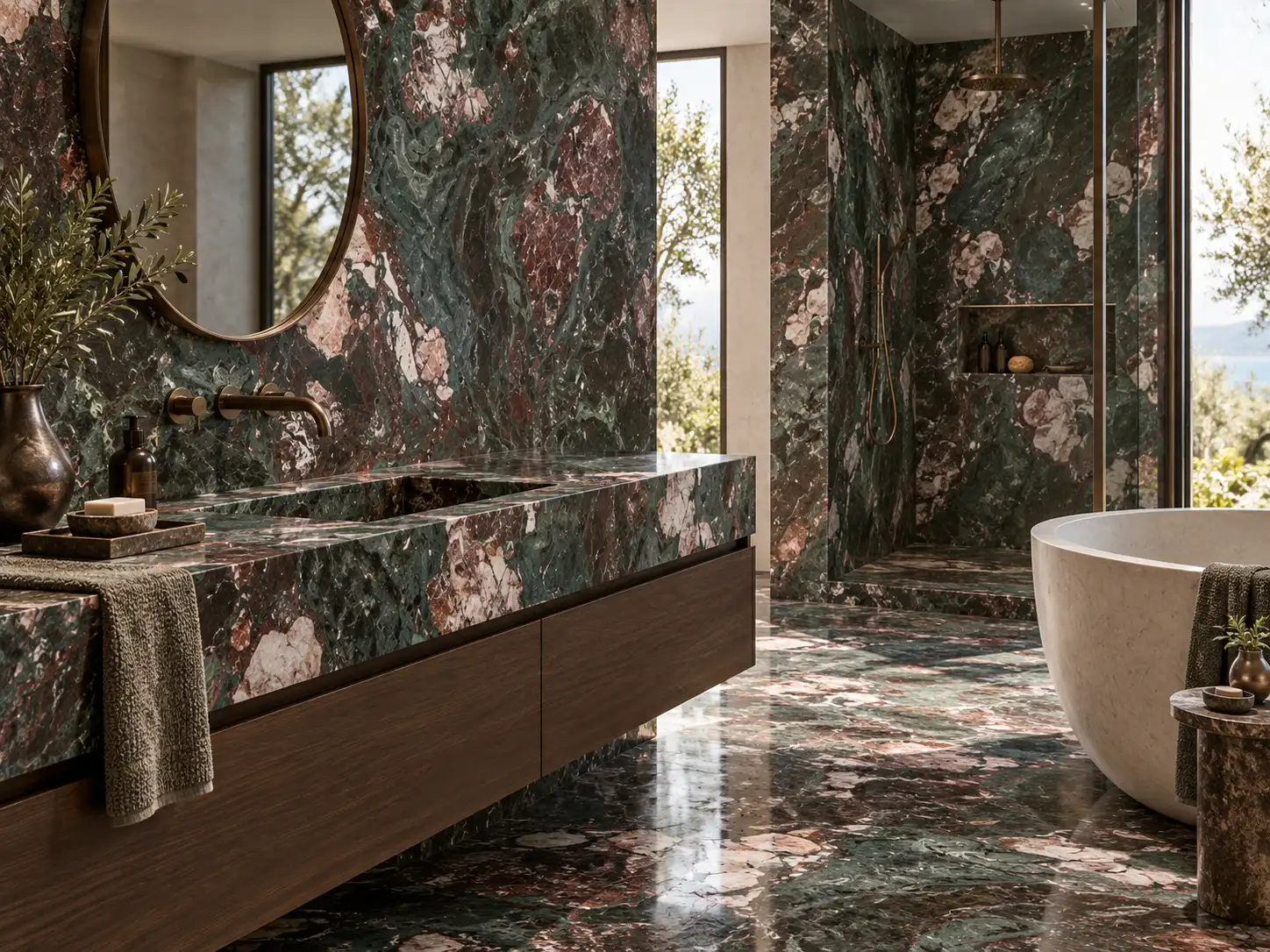
Four Seasons Green Marble Bathroom Vanity and Wall Design
Material Specifications: What Buyers Should Verify
Thickness, Dimensions, and Surface Finish
Slab thickness and available dimensions influence fabrication, weight, panel layout, and installation. A supplier may offer a standard thickness and may also accommodate other thicknesses, but the actual options should be confirmed for the product and current inventory.
For example, the published product information for Four Seasons Green from ICE STONE lists a 20 mm thickness and notes that 18 mm slabs can be customized. It also identifies polished, honed, and leather finishes as available options. These are product-specific published details, not universal specifications for every material sold under the Four Seasons name.
Buyers should verify dimensions and finishes for the actual order, including tolerances, edge requirements, and whether the requested customization is feasible. The final selection should be recorded in the purchase documentation.
Technical Parameters and Their Significance
Technical data helps buyers compare materials and assess whether a stone is appropriate for a particular application. The most useful parameters depend on the intended use and may include bulk density, water absorption, flexural strength, slab dimensions, thickness, and surface characteristics.
| Parameter | Unit | Why It Matters | What to Verify |
|---|---|---|---|
| Thickness | mm | Affects panel weight, edge details, fabrication, and support. | Actual slab specification and project requirements. |
| Bulk density | kg/m³ | Supports approximate weight calculations and engineering review. | Material-specific data or test results. |
| Water absorption | % | Helps inform moisture exposure and maintenance decisions. | Test method and result for the selected stone. |
| Flexural strength | MPa | Provides information about bending resistance under defined test conditions. | Test report and relevance to the intended application. |
| Finish | Descriptive | Influences reflection, appearance, cleaning, and use suitability. | Approved sample or finish specification. |
| Slab dimensions | mm | Determines cutting layout, material yield, and joint locations. | Actual slab measurements and tolerances. |
The table lists parameters to verify rather than fixed values for Four Seasons Marble. ASTM C97/C97M provides a recognized method for measuring water absorption and bulk specific gravity of dimension stone. ASTM C880/C880M addresses flexural strength testing. A buyer should request applicable product-specific results rather than assume that generic figures apply to every slab.
How to Estimate Panel Weight
For preliminary planning, a rectangular stone panel’s approximate mass can be calculated by multiplying its length, height, and thickness in metres to obtain volume in cubic metres, then multiplying the volume by the relevant density in kilograms per cubic metre.
For illustration only, a panel measuring 2.0 m by 1.0 m by 0.020 m has a volume of 0.040 cubic metres. If a verified density of 2,700 kg/m³ were appropriate for the selected stone, the estimated panel mass would be 108 kg. This is a mathematical example, not a measured density or declared weight for Four Seasons Marble.
Actual lifting and support decisions must use verified product information and the installation design. Handling equipment, access routes, substrate capacity, fixing details, and safety procedures should be assessed by qualified professionals.
Four Seasons Marble vs. Other Surface Materials
Four Seasons Marble vs. Conventional White Marble
Conventional white marble is often selected for its light appearance, subtle veining, and ability to complement many interior palettes. Four Seasons Marble varieties may offer more distinctive colors and visual movement, making them attractive for projects that need a recognizable focal point.
The decision is primarily aesthetic and practical rather than a universal ranking of quality. A highly expressive stone may be ideal for a feature wall or furniture piece but may compete with other strong design elements in a small room. A quieter white marble may be more appropriate where the design calls for visual continuity.
Four Seasons Marble vs. Quartzite
Quartzite is a different natural stone category and should not be treated as interchangeable with marble. Genuine quartzite is generally quartz-rich, while true marble is typically dominated by recrystallized carbonate minerals. Their mineralogy can influence hardness, chemical sensitivity, and maintenance behavior.
However, performance varies between individual stones, and commercial names are not sufficient proof of geological identity. Buyers should confirm the actual material and request relevant technical information before comparing durability or suitability for a countertop, floor, or wall.
Four Seasons Marble vs. Porcelain Slabs
Porcelain slabs can provide manufactured patterns and controlled product dimensions, while natural stone offers geological variation and an individual surface. Porcelain may be suitable where consistency or a particular maintenance profile is important; natural stone may be preferred when the authentic material and unique pattern are central to the design.
The complete installed system should be compared, including slab or panel cost, fabrication, support, edge details, transportation, maintenance, and replacement considerations. Neither category is automatically better for every project.
Fabrication, Installation, and Quality Control
Slab Selection Before Cutting
Buyers should inspect the actual slabs before fabrication whenever the design depends on vein direction, color balance, or a particular visual feature. Photographs are useful for preliminary selection, but lighting and image processing can change how colors appear. The approved material should be identifiable in the order documentation.
For multiple panels, the fabricator should prepare a layout showing the location and orientation of each piece. This is particularly important for bookmatching, large feature walls, and furniture with cut-outs or curved edges. Early approval helps reduce the risk of a desirable vein being cut away or positioned incorrectly.
Cutting, Edge Profiles, and Material Yield
Natural stone fabrication must account for the dimensions of the finished product, the characteristics of the slab, the cutting plan, and the amount of material likely to be lost during processing. Complex shapes, matching patterns, narrow components, and large cut-outs can affect material yield.
Custom designs should be reviewed against the available slab dimensions before final approval. If the design changes after cutting begins, the project may require additional material or a revised layout. Written approval of drawings, dimensions, finish, and edge details can help prevent misunderstandings.
Packaging, Transportation, and Delivery
Natural stone can be damaged by impact, unsuitable support, or poor handling. Slabs and fabricated pieces should be packaged and transported in a manner appropriate to their dimensions and form. Buyers should clarify who is responsible for inspection, packing, shipment coordination, delivery, and any damage reporting procedures.
For international procurement, confirm the commercial terms, lead time, packing arrangements, required documentation, and responsibilities for customs and delivery. These details should be established before the project schedule depends on the stone arriving at a particular time.
Maintenance and Common Buyer Mistakes
Cleaning Natural Stone Correctly
Maintenance begins with identifying the actual stone and following the relevant care guidance. The Natural Stone Institute recommends suitable, non-acidic cleaning products for calcareous stones because acids can damage sensitive surfaces. Abrasive products can also affect some finishes.
Routine care should be based on the intended application and the supplier’s instructions. Spills should be addressed promptly, and cleaning products should be tested for compatibility before widespread use. For commercial environments, a documented cleaning procedure helps reduce the risk of inconsistent maintenance practices.
Sealing Does Not Make Marble Stain-Proof
Some natural stones may benefit from an appropriate impregnating treatment, but sealing does not make a surface completely stain-proof. It also does not prevent acid etching on acid-sensitive marble. The correct treatment depends on the material, finish, and location.
Buyers should avoid choosing a product based on the assumption that sealing eliminates all maintenance concerns. The more useful question is whether the selected stone is appropriate for the intended use and whether the owner is comfortable with its expected care requirements.
Common Procurement Mistakes
- Choosing slabs based only on a small sample or a single edited photograph.
- Assuming a commercial stone name establishes geological composition or technical performance.
- Approving a complex cutting layout before confirming slab dimensions and pattern direction.
- Comparing material prices without considering fabrication, packaging, transportation, installation, and expected waste.
- Using a decorative stone in a demanding application without checking relevant performance requirements.
- Failing to confirm the responsibilities of the supplier, fabricator, installer, and project team.
Addressing these issues early can help buyers make better-informed purchasing decisions and reduce avoidable project delays.
Industry Trends: Natural Stone as a Design Investment
Individuality and Bespoke Interiors
Designers often use distinctive materials to create interiors that feel tailored to a particular client or property. Natural stone supports this approach because its pattern varies from slab to slab. Rather than repeating the same decorative element throughout a room, a designer can select one slab for a focal point and coordinate the remaining finishes around it.
This approach can be effective in residential interiors, boutique hospitality projects, and custom furniture. However, individuality requires more active material selection and should be planned early enough to coordinate fabrication and installation.
Furniture as a Smaller-Scale Way to Use Statement Stone
Stone furniture allows designers to introduce a distinctive material without committing to extensive wall or floor coverage. A coffee table, dining table, console, or side table can showcase natural pattern while keeping the overall material quantity more manageable.
For Four Seasons Green Marble, the design opportunity lies in coordinating the slab’s pattern with the furniture’s shape, support, and edge details. A small furniture piece may be visually striking, but it still requires careful fabrication and suitable structural support.
Digital Selection and Better Project Documentation
Digital slab photographs, numbered inventory images, layout drawings, and approval records can make procurement more transparent. These tools help buyers and fabricators communicate about the actual material instead of relying on a generic product image.
Digital selection is most useful when it complements physical inspection and technical verification. It should not replace confirmation of the actual slab, product specifications, or final installation requirements.
Regulations and Responsible Specification
Requirements Depend on the Application and Location
Building requirements vary according to the country, building type, installation location, and intended use. Internal decorative wall panels, external cladding, bathroom floors, and kitchen countertops can involve different technical considerations. A general product description cannot establish compliance with all applicable regulations.
For Australian projects, the design team should review the applicable National Construction Code provisions, relevant referenced standards, project specifications, and local approval requirements. Wet-area installations may require appropriate waterproofing design, while floors may require assessment of slip resistance. External cladding and heavy panels may need project-specific engineering and fixing design.
For projects in other jurisdictions, local building codes and relevant standards should be checked. Architects, engineers, certifiers, and qualified installers should determine the requirements applicable to the actual building and installation system.
Environmental and Supply-Chain Considerations
Natural stone sourcing can involve quarrying, processing, transport, and installation. Buyers concerned about environmental performance should ask for available documentation concerning sourcing, manufacturing processes, transport, and relevant environmental declarations. Claims about responsible extraction or sustainability should be supported by evidence rather than inferred from the natural origin of the material.
Procurement teams should also consider expected service life, maintenance, repair options, and the possibility of retaining or reusing material. These factors can help provide a more complete view of the material’s role in the project.
How to Choose a Four Seasons Marble Supplier
Evaluate Product Information and Technical Support
A reliable procurement process begins with clear product identification and transparent communication. Buyers should ask for current slab photographs, dimensions, available finishes, relevant technical data, and information about the material’s origin where available. If the supplier cannot confirm a requested property, that limitation should be clarified before the specification is finalized.
For a broader comparison of available materials, review the supplier’s marble slab collection and compare the available product options against the project’s design and technical requirements. A category page can help with initial exploration, but the final order should identify the actual stone and slab selection.
Confirm the Supplier’s Role and Production Scope
In B2B procurement, the terms manufacturer, factory, supplier, and fabricator can refer to different responsibilities. Buyers should confirm which operations the company performs directly and which are handled by external partners. This is important for quality control, lead times, custom cutting, packaging, and handling of issues after delivery.
Before placing a wholesale order, confirm the material quantity, dimensions, finish, inspection process, packaging method, delivery schedule, commercial terms, and documentation. A clear specification is more useful than a general promise of quality because it gives both parties a common basis for approval.
Review Four Seasons Green Product Details
For buyers specifically considering green-toned stone, the supplier’s Four Seasons Green natural stone product details provide a product-specific starting point for reviewing available finishes, dimensions, and intended decorative applications. Buyers should verify current stock and confirm that the selected slabs match the approved design.
Product details should be evaluated together with the intended application. A slab selected for a feature wall may not automatically be appropriate for a high-use countertop or wet-area floor. The relevant technical requirements and maintenance expectations should be checked for each use.
Use Product Guides to Refine Furniture and Finish Decisions
When the project involves tables, consoles, or other bespoke furniture, the design team should consider slab dimensions, edge profiles, support, finish, and vein placement together. These details influence both the appearance and the practical performance of the finished piece.
A focused Four Seasons Green Marble furniture and finish guide can help organize questions about furniture applications, surface finishes, and design coordination. The final specification should still be based on the actual stone, fabrication drawings, and project conditions.
Consider Pink Marble for Projects Requiring a Warmer Palette
Green and pink varieties can serve different design goals. Green may provide a stronger connection with botanical or earth-toned palettes, while pink can introduce warmth and a more decorative character. Neither should be selected solely on the basis of trend appeal; the stone should complement the architecture, lighting, and materials around it.
For a project exploring warm-toned interiors, the Four Seasons Pink Marble design guide for high-end residences offers a relevant direction for considering color, texture, and residential applications. Actual slab photographs and the final sample should be checked under the project’s lighting conditions before approval.
Confirm Company Information and Discuss Project Requirements
Before entering a supply agreement, buyers should understand the company’s product range, communication process, quality-control procedures, and ability to support the intended project. Ask who will handle slab selection, technical questions, fabrication coordination, shipment, and any post-delivery issues.
For supplier background and business information, consult the company profile and supplier information. The procurement team should independently confirm the scope of the proposed supply and ensure that commercial commitments are documented clearly.
Once the material, quantities, dimensions, and application have been defined, buyers can contact the stone supplier to discuss project requirements, request current slab information, and clarify the available options. A useful inquiry includes the project location, application, estimated quantity, preferred finish, required dimensions, and expected schedule.
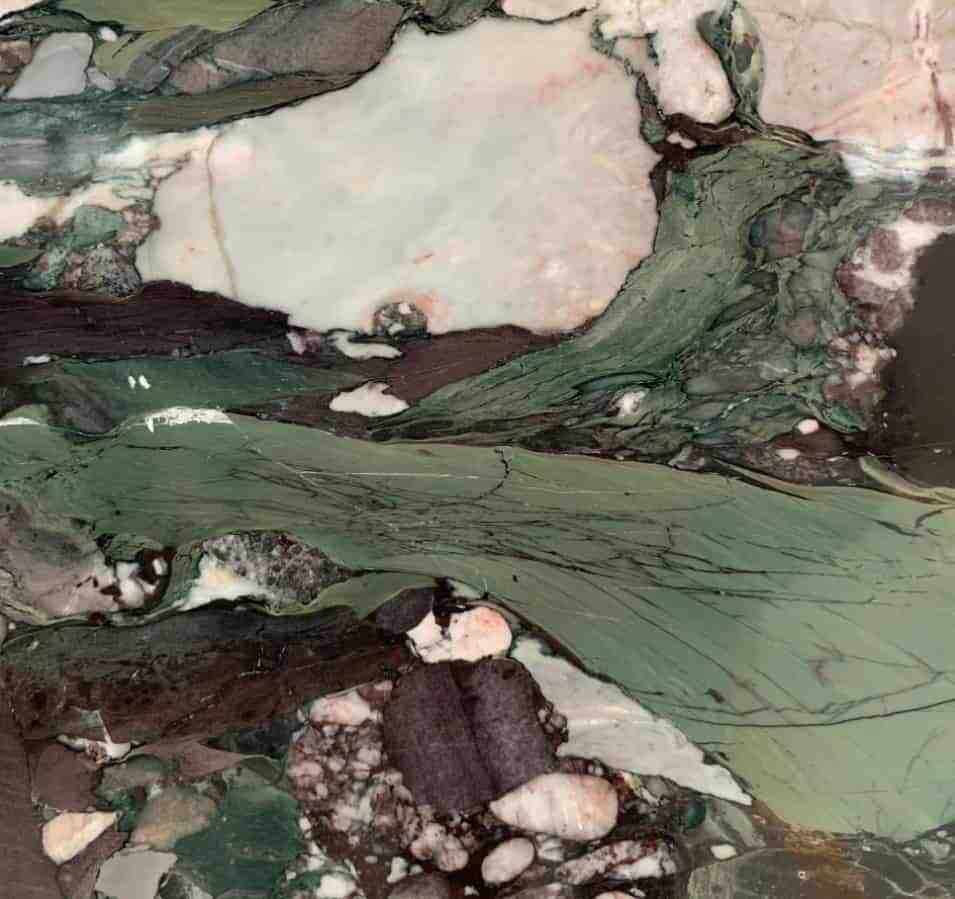
Four Seasons Green Marble Supplier
Is Four Seasons Marble the Right Choice for Your Project?
Four Seasons Marble can be a compelling option when the design calls for distinctive natural color, expressive veining, or a surface that becomes a focal point. Green and pink varieties may suit different palettes, while furniture and feature-wall applications provide ways to introduce the material at different scales.
The decision should be based on the actual slab, not the commercial name alone. Buyers should verify material identity, dimensions, finish, relevant technical data, fabrication requirements, and maintenance expectations. For demanding applications, qualified professionals should assess the complete installation system and applicable regulations.
For architects, designers, distributors, and project buyers, the most effective next step is to define the application, review the actual material, compare suitable finishes, and document the requirements before fabrication. This approach helps align the visual potential of Four Seasons Marble with the technical and commercial needs of the project.
Frequently Asked Questions About Four Seasons Marble
1. What is Four Seasons Marble?
Four Seasons Marble is a commercial name used for decorative natural stone varieties, including green and pink products. Its appearance can feature distinctive colors and natural veining, making it suitable for selected interior design applications such as feature walls, furniture, and decorative surfaces. However, the commercial name alone does not establish the exact geological classification, mineral composition, origin, or technical performance. Buyers should confirm the specific product identity and review actual slab photographs, dimensions, finishes, and available technical information before specifying it for a project.
2. What is Four Seasons Green Marble used for?
Four Seasons Green Marble may be considered for feature walls, decorative flooring, furniture, selected countertops, and other interior applications where its green tones and natural pattern complement the design. The best use depends on the particular slab, surface finish, technical properties, and intended environment. A decorative wall and a high-use countertop have different performance requirements, so suitability should not be assumed across all applications. Before purchasing, review the actual slabs and confirm the installation and maintenance requirements for the intended use.
3. Is Four Seasons Marble suitable for kitchen countertops?
It may be suitable for some countertop projects, but the decision requires product-specific verification. Buyers should confirm the stone’s geological identity, chemical sensitivity, water absorption characteristics, finish, fabrication requirements, and recommended care procedures. Some true marbles are sensitive to acids and can develop etch marks from substances such as lemon juice or vinegar. Sealing may reduce absorption of certain liquids but does not prevent acid etching or make the surface completely stain-proof. The owner should understand these maintenance considerations before approving the material for a high-use kitchen.
4. How should Four Seasons Marble be cleaned and maintained?
Maintenance should follow the guidance provided for the actual stone and finish. In general, use a compatible, non-acidic cleaner, avoid abrasive products that may scratch the surface, and address spills promptly. The appropriate cleaning method depends on the material’s composition and application. Some stones may benefit from a suitable impregnating treatment, but sealing does not eliminate all staining or chemical-damage risks. For commercial projects, such as hotels and restaurants, a written cleaning procedure can help staff use suitable products consistently and reduce avoidable surface damage.
5. What should buyers check before ordering Four Seasons Marble wholesale?
Wholesale buyers should confirm the product name, available origin information, actual slab photographs, dimensions, thickness, finish, quantity, and any relevant technical data. For projects that require visual consistency, the buyer should approve the actual slab selection and cutting layout before fabrication. Commercial terms should clarify packaging, shipment, delivery timing, inspection procedures, and responsibility for damage or discrepancies. Buyers should also confirm whether the supplier provides slabs only or offers additional fabrication and project coordination. A documented specification and clear communication can reduce procurement risks and help ensure that the material matches the intended design.
References
- ICE STONE. Four Seasons Green Popular Natural Stone. ICE STONE, product information covering listed thickness, finishes, and decorative applications.
- ICE STONE. Four Season Green. ICE STONE, commercial product overview and general application information.
- Natural Stone Institute. Care and Cleaning of Natural Stone. Natural Stone Institute, consumer guidance on stone identification, cleaning, sealing, and maintenance.
- Natural Stone Institute. Marble, Onyx, and Serpentine. Natural Stone Institute, technical information about mineral composition and acid sensitivity.
- ASTM International. ASTM C97/C97M: Standard Test Methods for Absorption and Bulk Specific Gravity of Dimension Stone. ASTM International.
- ASTM International. ASTM C880/C880M: Standard Test Method for Flexural Strength of Dimension Stone. ASTM International.
- Australian Building Codes Board. National Construction Code. Australian Building Codes Board, building requirements and referenced technical provisions.
- Natural Stone Institute. Dimension Stone Design Manual. Natural Stone Institute, professional reference for natural dimension stone selection and specification.
Four Seasons Marble: Material Fit, Design Options, and Buying Considerations
How does Four Seasons Marble contribute to contemporary design? It offers a natural surface whose color and pattern can become an architectural focal point. Green varieties may complement timber, botanical palettes, and warm neutral interiors, while pink varieties can support softer, warmer decorative schemes. The final effect depends on the actual slab, lighting, surface finish, and surrounding materials.
Why is product verification important? A commercial name does not establish a stone’s exact geological composition or guarantee uniform performance. Natural variation can affect color, veining, and material yield. Buyers should verify the selected slabs, review relevant technical information, and confirm the application before finalizing the design.
What should buyers evaluate? Consider the intended use, slab dimensions, thickness, finish, maintenance requirements, fabrication plan, transport, installation, and total project cost. The most visually distinctive option is not automatically the most practical for every environment.
Material fit by product direction
Legend:
- ●●● = Primary
- ●●○ = Strong Option
- ●○○ = Depends on Workflow
- — = Usually Not First Choice
The following matrix provides qualitative fit hints, not statistical data, certified performance ratings, or guarantees of suitability. The ratings are intended to support early design discussions. Actual suitability depends on the specific material, installation system, and project conditions.
| Product Direction | Indicative Fit | Main Design or Technical Factor | Buyer Consideration |
|---|---|---|---|
| Living-room feature wall | ●●● | Natural pattern and visual focal point | Inspect the actual slabs and coordinate lighting and panel layout. |
| Custom coffee table or console | ●●● | Slab dimensions, edges, and support structure | Review the fabrication drawing and handling requirements. |
| Hotel reception feature | ●●○ | Visual impact and maintenance expectations | Confirm slab availability, layout approval, and installation planning. |
| Kitchen countertop | ●○○ | Acid sensitivity, absorption, and cleaning | Verify the exact stone and ensure the owner accepts the care requirements. |
| Bathroom vanity or decorative panel | ●●○ | Moisture exposure and finish selection | Confirm substrate, waterproofing, maintenance, and installation details. |
| Wet-area floor | ●○○ | Slip resistance and surface performance | Check application-specific test data and local requirements. |
| External architectural cladding | ●○○ | Weather exposure, fixing design, and durability | Requires project-specific technical review and compliance checks. |
What are the main risks? Common problems include assuming all slabs are visually identical, selecting a countertop without understanding acid sensitivity, approving cutting before checking the layout, and overlooking transportation or support requirements. These risks can be reduced through actual slab inspection, written specifications, approved drawings, and clear responsibilities.
What is the recommended decision process? Define the intended application first. Review the actual stone and available data. Confirm the finish, dimensions, fabrication details, maintenance requirements, and installation system. Compare the complete project scope rather than only the slab price.
What is the practical next step? Prepare a concise project brief covering the application, quantity, dimensions, finish, design preferences, location, and schedule. Request current slab information and technical documentation, then confirm the proposed material and scope before production.
Final insight: Four Seasons Marble is best treated as a design-led material choice that requires product-specific verification. Its value comes from the relationship between natural appearance, thoughtful fabrication, suitable application, and a well-managed procurement process.
 By
Xiamen Ice Stone Imp.& Exp. Co., Ltd.
By
Xiamen Ice Stone Imp.& Exp. Co., Ltd. Feature Product
-
 Sakura Marble: A Timeless Beauty and Elegant fo...
Why Choose Cambodian Sakura Marble? 1. Unmat...
-
Morse Code Natural Marble Slabs and Tiles
Dimensions and Specifications Morse Code...
-
Vivid Brilliant Natural Marble of Prague Green
How to pack and load ? 1. Fumigated wooden b...