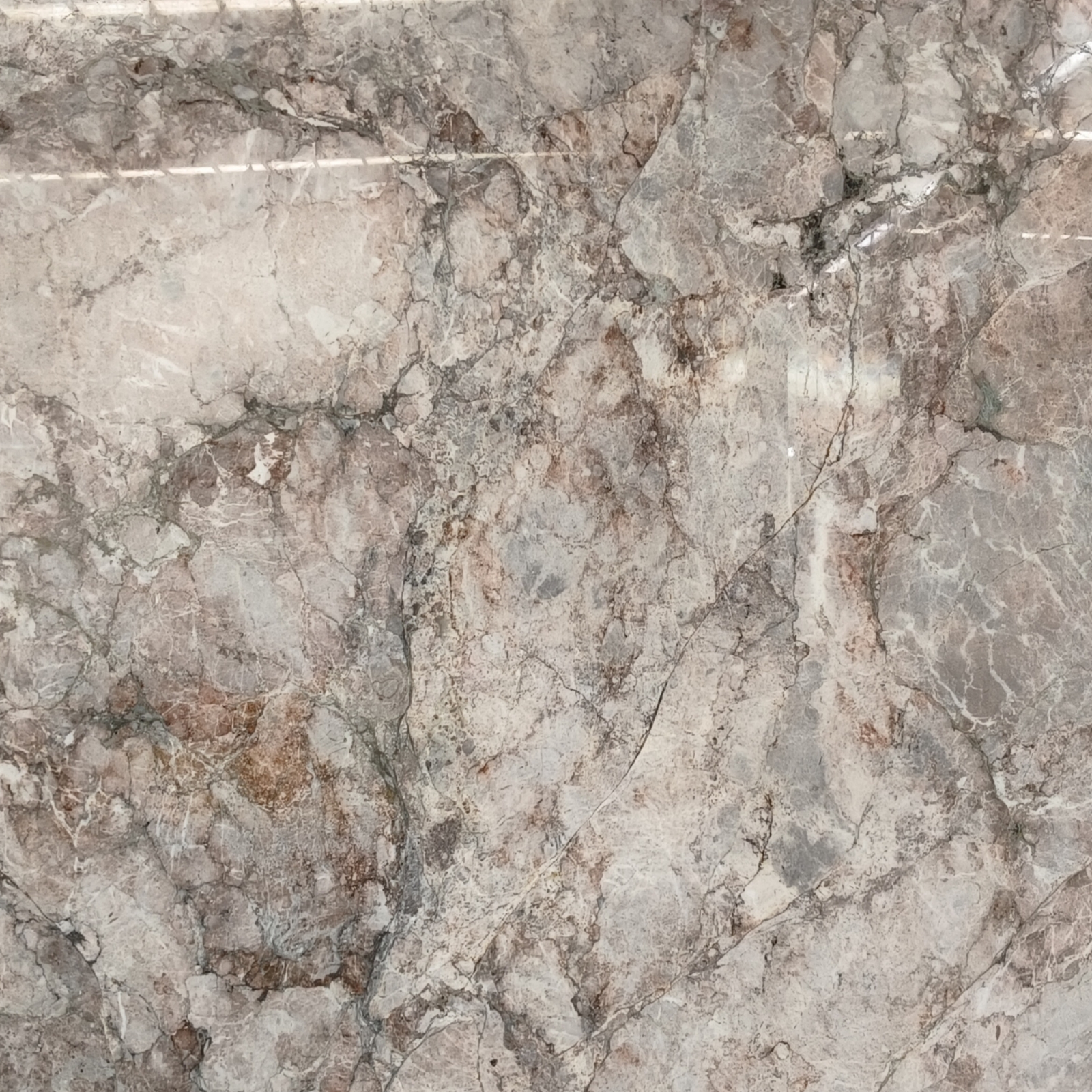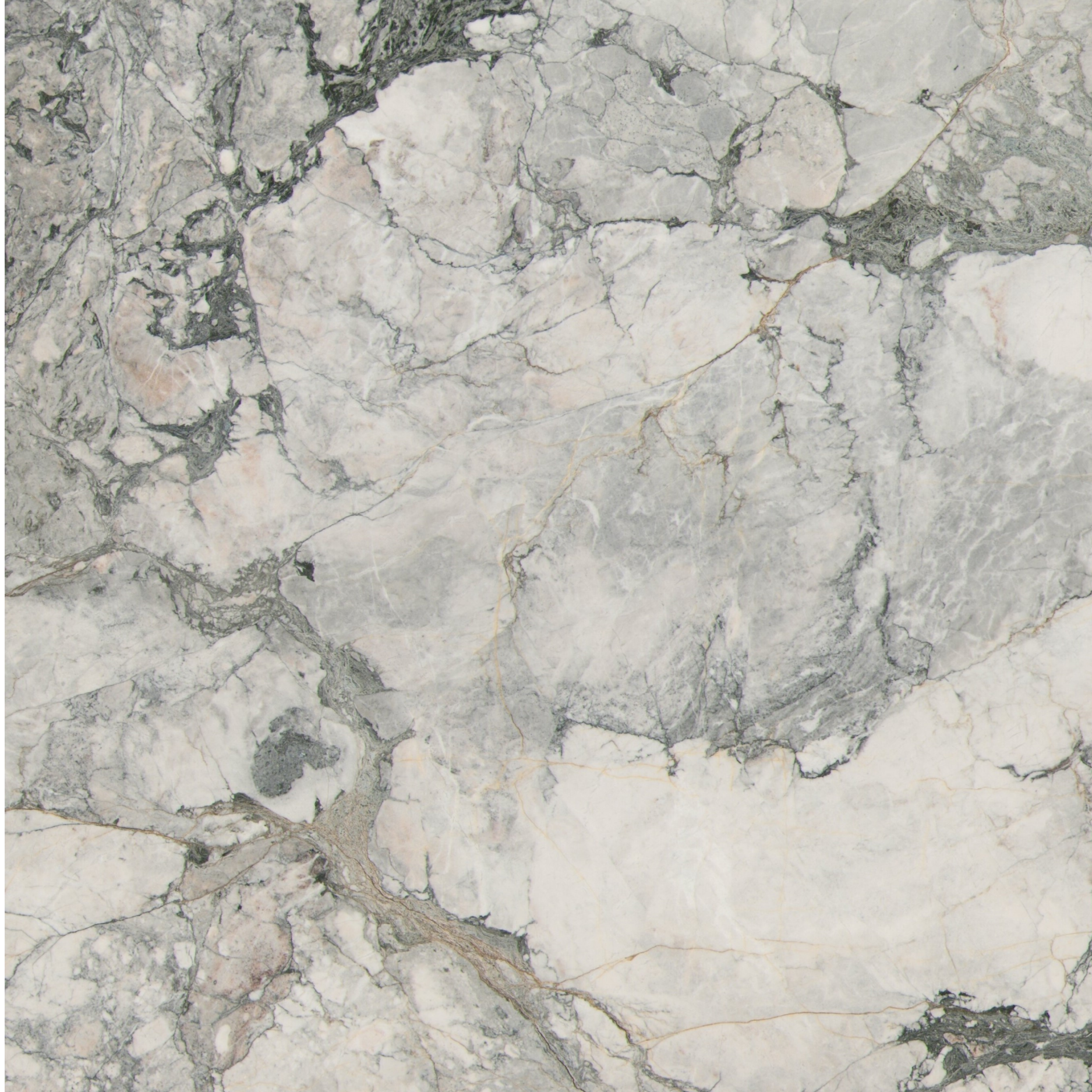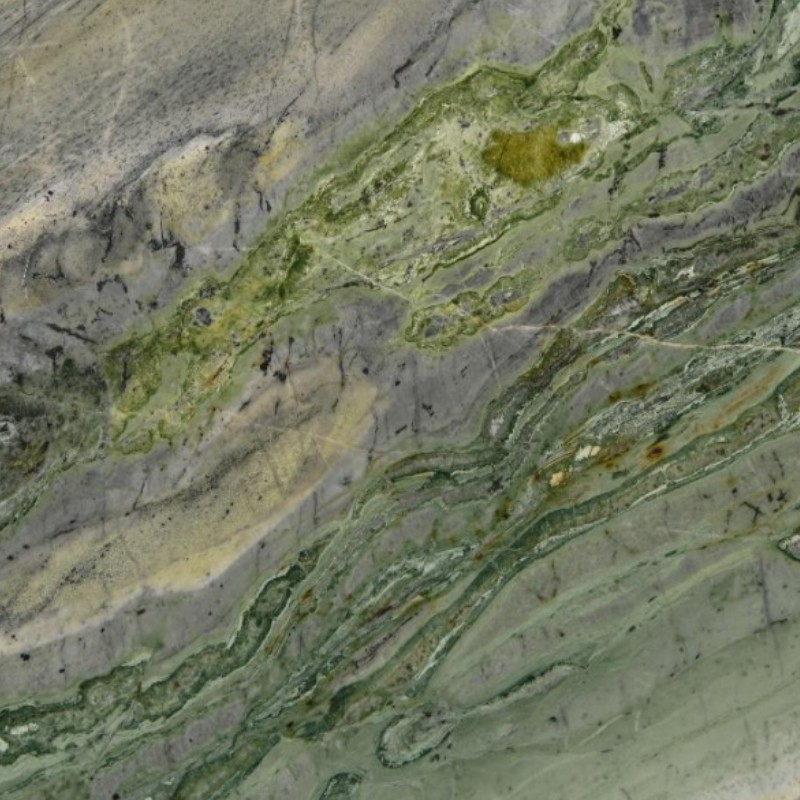
A marble furniture project succeeds when the shape of the furniture and the natural movement of the slab are designed together. Four Seasons Green Marble is visually expressive: green fields, contrasting veins and natural color changes can make a dining table feel calm and architectural or turn a compact coffee table into the focal point of a room. That same variation also means a designer cannot treat the stone like a uniform sheet material. The exact slab needs to be selected before final cutting decisions are locked.
For custom furniture, the important questions are practical as well as visual. Is the selected slab large enough for the tabletop? Does a major fissure cross the center of a narrow console? Should the grain run along the long axis or across it? Will the stone sit on a steel frame, timber base or full cabinet? Buyers preparing custom dimensions, edge details or project quantities can begin with a Four Seasons Green Marble project inquiry that includes furniture drawings, target sizes, finish, thickness and destination rather than asking only for a square-meter price.
Natural Marble Gives Furniture Something Printed Materials Cannot Repeat Exactly
Natural stone furniture is attractive partly because every piece can be different. A 600 mm round coffee table and a 2400 mm dining table cut from the same marble family may show completely different compositions because one captures a small concentrated section of the slab while the other reveals a wide landscape of veins and color movement.
That difference is useful when designers want individual pieces to feel collected rather than manufactured identically. It also creates a procurement challenge: small samples cannot show the real scale of the pattern. Buyers should compare full slabs, not only chips, especially for large tables, consoles and bar counters.
A broad Natural Marble Slabs collection helps designers compare green, white, pink, violet and multicolored stones at the concept stage. Once Four Seasons Green is selected, however, furniture approval should move from category-level inspiration to the exact slab and cutting area.
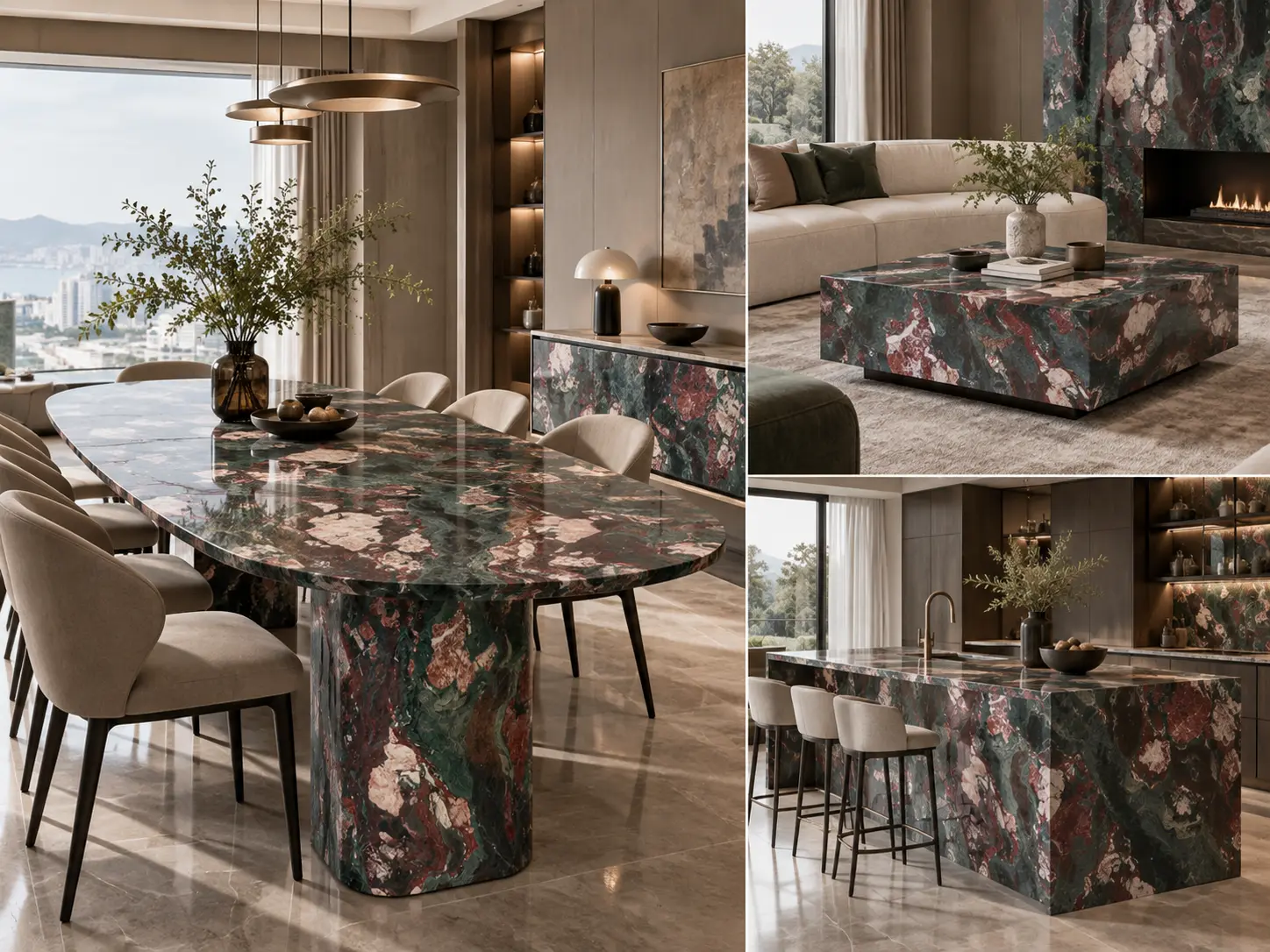
Four Seasons Green Marble Applications
Furniture Buyers Should Compare More Than One Marble Direction
Four Seasons Green is a strong statement material, but it is not the only natural marble direction suitable for furniture. Softer stones may work better in minimalist hospitality schemes, while purple or pink marbles can create more decorative side tables and consoles. The choice depends on room palette, furniture scale and how dominant the stone should be.
For example, a green marble dining table can become the main color anchor in a neutral room, while the same material used on small cabinet fronts may act more like jewelry. A stone with strong brecciation may look excellent at large scale but visually crowded on a 350 mm side table. This is why pattern scale matters as much as stone color.
Designers comparing Decorative Marble Slabs should consider furniture dimensions before deciding which stone has the “best” pattern. The most attractive full slab is not automatically the best material for every furniture piece.
Current Four Seasons Green Supply Direction
The current public product information for Four Seasons Green lists 20 mm as a standard slab thickness direction, with 18 mm customization available. Surface directions include polished, honed and leather finishes. Slab dimensions vary according to the natural block, which is normal for natural marble rather than an engineered standardized-sheet product.
Published applications include walls, floors, countertops, TV backgrounds and tabletops, making the material especially relevant to interiors where the same stone language can move between architecture and furniture.
Buyers can review the current Four Seasons Green Marble slabs direction before deciding whether the project should use full slabs, cut-to-size tabletops or custom fabricated furniture components. Final thickness, finished dimensions and reinforcement should still be agreed with the fabricator based on the actual slab.
Why Four Seasons Green Works in Contemporary Interiors
Green marble can operate as both a surface material and a color element. Against white walls, oak or beige upholstery, Four Seasons Green creates strong natural contrast. Against dark timber, black metal or bronze finishes, the stone can feel deeper and more formal. This allows the same marble to work in modern apartments, hotel lounges, retail interiors and more classical homes.
The material becomes especially effective when the designer repeats it selectively rather than covering every surface. A dining table can reference a smaller console top. A vanity can relate to a side table. A stone coffee table can connect visually with a fireplace surround without making the room feel overdesigned.
The existing discussion of Four Seasons Green Marble in modern interior design shows this wider architectural direction. Furniture can be treated as the smaller-scale continuation of the same material language.
Price Should Be Evaluated Per Finished Furniture Piece
Natural stone furniture is often priced incorrectly when buyers focus only on slab price. A dining table may use only part of one slab, but it can require careful vein placement, CNC cutting, edge polishing, reinforcement, custom crating and heavy freight. A smaller side table may have a higher fabrication cost per square meter because the edge length is high relative to the stone area.
The useful commercial question is therefore not “What is the cheapest marble per square meter?” but “What does the finished piece cost after yield, fabrication, edge work, packing and replacement risk?”
The current article on Four Seasons Green Marble pricing and sourcing also emphasizes material selection, finish options and supplier QC. For furniture procurement, these factors should be converted into piece-level cost rather than compared as raw slab price alone.
How to Read a Four Seasons Green Marble Slab Before Designing Furniture
Start by dividing the slab visually into usable design zones.
Look for:
- large calm green fields;
- dense vein zones;
- high-contrast lines;
- natural fissures;
- resin-filled areas;
- edge defects;
- areas suitable for mirrored or paired pieces.
A furniture designer may deliberately place a dramatic vein through the center of a dining table while using quieter areas for side tables. Alternatively, the project may require a more uniform set of six tables, in which case the goal is to find several pieces with similar visual density rather than one spectacular slab.
Furniture Scale Should Match Vein Scale
| Furniture Type | Typical Visual Scale | Preferred Vein Strategy | Main Risk |
|---|---|---|---|
| Large Dining Table | Large | One major composition or long directional movement | Strong vein lost at edge or cutout |
| Coffee Table | Medium | Concentrated statement area | Pattern feels too busy |
| Side Table | Small | Simple controlled detail | Large vein overwhelms small top |
| Console Table | Long / narrow | Vein direction along length | Weak fissure crosses narrow section |
| Cabinet Front | Repeated panels | Matched or sequenced movement | Misaligned adjacent pieces |
| Countertop / Bar | Large | Layout around openings and seams | Important pattern removed by cutout |
How to Choose Four Seasons Green Marble for Dining Tables
A dining table is often the best application for a highly expressive green marble because the large horizontal surface can show the full character of the slab. The main challenge is structural: the tabletop is typically supported by legs or a central base rather than continuous cabinetry.
Review:
- finished table length and width;
- stone thickness;
- support position;
- base geometry;
- tabletop span;
- fissure location;
- edge profile;
- transport route;
- site assembly method.
For large dining tables, the support frame should be designed around the actual stone and dimensions. Do not assume that a thick slab can safely span any distance without engineered support.
Rectangular Dining Tables
Rectangular tables are efficient when the slab has directional veins. Long movement can be aligned with the table axis so the stone visually lengthens the furniture.
They also create long unsupported zones if the base is poorly positioned. A steel subframe, continuous apron or adequately distributed support may be appropriate depending on size and stone condition.
Oval Dining Tables
Oval shapes soften the visual weight of green marble and can work especially well in hospitality or residential dining spaces.
However, the curved perimeter increases edge-fabrication length and can lower slab yield because the offcuts around the oval are less reusable than rectangular strips.
Round Dining Tables
Round tables focus attention toward the center. A strong central vein can become a feature, but a random layout can also make the table look visually unbalanced.
For a round table, consider using a paper or digital circular template over the slab photograph before cutting.
How to Choose Four Seasons Green Marble for Coffee Tables
Coffee tables require less stone area but often receive more close-up visual attention. Because users sit around them at eye level, edge finishing, corner quality and polish consistency are easy to notice.
A **Four Seasons Green Marble coffee table** works especially well when:
- the tabletop is visually simple;
- the base does not compete with the stone;
- the selected slab area contains one strong focal movement;
- edges are carefully polished;
- the proportions suit the pattern scale.
Round vs Oval vs Rectangular Coffee Tables
| Shape | Design Strength | Fabrication Consideration |
|---|---|---|
| Round | Soft, sculptural | Higher curved-edge finishing |
| Oval | Elegant, elongated | More complex CNC geometry |
| Rectangular | Architectural, efficient | Better slab yield |
| Irregular Organic | Highly distinctive | Lower yield and more complex finishing |
Side Tables and Bedside Tables
Small tables are a useful way to introduce green marble without dominating the room. They also allow premium sections of a slab to be used efficiently after larger furniture pieces have been cut.
A large slab offcut may produce:
- bedside tables;
- pedestal tops;
- drink tables;
- small consoles;
- shelves.
This can improve material yield and reduce the real cost of a larger custom furniture program.
Four Seasons Green Marble for Consoles
Console tables are long and narrow, so fissure direction matters. A vein or structural feature crossing the short axis of a narrow stone top deserves more attention than the same feature in a broad wall panel.
Before cutting:
- mark natural fissures;
- review support spacing;
- confirm whether mesh is present;
- check whether the top needs a hidden frame;
- verify edge condition.
Cabinets and Furniture Fronts
Green marble can be used on cabinet tops, drawer fronts, door panels and decorative furniture facings, but weight and fixing become more important as the stone moves from horizontal to vertical orientation.
For vertical pieces, consider:
- panel thickness;
- substrate;
- adhesive compatibility;
- mechanical restraint where required;
- hinge and cabinet load capacity;
- edge protection.
Stone should not simply be attached to lightweight cabinetry without checking the complete furniture structure.
How to Choose Four Seasons Green Marble for Countertops
Countertops behave differently from freestanding tabletops because the stone usually has continuous cabinet or substrate support.
This makes Four Seasons Green suitable for:
- kitchen counters;
- bathroom vanities;
- bar counters;
- reception counters;
- furniture-integrated tops.
Cutouts create new risks, however. A sink or cooktop can leave narrow stone bridges and remove important parts of the pattern. Digital slab layout should be completed before fabrication when the vein composition matters.
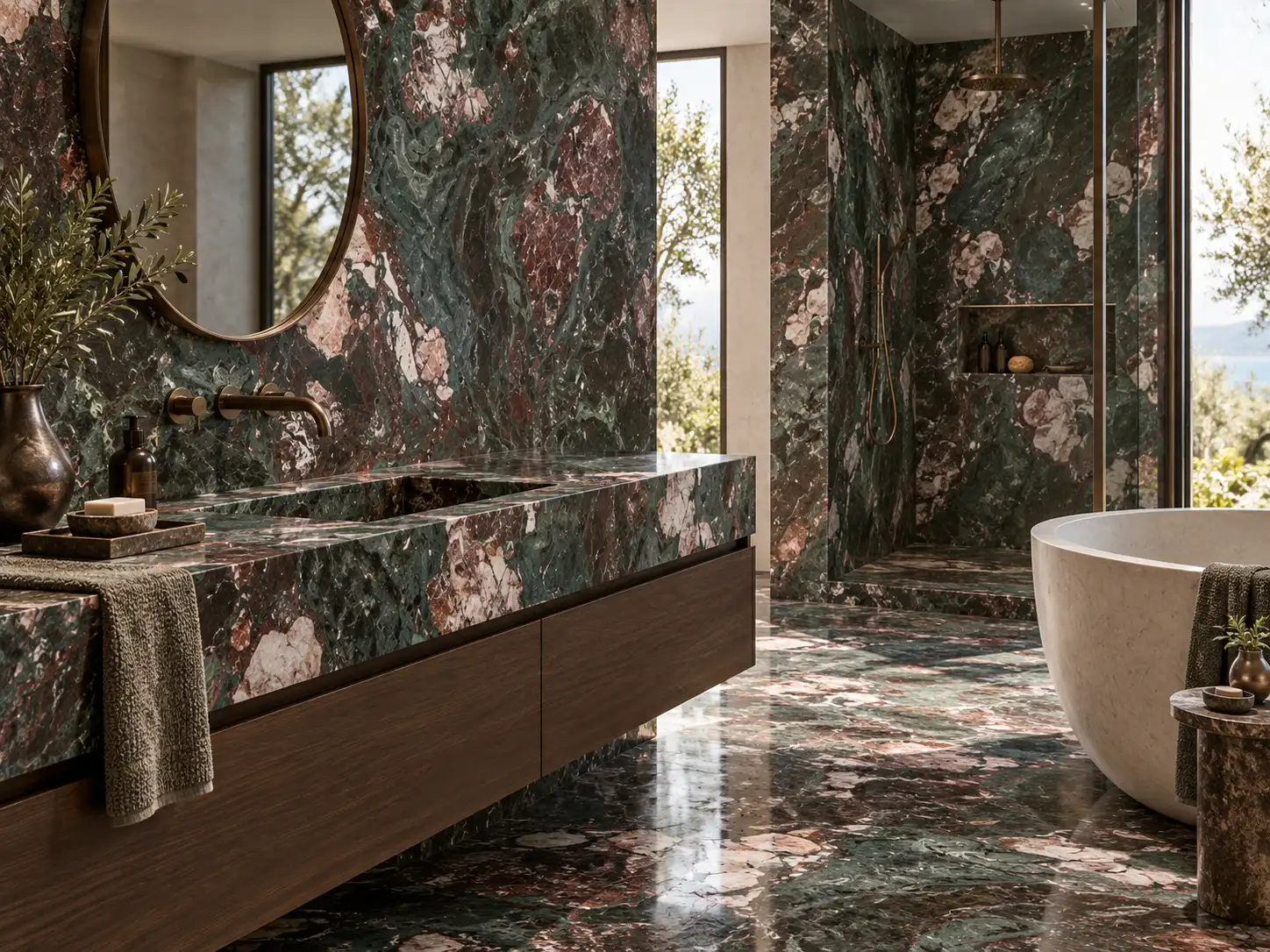
Four Seasons Green Marble Bathroom Vanity and Wall Design
18mm vs 20mm vs 30mm Marble for Furniture
The current Four Seasons Green product direction publicly lists 20 mm and offers 18 mm customization. Thirty-millimeter marble is also common in the broader stone market, but availability for this specific product should be verified before specification rather than assumed.
| Thickness Direction | Typical Furniture Use | Buyer Consideration |
|---|---|---|
| 18 mm | Furniture panels, lighter tops, selected custom work | Lower weight but support remains critical |
| 20 mm | Current standard Four Seasons Green slab direction | Strong general furniture option |
| 30 mm | Heavier tabletop direction where available | Greater weight and lifting requirement |
How Much Does a Marble Tabletop Weigh?
Stone weight should be calculated before designing the base.
Using an illustrative marble density of 2,700 kg/m³:
| Example Tabletop | Thickness | Volume | Illustrative Weight |
|---|---|---|---|
| 1800 × 900 mm | 20 mm | 0.0324 m³ | ≈87.5 kg |
| 2400 × 1000 mm | 20 mm | 0.0480 m³ | ≈129.6 kg |
| 1200 mm round | 20 mm | ≈0.0226 m³ | ≈61 kg |
These are calculation examples, not product weight specifications. Actual weight depends on the measured density, final dimensions and fabrication details.
Why Weight Changes Furniture Design
A 100 kg tabletop changes:
- base design;
- floor loading;
- lifting equipment;
- packing;
- delivery crew size;
- site access;
- installation method.
Large natural-stone furniture should be planned as a structural object, not a normal lightweight household table.
How to Support Large Marble Tabletops
The Natural Stone Institute’s current Dimension Stone Design Manual includes specific guidance for stone furniture as well as countertops, emphasizing that support, stone properties and geometry matter together.
For custom furniture, support may include:
- steel subframes;
- perimeter frames;
- central pedestals;
- multiple legs;
- structural cabinetry;
- hidden reinforcement.
Do not establish a universal maximum unsupported span without reviewing the specific stone, thickness and base design.
Stone-to-Metal Furniture
Black steel, bronze, brass and stainless steel pair naturally with green marble.
A metal base can also provide a strong structural frame, but the connection needs to allow the stone to sit uniformly without point loading.
Review:
- frame flatness;
- bearing pads;
- adhesive choice;
- differential movement;
- concealed fixing;
- transport strategy.
Four Seasons Green Marble + Brass
Brass or warm bronze emphasizes the warmer veins inside many green stone compositions. This pairing works especially well for:
- luxury consoles;
- cocktail tables;
- hotel side tables;
- vanities;
- statement dining tables.
Use metal selectively. Too much gold tone can compete with the stone instead of supporting it.
Four Seasons Green Marble + Black Metal
Black metal provides a stronger contrast and makes the stone appear more contemporary.
This combination is well suited to:
- minimalist dining tables;
- retail furniture;
- modern coffee tables;
- office reception furniture;
- architectural consoles.
Four Seasons Green Marble + Wood
Timber softens the visual coolness of stone and can create a more residential atmosphere.
Good combinations can include:
- oak;
- walnut;
- smoked timber;
- dark stained wood;
- light natural veneers.
The furniture structure must still be designed for the marble weight rather than assuming a decorative timber carcass can carry any slab size.
Polished vs Honed vs Leathered Four Seasons Green Marble
| Finish | Visual Effect | Good Furniture Fit | Main Consideration |
|---|---|---|---|
| Polished | High color depth and reflection | Dining tables, consoles, vanities | Etching and scratching may appear more visible |
| Honed | Soft matte appearance | Modern tables and understated interiors | May show oils or handling differently |
| Leathered | Textured, tactile surface | Statement furniture and lower-reflectivity designs | Cleaning behavior differs from smooth surfaces |
Polished Finish for Furniture
Polishing highlights the saturated green background and makes veins more dramatic. This is useful when the table is intended to act as a centerpiece.
Strong lighting can also reveal:
- fine scratches;
- etching;
- polish variation;
- surface repairs.
Honed Finish for Furniture
Honed Four Seasons Green creates a quieter, more architectural appearance. It works particularly well with oak, blackened steel and neutral textiles.
Honing does not make marble chemically resistant to acids. It mainly changes reflectivity and visual behavior.
Leathered Finish for Furniture
The current product page also lists leather finish as a direction for Four Seasons Green. Leathering can add tactile depth and make the stone feel more crafted.
For dining surfaces, test cleanability and maintenance expectations before choosing a heavily textured finish.
Edge Profiles Change the Furniture Style
| Edge Profile | Visual Character | Best Fit |
|---|---|---|
| Straight / Eased | Clean, modern | Minimal dining and coffee tables |
| Bevel | Lightens visual edge | Contemporary furniture |
| Half Bullnose | Softer traditional detail | Residential dining tables |
| Full Bullnose | Rounded, tactile | Traditional / family-use furniture |
| Mitered Built-Up Edge | Thick visual profile | Luxury consoles and statement tables |
Mitered Furniture Edges
A miter can create the appearance of a much thicker block of stone without using a solid slab of that thickness.
It can be especially effective on:
- console tables;
- box-style coffee tables;
- stone pedestals;
- reception desks;
- large dining-table aprons.
The final quality depends heavily on fabricator accuracy and adhesive-line control.
How Vein Direction Changes Furniture Design
The same slab can produce very different furniture depending on how pieces are rotated.
For a long table:
- parallel veins emphasize length;
- diagonal veins create movement;
- crosswise veins make the composition feel more segmented.
For multiple furniture pieces, intentional rotation can also prevent them from looking too repetitive.
Bookmatching Four Seasons Green Marble Furniture
Bookmatching is not only for walls. Consecutive or mirrored pieces can be used in:
- paired side tables;
- double-door cabinets;
- large dining tables assembled from two slabs;
- matching consoles;
- furniture fronts.
This requires early slab reservation. Once consecutive slabs are sold separately, the bookmatch opportunity may be lost.
Natural Fissure vs Structural Crack
Marble can contain geological fissures as part of its natural structure. These may follow mineral boundaries or veins and can be stabilized during processing.
A fresh crack from transport, handling or fabrication requires different evaluation.
For furniture, pay special attention to features crossing:
- narrow tabletops;
- cantilevered corners;
- drilled fixing locations;
- edge cutouts;
- thin console sections.
Resin and Mesh Backing
Some decorative natural marbles may use resin treatment and fiberglass mesh to improve processing stability.
This does not automatically mean poor quality. The correct questions are:
- Is the repair visually acceptable?
- Is the repaired zone structurally appropriate for the planned piece?
- Does mesh interfere with the intended fixing?
- Will the back be visible on the final furniture?
Marble Soundness Is Not a Luxury Grade
The Natural Stone Institute’s Marble Soundness Classification describes working characteristics and explicitly separates soundness from market value.
This matters for decorative furniture because a visually spectacular marble may require more resin, filling or reinforcement than a visually simple stone.
ASTM C503 and Technical Stone Selection
ASTM C503/C503M-23 covers material characteristics and physical requirements for marble dimension stone used in general building and structural purposes.
Relevant property areas include:
- water absorption;
- density;
- compressive strength;
- modulus of rupture;
- abrasion resistance;
- flexural strength.
For custom furniture, these data can support technical evaluation, but they do not replace inspection of the actual slab, fissures, repairs and furniture geometry.
ASTM Data Does Not Tell You Where to Cut the Table
Two slabs can meet the same physical specification and still produce completely different furniture results.
Test data cannot tell the designer:
- which vein should run through the center;
- whether a large green field is visually balanced;
- whether two side tables match;
- whether a repair sits in the most visible corner.
Technical testing and slab layout solve different problems.
Dining Table Stain and Etching Risk
Marble is carbonate-based and can react with acids.
Common dining-table exposures include:
- wine;
- citrus;
- vinegar;
- tomato-based food;
- carbonated beverages.
These can cause etching, which is a chemical change in the surface rather than simply a stain.
What Sealer Can and Cannot Do
A suitable penetrating sealer can reduce absorption and help with some staining risks.
It does not make marble:
- acid-proof;
- scratch-proof;
- heat-proof;
- maintenance-free.
Owners should understand natural patina before purchasing a marble dining table.
Daily Care for Four Seasons Green Marble Furniture
- Wipe spills promptly.
- Use stone-compatible cleaners.
- Avoid acidic household cleaners.
- Use coasters where practical.
- Use trivets for very hot objects.
- Avoid dragging ceramic or metal objects across polished surfaces.
- Follow the chosen sealer manufacturer’s maintenance guidance.
Furniture Fabrication Dust and Worker Safety
Sawing, grinding, drilling and polishing natural stone can generate respirable dust. Marble is generally carbonate-rich, but actual mineral composition varies, so workplace controls should follow exposure assessment rather than assumptions based only on the commercial stone name.
Where respirable crystalline silica exposure is relevant, U.S. OSHA requirements may apply. Fabricators should use appropriate engineering controls, wet processing, housekeeping practices and protective equipment according to the actual work environment.
How to Pack Finished Marble Furniture
Finished furniture is more vulnerable than raw slab because it already contains polished edges, corners and custom geometry.
Packing should protect:
- corners;
- polished edges;
- miter joints;
- thin projections;
- drilled areas;
- finished surfaces.
Large tabletops are often safer when shipped separately from the furniture base and assembled at destination, depending on the design.
Shipping Marble Tables Internationally
Before shipment, confirm:
- net stone weight;
- crate weight;
- lifting points;
- forklift access;
- orientation;
- installation sequence;
- site doorway and elevator dimensions.
A 2.4 m dining table can be fabricated perfectly and still become unusable if it cannot enter the project building.
Pre-Shipment Inspection for Marble Furniture
| Inspection Item | What to Check |
|---|---|
| Finished Size | Length, width, diameter and thickness |
| Pattern | Approved slab area and vein direction |
| Finish | Polish, hone or texture consistency |
| Edges | Chips, profile consistency and polish |
| Repairs | Visibility and stability |
| Support | Frame flatness and fixing points |
| Assembly | Parts align correctly |
| Packing | Corner and surface protection |
Cost per Finished Piece Matters More Than Slab Price
A cheaper slab can become more expensive when:
- the usable area is poor;
- several repairs need avoidance;
- the shape creates high waste;
- the edge requires complex polishing;
- the furniture base needs redesign.
How to Improve Slab Yield Across a Furniture Collection
A strong custom furniture program can nest several products into one slab.
For example:
- dining tabletop first;
- console top from long side offcut;
- two side tables from corner areas;
- small shelves from remaining strips.
This can reduce waste while keeping one visual material family across the room.
Furniture Trends to Watch
Statement Natural-Stone Dining Tables
Large natural-stone tables continue to function as sculptural centerpieces rather than neutral furniture.
Mixed Stone + Timber Furniture
Stone tops with warmer natural wood bases create a softer residential balance.
Thin Stone Profiles With Hidden Steel Frames
Slimmer tabletops can create a more contemporary appearance when the support structure is designed carefully.
Monolithic Stone Furniture
Mitered slab construction can create the appearance of solid stone blocks for consoles and coffee tables without using a single massive block.
Matched Furniture Sets
Designers increasingly use one slab sequence across dining tables, consoles and side tables so separate pieces feel like one collection.
10 Common Four Seasons Green Marble Furniture Mistakes
1. Choosing the Slab After Finalizing the Table Design
Consequence: the desired pattern may not fit the furniture geometry.
2. Ignoring Stone Weight
Consequence: the base is under-designed.
3. Using the Most Dramatic Vein on a Tiny Side Table
Consequence: the pattern scale overwhelms the furniture.
4. Assuming 20mm Marble Can Span Any Distance
Consequence: unsupported areas create avoidable structural risk.
5. Ignoring Natural Fissures
Consequence: a weak feature crosses a narrow tabletop zone.
6. Rejecting All Resin Repairs
Consequence: normal natural-stone fabrication practices are misunderstood.
7. Accepting Every Repair Without Review
Consequence: visually or structurally unsuitable areas enter the finished piece.
8. Choosing Finish Only From Appearance
Consequence: maintenance expectations do not match actual use.
9. Shipping a Large Table Fully Assembled Without Access Planning
Consequence: the finished furniture cannot enter the building safely.
10. Comparing Suppliers Only by Slab Price
Consequence: cutting, QC, edge work, packing and shipping risk are ignored.
What Should Be Included in a Four Seasons Green Furniture RFQ?
- furniture type;
- finished dimensions;
- quantity;
- preferred slab visual range;
- thickness;
- finish;
- edge profile;
- base material;
- support concept;
- vein direction;
- bookmatch requirement;
- repair acceptance criteria;
- pre-shipment inspection;
- packing method;
- destination;
- site access limitations;
- replacement material requirement.
If X → Choose Y: Four Seasons Green Furniture Decision Guide
| If Your Project Needs… | Prioritize… | Why |
|---|---|---|
| Large Dining Table | Full slab composition + structural base | Pattern and span both matter |
| Small Coffee Table | Focused vein area | Small scale needs controlled movement |
| Long Console | Fissure direction + hidden support | Narrow geometry can be more vulnerable |
| Luxury Side Tables | Matched offcuts or paired slabs | Creates a coordinated furniture set |
| Minimalist Interior | Honed finish + simple base | Reduces visual competition |
| Formal Interior | Polished finish + brass/bronze | Increases color depth and luxury effect |
| International Shipment | Weight + crate engineering | Finished edges are vulnerable in transit |
| Multiple Custom Pieces | Slab nesting | Improves yield and visual consistency |
Four Seasons Green Furniture Insight: The Slab Is Part of the Furniture Structure, Not Just the Finish
Four Seasons Green Marble furniture works best when the stone is treated as both a design material and a structural load. The veins determine the visual composition, but thickness, support, fissures, weight, edge geometry and fixing determine whether the piece can be fabricated, transported and used successfully.
What Makes Four Seasons Green Marble Especially Suitable for Furniture?
Its strong green base and natural vein movement can carry enough visual character to make one furniture piece the focal point of a room. That reduces the need for decorative detailing elsewhere. The material also works with a broad range of bases, including wood, brass, black steel and stainless steel, making it flexible across contemporary and classical interiors.
Why Should Furniture Design Begin With the Actual Slab?
Natural pattern scale cannot be controlled after the stone has been quarried. A furniture drawing may require a calm central field, a dramatic diagonal vein or a matched pair. Selecting the slab first allows the designer to position the furniture geometry around the best usable areas instead of forcing a predesigned shape onto unsuitable stone.
Why Does Furniture Need Different Stone Engineering From Countertops?
Countertops often sit continuously on cabinetry. Dining tables and coffee tables frequently have open spans between legs or pedestals. Their support conditions are therefore very different. A tabletop specification should review support geometry, stone properties and weight rather than copying a kitchen-countertop detail.
Material Fit by Product Direction
The following matrix is an application-fit indicator only. It is not statistical data, a probability estimate, a structural guarantee or a substitute for fabricator or furniture-engineering review. No precise success percentage is implied. Final suitability depends on the actual slab, soundness, thickness, finish, furniture dimensions, support system and fabrication method.
●●● = Primary
●●○ = Strong Option
●○○ = Depends on Workflow
— = Usually Not First Choice
| Current Product Direction | Dining Table | Coffee Table | Console | Countertop | Decorative Furniture | Product Page Entry | Selection Logic |
|---|---|---|---|---|---|---|---|
| Four Seasons Green | ●●● | ●●● | ●●● | ●●● | ●●● | Four Seasons Green | Strong green statement material with current polished, honed and leather-finish directions and direct tabletop relevance. |
| Four Seasons Pink | ●●● | ●●● | ●●● | ●●○ | ●●● | Four Seasons Pink | Softer decorative direction for interiors where warmer color is preferred over deep green. |
| Panda Green | ●●○ | ●●● | ●●● | ●●○ | ●●● | Panda Green | High-contrast green-and-white direction suited to smaller statement pieces and accent furniture. |
| Prague Green | ●●● | ●●● | ●●● | ●●○ | ●●● | Prague Green | Vivid green decorative direction suited to furniture where stone color should dominate the composition. |
| Fantasy Violet | ●●● | ●●● | ●●● | ●●○ | ●●● | Fantasy Violet | Colorful statement marble suited to bespoke tables and decorative luxury furniture. |
| Bulgari Viola | ●●● | ●●● | ●●● | ●●○ | ●●● | Bulgari Viola | Brecciated luxury marble direction suitable for bold furniture where every cut piece is treated as a composition. |
| Sakura | ●●○ | ●●● | ●●● | ●●○ | ●●● | Sakura Marble | Softer decorative direction suited to side tables, vanities and lighter furniture palettes. |
| Ice Connect Marble | ●●● | ●●● | ●●● | ●●● | ●●● | Ice Connect Marble | Highly expressive green-white movement works well for furniture where slab layout and vein composition are carefully controlled. |
Option: When the Furniture Is a Large Dining Table
Prioritize the complete slab composition first, then confirm support. The table should not be designed from dimensions alone. Review the actual vein pattern, structural features and base position before cutting.
Option: When the Furniture Is a Coffee Table
Use a tighter section of the slab and focus on one visual event. Small furniture often benefits from a stronger but more controlled pattern than a large table.
Option: When the Design Uses Brass or Bronze
A polished or finely honed green marble can pair strongly with warm metal. Keep the base simple enough that the stone remains the primary visual material.
Option: When the Design Uses Wood
Use wood to soften the stone and create a more residential appearance. Confirm that the wood structure and concealed frame are designed for the weight of the marble rather than treating the slab as a decorative lightweight top.
Consideration: Is 20mm Always Enough for a Table?
No universal answer is appropriate. Twenty millimeters is a current slab direction for Four Seasons Green, but tabletop span, support position, soundness, finished dimensions and edge geometry still need review. Thickness alone does not guarantee furniture performance.
Consideration: Is Polished Marble Better for Furniture?
Polished marble provides greater color depth and drama, while honed and leathered surfaces can create a quieter or more tactile appearance. The best finish depends on design intent and maintenance expectations rather than one universal hierarchy.
Consideration: Should Buyers Avoid Mesh or Resin?
Not automatically. Repairs and reinforcement can be normal for decorative marble. The important question is whether the repaired area is appropriate for the intended furniture part and whether the treatment affects fixing, appearance or fabrication.
How Should Buyers Use Technical Standards?
ASTM C503/C503M and related test methods help characterize dimension marble, while the Natural Stone Institute Dimension Stone Design Manual includes specific guidance for marble, countertops and stone furniture. Technical standards support the design process, but they do not replace actual slab selection or project-specific furniture engineering.
The Complete Four Seasons Green Furniture Selection Sequence
A practical workflow is:
Furniture Type → Finished Dimensions → Actual Slab → Vein Scale → Usable Area → Thickness → Soundness → Support Structure → Edge Profile → Finish → Fixing → Fabrication → Inspection → Packing → Site Access → Installation.
This sequence avoids one of the most expensive custom-furniture mistakes: selecting a beautiful slab and designing the furniture structure only afterward.
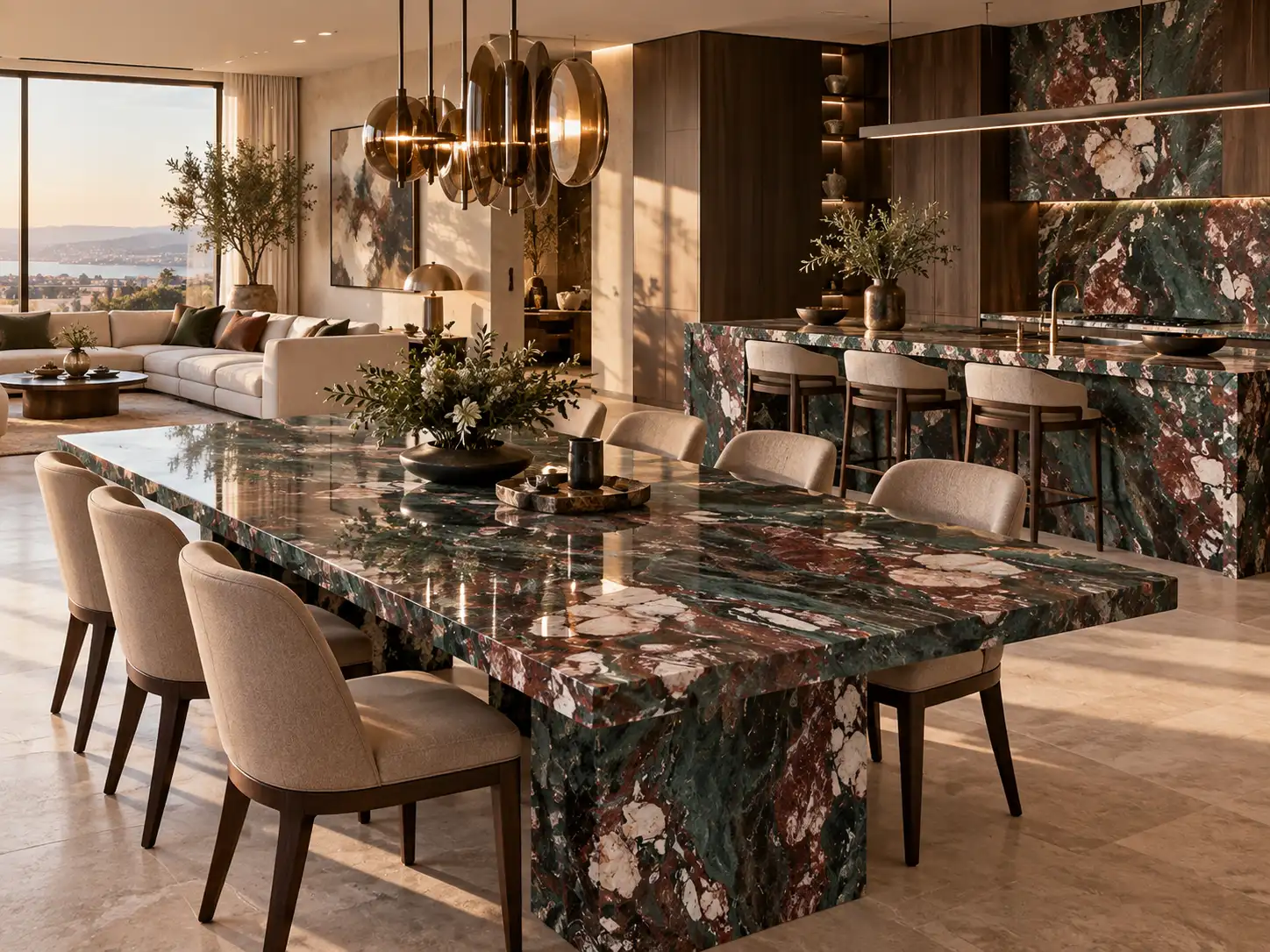
Four Seasons Green Marble Dining Table and Kitchen Island Design
Final Recommendation: Make the Stone and the Furniture Structure One Design Decision
If the project is a large dining table, select the slab and support structure together.
If it is a small coffee table, choose a controlled part of the pattern rather than automatically using the most dramatic vein.
If the furniture uses thin stone, do not assume thickness alone determines safe span.
If the design uses metal or timber, verify how the stone bears on the frame and how the complete piece will be moved.
If the marble contains natural fissures or repairs, position them intentionally rather than ignoring them.
If the furniture will ship internationally, calculate weight, crate design and site access before fabrication.
Four Seasons Green Marble becomes most successful in furniture when the natural slab, edge detail, support structure and room design are treated as one coordinated object rather than four separate decisions.
Planning Custom Four Seasons Green Marble Furniture?
Prepare the furniture drawings, finished dimensions, preferred slab pattern, thickness, finish, edge profile, base material, support concept, quantity, destination and site-access limitations before requesting production pricing. For large dining tables or custom architectural furniture, full-slab selection and pre-shipment assembly checks should be completed before international delivery.
Frequently Asked Questions About Four Seasons Green Marble Furniture
1. Is Four Seasons Green Marble good for dining tables?
Four Seasons Green Marble can be an excellent choice for dining tables because its deep green color and natural vein movement create a strong focal surface. However, a dining table should not be selected from appearance alone. The buyer should review the actual slab, finished dimensions, thickness, natural fissures, resin repairs, edge profile and support structure. Large freestanding tabletops have different support conditions from kitchen countertops because they may span between legs or a central pedestal rather than rest continuously on cabinetry. For larger tables, the stone and furniture base should therefore be designed together, and the finished tabletop weight should be considered during fabrication, packing and installation.
2. What thickness is best for Four Seasons Green Marble furniture?
The current Four Seasons Green product direction lists 20 mm as a standard slab thickness and 18 mm as a customizable option, but there is no universal thickness that is best for every furniture design. A small side table, large dining table, cabinet front and continuously supported countertop have very different structural conditions. Thicker stone also increases the furniture weight substantially. Designers should consider the actual slab soundness, tabletop size, support spacing, base design, edge detail and fabrication method rather than assuming a thicker slab is automatically safer or more premium. If another thickness is required, current availability should be confirmed with the supplier before the furniture design is finalized.
3. Is polished or honed Four Seasons Green Marble better for tables?
Polished and honed Four Seasons Green Marble create different visual and maintenance experiences. Polishing increases reflection, color depth and vein contrast, which can make a dining or console table feel more dramatic. A honed finish creates a softer, lower-reflectivity appearance that often works well in contemporary interiors and with natural timber or black metal. Neither finish prevents acid etching because marble remains a carbonate-based natural stone. Leather finish is also currently offered as a direction for Four Seasons Green and can create a more tactile appearance. The best finish should be selected according to furniture style, cleaning expectations, lighting and the type of use the tabletop will receive.
4. How heavy is a Four Seasons Green Marble tabletop?
The exact weight depends on the stone’s measured density, finished dimensions and thickness. As an engineering illustration, using a marble density of about 2,700 kg/m³, a 1,800 × 900 × 20 mm tabletop would weigh roughly 87.5 kg before adding the furniture base, reinforcement or packing. A 2,400 × 1,000 × 20 mm top would be roughly 130 kg under the same assumption. These examples are not product specifications, but they show why the support frame, lifting method, crate and site access should be planned before production. For a real furniture order, use the actual finished dimensions and product-specific material data where available.
5. What should buyers check before ordering custom Four Seasons Green Marble furniture?
Buyers should confirm the actual slab, finished furniture dimensions, thickness, finish, vein direction, edge profile, natural fissures, repairs, mesh backing, support frame, fixing method and overall stone weight before production. For multiple pieces, a digital cutting layout can improve slab yield and help distribute similar colors and patterns across the furniture set. The supplier should also confirm fabrication tolerances, pre-shipment assembly or inspection, edge protection, crate design and international shipping requirements. Large tables should be checked against elevators, doorways and site access before shipment. A complete furniture RFQ is safer than purchasing from a slab image and raw stone price alone.
References
- ASTM C503/C503M-23 — Standard Specification for Marble Dimension Stone — ASTM Committee C18 on Dimension Stone — ASTM International — Dimension Stone Standard.
- ASTM C97/C97M — Standard Test Methods for Absorption and Bulk Specific Gravity of Dimension Stone — ASTM Committee C18 on Dimension Stone — ASTM International — Dimension Stone Test Method.
- ASTM C170/C170M — Standard Test Method for Compressive Strength of Dimension Stone — ASTM Committee C18 on Dimension Stone — ASTM International — Dimension Stone Test Method.
- ASTM C880/C880M — Standard Test Method for Flexural Strength of Dimension Stone — ASTM Committee C18 on Dimension Stone — ASTM International — Dimension Stone Test Method.
- ASTM C1528/C1528M — Standard Guide for Selection of Dimension Stone — ASTM Committee C18 on Dimension Stone — ASTM International — Dimension Stone Selection Guide.
- Dimension Stone Design Manual — Marble & Onyx Chapter — Natural Stone Institute Technical Committee — Natural Stone Institute — Dimension Stone Design Manual, 2024 Edition.
- Dimension Stone Design Manual — Stone Counter and Lavatory Tops — Natural Stone Institute Technical Committee — Natural Stone Institute — Dimension Stone Design Manual, 2024 Edition.
- Dimension Stone Design Manual — Stone Furniture — Natural Stone Institute Technical Committee — Natural Stone Institute — Dimension Stone Design Manual, 2024 Edition.