The Future of Marble Floors in North America: Data, Durability, and Design Trends
“Are we designing this lobby for the opening photos—or for year ten?”
A property developer in Ontario asked this while standing in a half-finished concrete shell, looking at mood boards of stone samples. The polished visuals promised luxury. The structural engineer, however, was thinking about load transfer, de-icing salts, rolling loads, and cleaning chemicals.
That’s the reality for modern interiors built on concrete and precast systems. A Marble Floor isn’t just a pretty finish; it’s a working surface that must survive trolleys, boots, moisture, and seasonal swings. Choosing the right marble type—and pairing it with the right finish, layout, and subfloor preparation—can be the difference between a floor that still looks sharp after a decade and one that needs patching in year three.
This guest post breaks down key Marble Floor types for modern interiors, using engineering logic, design thinking, ESTA guidance highlights, and export case experience from ICE STONE’s global projects.
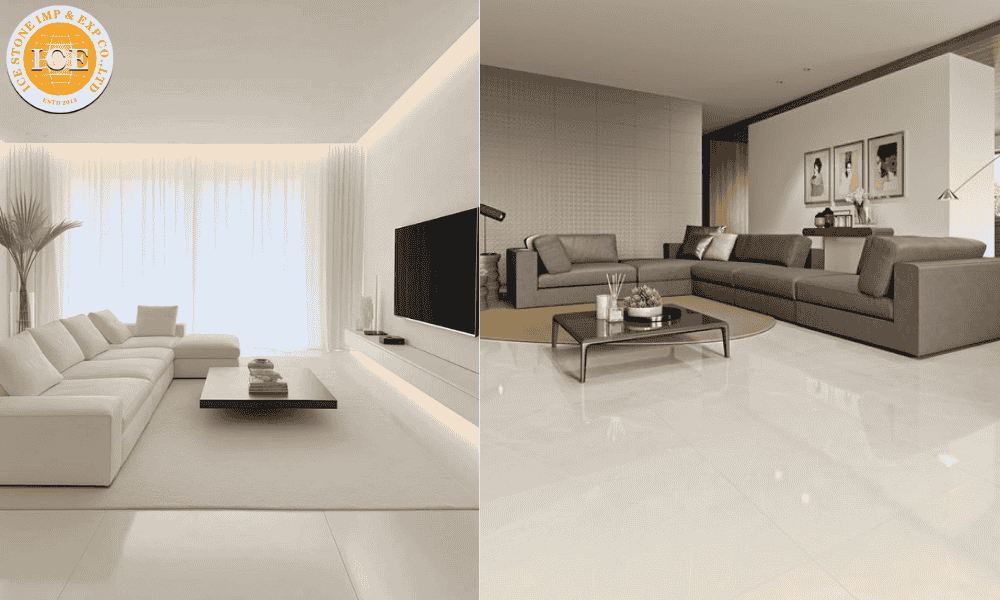
Marble Slabs Floor
Why Marble Floors Still Matter in Concrete Structures
In commercial and residential concrete buildings, floor finishes do a lot of heavy lifting:
-
They visually define zones in open-plan spaces.
-
They influence acoustics, cleaning regimes, and lighting.
-
They communicate value to tenants and visitors from the moment they enter.
Properly specified, a Marble Floor offers:
-
High compressive strength and excellent bearing over solid subfloors.
-
Long-term dimensional stability when correctly installed.
-
A timeless aesthetic that can outlive multiple interior fit-outs.
ESTA technical discussions and post-occupancy surveys repeatedly show that natural stone floors, including marble, have some of the lowest “replacement frequency” when they’re detailed correctly and matched to their use class. The challenge isn’t the material—it’s matching the type of marble to the project and climate.
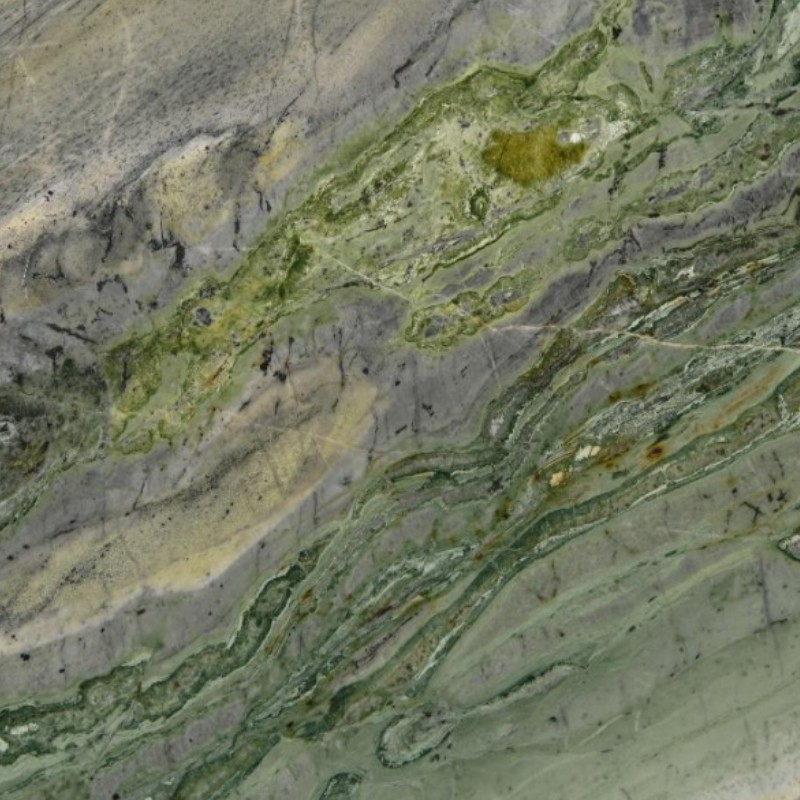
Green Marble Floors for Biophilic, Modern Interiors
For designers who want to soften concrete-heavy architecture, Green Marble is one of the most effective tools. It brings a natural, biophilic tone into lobbies, corridors, and living areas without feeling synthetic or overly decorated.
If you’re exploring layout options, colour zoning, or pattern directions, it’s worth studying proven green marble flooring ideas from completed projects. These case studies show how Green Marble performs in both modern and traditional interiors, especially when combined with muted walls and simple joinery.
In practice, Green Marble floors often work best when:
-
The rest of the palette stays restrained (off-whites, warm greys, black metal details).
-
You allow the veining to flow across larger areas instead of chopping it into tiny modules.
-
You limit the number of competing materials—concrete, timber, and Green Marble are usually enough.
This gives you a floor that feels connected to nature but still clean and architectural, not “busy.”
Honed Calacatta Verde for Low-Glare, Human-Centred Spaces
Not every Marble Floor should be polished to mirror level. In offices, healthcare environments, or residential corridors, glare control and visual comfort matter just as much as reflectivity. Honed finishes often deliver a better balance between elegance and practicality.
A high-quality material like honed marble floor tile in Calacatta Verde Green natural stone is a strong example of this approach. With a honed finish, you get:
-
Reduced glare under strong downlights or daylight from large glazing.
-
A softer, more contemporary look that pairs well with matte fixtures and concrete.
-
A slightly more forgiving surface for minor wear and micro-scratches.
From an engineering perspective, honed Marble Floor surfaces also tend to show less visual impact from traffic patterns and routine cleaning, especially in high-use circulation routes. Combine this with proper sealing, and you end up with a floor that looks calm and consistent even in busy spaces.
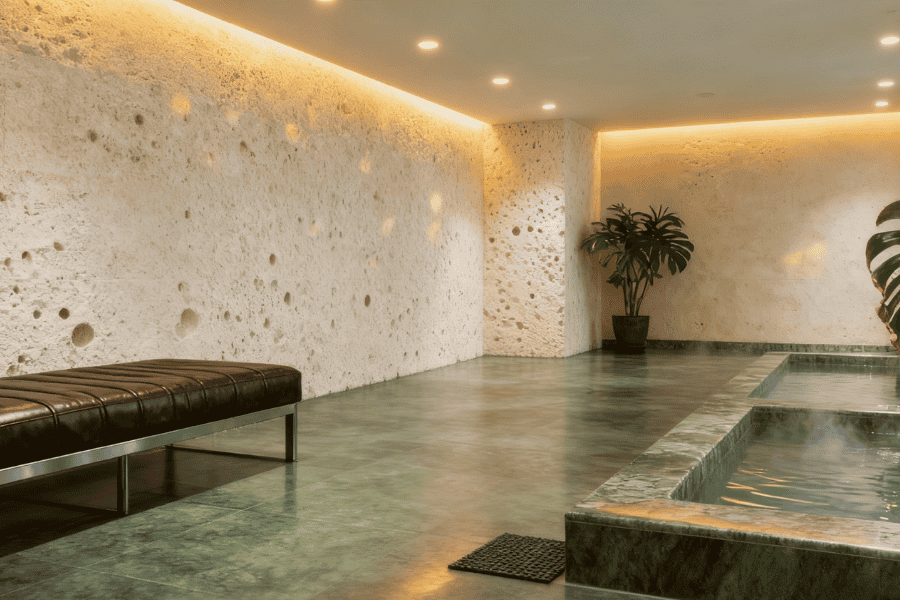
Green Marble honed floors
Neutral Multi-Tone Marble Floors for Flexible Interiors
Some projects—especially multi-tenant offices or mixed-use developments—demand a highly adaptable backdrop. In these cases, a neutral multi-tone Marble Floor can bridge differing interior styles over the life of the building.
A versatile solution is a white black brown grey marble slab for wall, floor, and countertops. Using this type of stone on the floor:
-
Creates a neutral but sophisticated field that works with warm or cool palettes.
-
Hides minor dirt and scuffs thanks to its subtle colour variation.
-
Makes it easier for future tenants to introduce their own brand colours and furniture.
For contractors and concrete specialists, this flexibility also makes the building more “future-proof.” The base Marble Floor doesn’t need to be ripped out every time a tenant changes their look sheet; it remains a stable, high-quality foundation layer.
Dark Statement Floors with Black Gold and Wood-Effect Marble
Where a project calls for a strong, high-impact first impression—premium retail, hotel lobbies, or executive suites—dark statement marbles are often the go-to. They ground the space, pair beautifully with brass and timber, and visually “shrink” overly large volumes into something more intimate.
Here, a material like black wood marble for floor and countertop delivers a unique combination of linear, wood-like veining and marble’s inherent luxury. Used on the floor, it can:
-
Define key areas such as reception desks or circulation axes.
-
Contrast strongly with pale walls and light furniture for a dramatic effect.
-
Tie into feature joinery and stair detailing in a cohesive way.
Technically, dark marbles still need careful detailing: good lighting design to avoid overly gloomy corners, sensible slip-resistance strategies, and smart cleaning protocols so streaks and residues don’t break the visual effect. But when well executed, a dark Marble Floor can become the signature element of a space.
Heritage-Inspired Floors with Raggio Verde and Classic Greens
Not every project is “glass and black steel.” Some Canadian interiors lean toward heritage, classical, or hospitality-inspired looks, even when built on modern concrete slabs. In those settings, traditional green marbles carry the story.
A classic option for such projects is Green Ancient Times Raggio Verde marble for flooring. This type of stone often works best when:
-
Paired with warm metals, timber panelling, and more traditional detailing.
-
Laid in larger modules or gentle patterns (like borders or inlays) rather than busy mosaics.
-
Combined with controlled lighting to bring out depth and variation in the stone.
In hospitality or boutique residential projects, a Raggio Verde Marble Floor can read as timeless and rich rather than fashionable. For concrete contractors, it’s also a predictable, well-understood stone family that can be integrated into robust floor build-ups.
Working with Exporters Who Understand Concrete Realities
One common pattern across successful projects is early collaboration between the structural/concrete team, the interior designer, and the stone exporter. Good suppliers don’t just send containers; they help align stone choice with structural logic and project use.
This is where reaching out to the ICE STONE contact team early in design can pay off. They can help clarify:
-
Which Marble Floor types have the right density and absorption profile for lobbies, corridors, or wet areas.
-
What slab thicknesses and formats are efficient for your floor spans and load conditions.
-
How to coordinate joint layouts and movement joints with the rhythm of the concrete structure.
Behind that support sits a broader portfolio of materials and field experience from
ICE STONE,covering everything from Green Marble to black wood-effect marbles and neutral multi-tone slabs. That accumulated knowledge is particularly valuable for Canadian projects, where freeze–thaw cycles, tracked-in grit, and de-icing salts push floors hard.
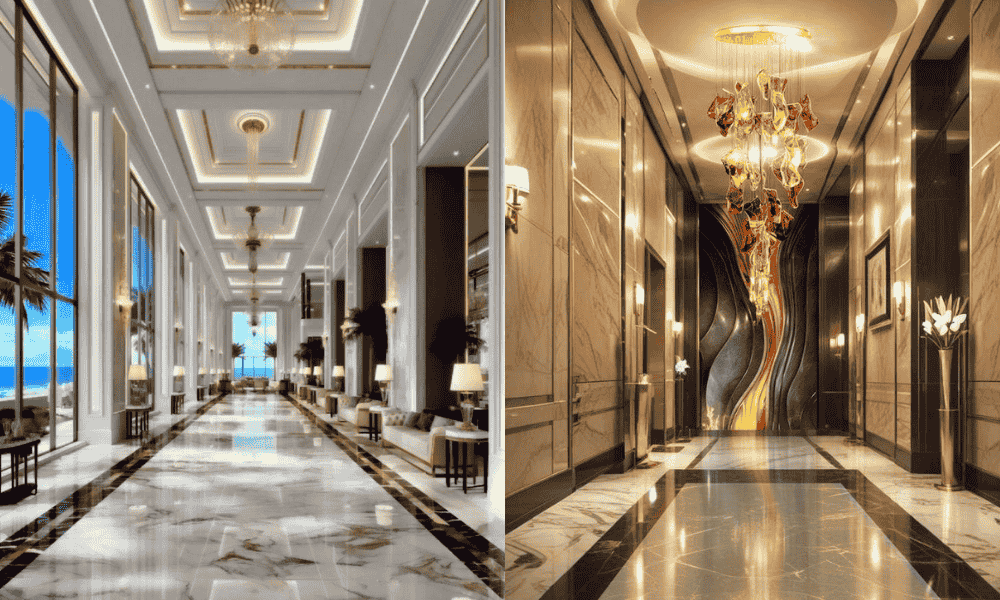
Marble floors for commercial areas
FAQ: Common Questions About Marble Floors in Modern Interiors
1. Are Marble Floors too fragile for high-traffic commercial spaces?
Not if they’re specified and detailed correctly. With the right stone type, thickness, subfloor preparation, and maintenance plan, a Marble Floor can handle heavy foot traffic and rolling loads. Many airports, hotels, and institutional lobbies worldwide rely on marble precisely because it can perform for decades.
2. Which Marble Floor finish is best for interiors with lots of daylight?
In spaces with strong natural light, honed or lightly textured finishes usually perform better than high-gloss polish. They reduce glare, show fewer cleaning streaks, and feel more contemporary. Polished floors can still work, but they demand tighter control over light, cleaning products, and slip resistance.
3. How do Marble Floors compare to porcelain in long-term value?
Porcelain is often easier upfront on cost and maintenance, but high-quality Marble Floors can offer superior long-term value in premium projects. They age more gracefully, support higher perceived property value, and can be refinished rather than simply replaced. The decision depends on the building’s positioning, budget, and lifecycle strategy.
4. Do Marble Floors require special structural support?
Marble is dense and heavy, but most modern concrete slabs can accommodate it if the structural engineer accounts for finish loads. The main requirement is flatness and proper preparation of the subfloor. In most commercial and multi-residential projects, a Marble Floor is well within typical load allowances, especially when coordinated early.
5. Are Marble Floors difficult to maintain for facility teams?
They require discipline, not mystery. Facility teams need clear guidelines: use pH-neutral cleaners, avoid harsh acids or abrasives, implement entrance matting to reduce grit, and schedule periodic resealing if required. When this is followed, feedback from building operators is often positive—especially in comparison to finishes that age poorly or look cheap once worn.
Match Marble Floor Types to Real-World Demands
Modern interiors built on concrete and precast structures demand more from their floors than ever before. A Marble Floor can’t just look good on handover day; it has to withstand seasons, tenants, cleaning regimes, and design changes.
By understanding the strengths of different marble types—Green Marble for biophilic calm, honed Calacatta Verde for low-glare environments, neutral multi-tone slabs for flexible interiors, dark black wood-effect marbles for statement zones, and heritage greens like Raggio Verde for classic atmospheres—you can match each floor to its real-world job.
ESTA discussions and field studies increasingly point toward one big takeaway: stone performs exceptionally well when designers and engineers treat it as part of the building’s performance system, not just decoration. When you combine the right Marble Floor type with a well-prepared concrete subfloor, sensible movement joints, and a realistic maintenance plan, you get surfaces that continue to earn their place year after year.
For Canadian builders, designers, and contractors, that combination—technical rigour plus material beauty—is exactly what distinguishes a project that merely looks expensive from one that genuinely performs.
Selecting the right Marble Floor type is ultimately about balancing aesthetics with structural realities. As shown throughout this guide, materials like polished Calacatta, honed Verde stones, and dense dark marbles perform very differently when exposed to foot traffic, winter moisture, or cleaning chemicals common in Canadian concrete buildings. When paired with proper subfloor preparation, moisture control, and a finish suited to the lighting and traffic pattern, marble becomes one of the longest-lasting surfaces available in high-end interiors.In a 2024 interview with an ESTA technical advisor, the expert noted: “Stone failures rarely come from the marble itself—they come from mismatched expectations between design intent and installation science.” ICE STONE’s project team has observed the same across hotels, airports, residential towers, and retail spaces worldwide. When both designers and builders treat marble as a structural material—not just a decorative one—its performance becomes predictable, stable, and remarkably enduring. That is how a floor chosen for beauty becomes an investment in long-term value.
 By
Xiamen Ice Stone Imp.& Exp. Co., Ltd.
By
Xiamen Ice Stone Imp.& Exp. Co., Ltd. Feature Product
-
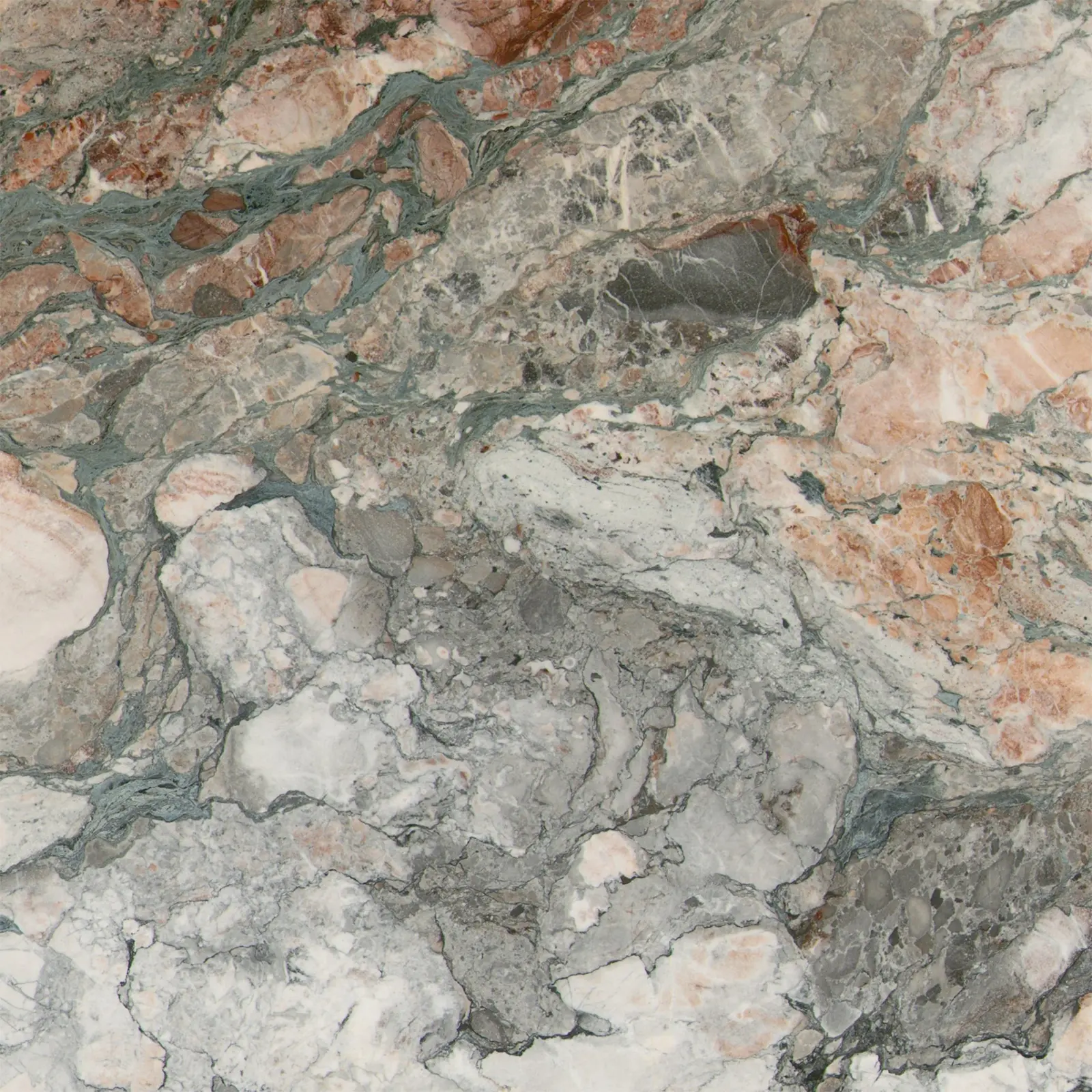 Four Season Grey Natural Marble Slabs and Tiles
The Charm of Four Season Pink Good size for ...
-
 Panda Green White Luxurious Quartzite Stone
Artistic Conception Like moonlight piercing ...
-
 Vivid Brilliant Natural Marble of Prague Green
How to pack and load ? 1. Fumigated wooden b...